
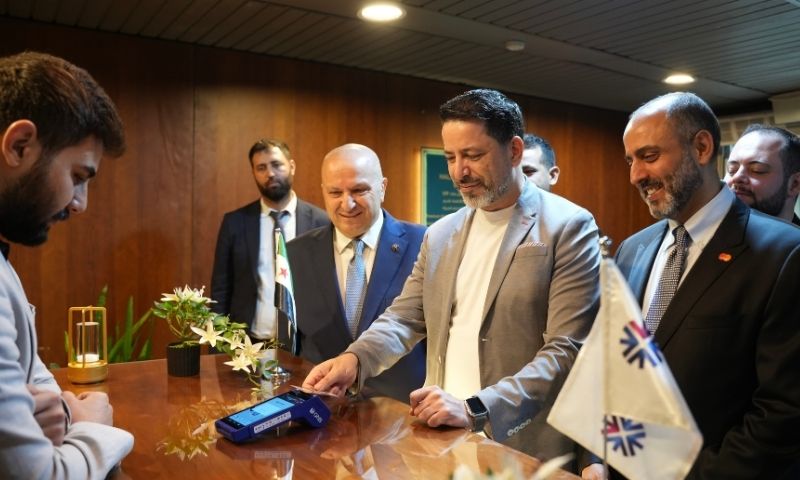

Safwat Raslan, governor of the Central Bank of Syria, responded to claims circulated on social media about electronic payment transactions conducted over the past two days, including claims that they were processed through a Turkish company rather than Visa.
In a post on his Facebook page on Friday, August 28, Raslan said some of the posts had confused two entirely different situations from a technical and regulatory standpoint, leading to an inaccurate conclusion.
Social media pages had circulated a report on Thursday evening, August 27, claiming there was no contract between the Central Bank of Syria and Visa to operate its cards for payments in Syria, and that the announced contract was instead with a Turkish company mostly owned by one person.
Raslan: Payment Was Not Processed Through Turkish Company
Raslan said the arrangement was not a contract with a Turkish company designed to bypass the Central Bank of Syria, nor was there a Turkish company with an agreement with Visa acting in Visa’s place in the transaction.
He added that Visa itself had officially announced that the transaction conducted in Damascus was its first live international transaction in Syria, carried out in cooperation with Fransabank Lebanon as a participating financial institution and Paymera as a technical partner, as part of a process that began months ago to launch Visa card acceptance in Syria.
According to the governor, claims that there was no direct agreement or cooperation with Visa were also incorrect. Visa announced in December 2025 a partnership and strategic roadmap with the Central Bank to launch its operations in Syria and connect Syria’s payment system to global networks.
Raslan said comparisons with arrangements previously available at some establishments, including Beit al-Wali Hotel, were also inaccurate. The presence of a foreign POS terminal inside Syria did not mean that Visa was operating in Syria.
Under the previous arrangement, cards were accepted through arrangements and a merchant account registered outside Syria under an acquiring license in another country. In other words, Raslan explained, the terminal was physically located in Damascus, but from the payment network’s perspective, the transaction was not considered a domestic Syrian acceptance transaction.
Connecting Syria to Global Payment Networks
Responding to the use of Visa and Mastercard cards at Beit al-Wali Hotel in Old Damascus before the first Visa payment transaction began operating in Syria, the Central Bank governor said the acceptance point and merchant are now identified within the system as being in Syria. The service operates within an approved framework and in coordination with the Central Bank of Syria, the merchant account is local, and the transaction appears to the cardholder as having taken place in Damascus, Syria, rather than with a merchant registered in another country.
The governor accompanied his explanation with a photo of a payment receipt from the same establishment, Beit al-Wali.

Electronic payment receipt for a Visa card transaction at Beit al-Wali Hotel, presented by the governor of the Central Bank of Syria, August 28, 2026 (Syrian Central Bank governor/Facebook)
Raslan added that this is precisely what reconnecting Syria to global payment networks means. It does not simply mean being able to process a foreign card by any means, but rather that Syria itself becomes a recognized acceptance market within the international network, with transactions carried out in the name of a Syrian merchant and from within the Syrian financial system.
As for Paymera and other technology companies, Raslan said they are part of the implementation chain for any payment system. The presence of a processor or technical partner does not make the transaction a third-party operation in a way that eliminates Visa’s role, just as a technology company operating a bank’s systems does not mean that the bank is not dealing with the international network.
Raslan concluded that the scale of the achievement or whether the way it was celebrated was appropriate can certainly be debated, as those are matters of opinion. However, he said it is important for that discussion to be based on an accurate description of what happened from a technical and banking perspective.
He said the achievement was not that a Visa card had been used on a terminal in Damascus for the first time, but that Damascus had, for the first time, become an actual and recognized part of an international acceptance and settlement process within an official framework capable of expansion.