

Syrian Central Bank Governor Mohammad Safwat Raslan said that “the next phase at the Syrian Central Bank will rely on institutional work and well-studied planning, and there will be no improvised or unilateral decisions. Instead, there will be high-level coordination among the various ministries, directorates, and relevant institutions in a way that achieves the desired economic goals.”
Participants in the first National Conference for Dialogue with the Private Sector, which the Syrian government is holding at the Palace of Conferences in Rural Damascus between June 1 and 3, asked about the new mechanism for dealing with the banking sector, after the relationship between the banking sector and former governor Abdulkader Husrieh was marked by some tension. The question came during a session that included representatives from the Ministry of Finance and several banks.
Raslan responded, according to Enab Baladi’s monitoring of the conference, by praising Husrieh’s performance and what he accomplished during his tenure as governor of the Central Bank. He said everyone at the bank had worked in a team spirit, and that the plan currently being implemented is a continuation of what the administrations began over the past year and a half.
He noted that from the first day he assumed his duties, work began on:
- Reviewing existing files.
- Identifying the challenges and problems facing the banking sector.
- Examining the conditions of banks in detail, allowing for appropriate and urgent remedies when needed.
- Strengthening communication and coordination between the Central Bank’s directorates and relevant government institutions to ensure clarity of vision and integrated efforts.
- Enhancing monetary and financial stability and coordinating with various government bodies.
He said the Central Bank does not operate in isolation from other ministries and institutions, adding that the success of economic policies requires continuous cooperation and coordination among all relevant parties.
Raslan: We Seek to Expand Cooperation with Financial and Banking Institutions
The Syrian Central Bank governor said that during the past period, a large part of the work focused on internal and institutional aspects, matters that may not be directly visible to public opinion. Officials are often asked after several months of work, “What have you accomplished?” he said, adding that the truth is that an important part of achievements lies in building systems, developing work mechanisms, and reorganizing institutions.
According to the governor, specialized teams worked with experts and specialists to review many files and prepare the studies and proposals needed to improve performance. Work is also ongoing with various institutions and relevant bodies to strengthen cooperation, exchange expertise, and benefit from successful experiences.
In the next phase, Raslan added, the bank seeks to expand cooperation with financial and banking institutions and related parties, and to look for additional opportunities for support and assistance in a way that reflects positively on the financial and economic sector.
The governor affirmed openness to receiving all comments and proposals, saying that any problem, whether small or large, must be raised and discussed directly. Continuous cooperation and communication, he said, are the best way to address challenges and overcome obstacles.
Gap Between Official and Black Market Exchange Rates Widens
Raslan revealed that the Central Bank held a series of meetings with various government bodies in recent weeks, with the first working session held with the Minister of Finance, with the aim of regulating economic tools and policies and strengthening coordination among linked institutions.
Issues related to monetary policy and investment were also discussed, including the impact of exchange rate changes and gaps between official and market rates on investment decisions and depositor behavior. The governor said that a widening gap between the official exchange rate and the market rate may increase uncertainty among market participants and affect their orientations toward saving or long-term investment.
On that basis, he affirmed that exchange rate stability is a key factor in:
- Strengthening confidence within the financial market.
- Encouraging banking activity.
- Improving the investment environment in a way that reflects positively on the economy in general.
He stressed the importance of developing banking systems and procedures in line with the requirements of the current phase, and in a way that enhances the efficiency of financial and banking work.
Study to Develop Islamic Products Legislatively and Economically
The Syrian Central Bank governor said a study is being prepared to develop Islamic banking products, including tools and banking services compatible with Islamic Sharia provisions. He pointed to growing interest in this type of product and work to expand its application within the banking sector.
According to Raslan, the file is being examined by the relevant legislative and economic bodies with the aim of assessing the benefits and the possibility of expanding the provision of Islamic financial products in an organized and effective manner. Work is also underway to strengthen the institutional structure supporting this type of service inside Syria, in line with the state’s general policies.
He noted the importance of supporting Islamic banking products and developing implementation mechanisms, in addition to discussing several proposals related to improving performance and expanding the range of services provided.
Abazid: Coordination with the Central Bank Was Not Achieved
Syrian Deputy Minister of Finance Mohamed Abazid said the past period witnessed continuous coordination between the Ministry of Finance and the Central Bank of Syria, especially regarding:
- Preparing and implementing the state’s general budget.
- Securing the liquidity needed for current and investment spending.
- Providing the foreign currency needed for external obligations and contracts.
Abazid considered that during the previous phase, the required level of coordination with the Central Bank had not been fully achieved. “However, we are currently working to strengthen cooperation and integration between fiscal policy, which is handled by the Ministry of Finance, and monetary policy, which is managed by the Central Bank, in a way that serves the public interest and preserves economic stability,” he said.
According to Abazid, the Ministry of Finance and the Central Bank agreed to establish working mechanisms for the next phase. These include addressing several pending files and securing the needs required for some purchasing and contracting operations, particularly those related to imports and external procurement.
The Syrian Ministry of Finance is currently facing a number of challenges linked to managing government bank accounts affiliated with public finances, especially the need to unify the public treasury account at the Syrian Central Bank. Abazid said this requires greater coordination with the Central Bank to reach a more efficient and transparent financial system.
Regarding investment spending, the Syrian Deputy Minister of Finance said, “The directives during the past period required keeping it within necessary limits due to limited resources and available capacities, provided that it expands gradually according to needs and available financial capacities. We worked during the previous period according to this approach, and we will continue developing it in a way that serves the public interest.”
Government Meetings with Businessmen
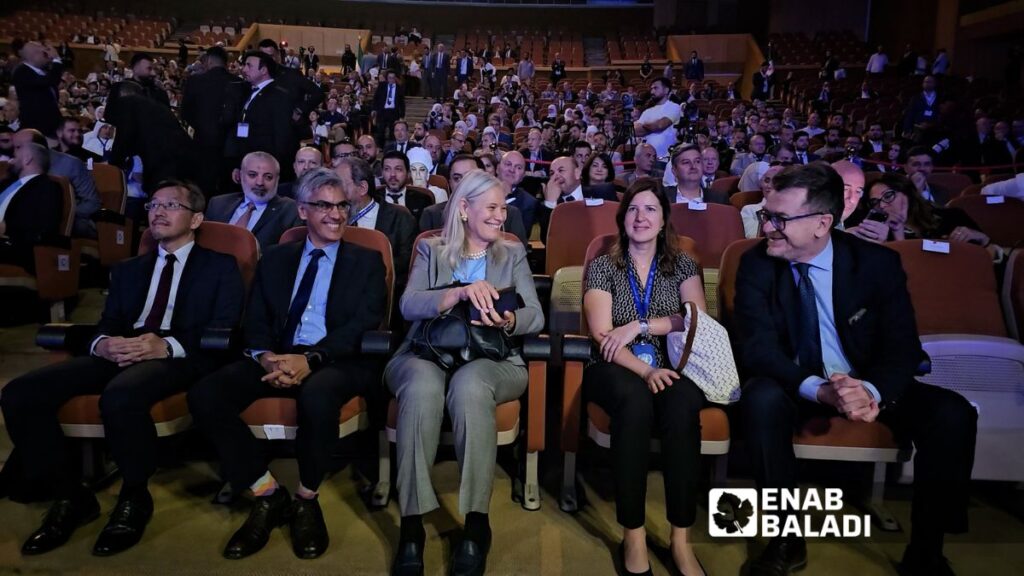
At the Palace of Conferences in Damascus, on Tuesday, June 2, the Syrian ministers of finance, transport, and agriculture met with businessmen and representatives of international organizations as part of the second day of the first National Conference for Dialogue with the Syrian Private Sector, in an attempt to outline a new economic phase in Syria after more than 14 years of war and destruction.
The conference is organized by the Ministry of Economy and Industry in cooperation with the United Nations Development Programme and the Japanese government, to hold talks on the role of the private sector in reactivating Syria’s economy and rebuilding infrastructure and productive institutions that sustained extensive damage during the years of conflict.
The discussions come at a time when the United Nations and World Bank estimates indicate that Syria faces one of the largest reconstruction processes in the world. According to a World Bank assessment issued in 2025, direct damage to physical assets, infrastructure, and residential and non-residential buildings reached about $108 billion.
The cost of reconstruction is estimated at $216 billion, with nearly one-third of the physical capital that existed before 2011 damaged.