


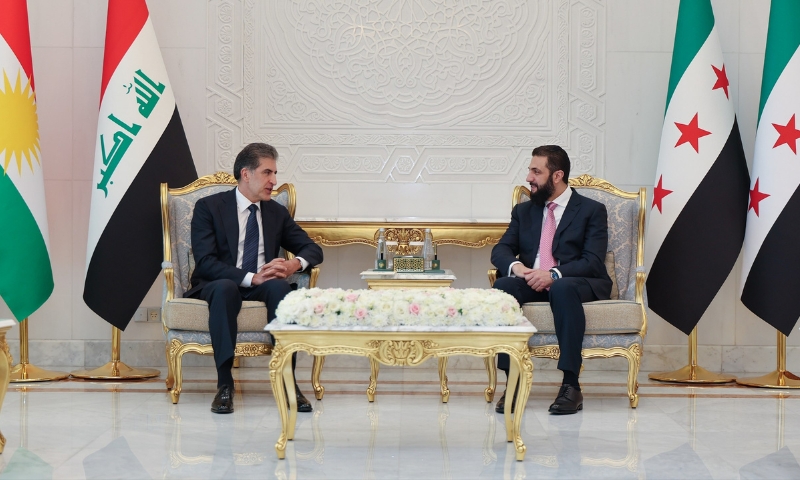
 Syrian President Ahmed al-Sharaa meets Kurdistan Region President Nechirvan Barzani, August 3, 2026. (Presidency of the Syrian Arab Republic)
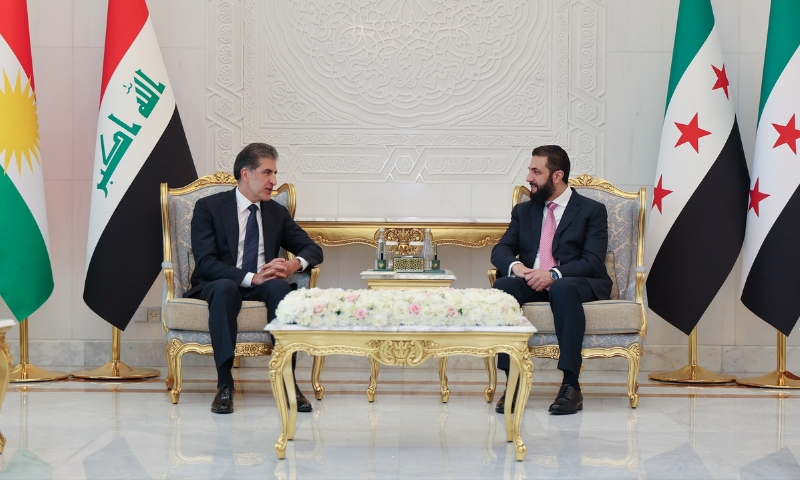
Syrian President Ahmed al-Sharaa meets Kurdistan Region President Nechirvan Barzani, August 3, 2026. (Presidency of the Syrian Arab Republic)
Enab Baladi, Rkkan al-Khder
The August 3 visit of Kurdistan Region of Iraq President Nechirvan Barzani to Syria has raised questions about its significance, implications, and timing, amid several shared issues involving Damascus and Erbil.
Barzani’s first visit since Syria’s new government took office addressed bilateral relations and ways to strengthen cooperation and coordination, particularly in the economic sphere, during a meeting with Syrian President Ahmed al-Sharaa at the People’s Palace in Damascus.
The meeting also discussed recent developments in the region and several issues of common interest that could contribute to supporting security and stability and strengthening regional cooperation, according to the Syrian presidency through its official channels.
Following the meeting, al-Sharaa said in a post on X that strengthening bilateral relations and expanding prospects for cooperation between the two sides were important.
He said the meeting addressed ways to develop cooperation in a manner that serves the interests of both peoples and contributes to greater security and stability in the region.
Al-Sharaa praised the experience of the Kurdistan Region of Iraq in various fields and stressed the importance of continuing joint efforts based on fraternal ties and good neighborly relations.
Barzani said after the meeting that Syria, Iraq, and the Kurdistan Region share many common interests and that significant opportunities exist to expand economic cooperation for the mutual benefit of their peoples.
Wael Alwan, a researcher at the Jusoor Center for Studies, believes the Kurdistan Region of Iraq has significant reasons to deepen its relationship with Syria, particularly by strengthening security and defense coordination amid the U.S. withdrawal from the region and following Iranian strikes on the Kurdistan Region during the ongoing conflict between the United States and Iran.
Alwan said Erbil wants to send a positive message to the allies of the new Syria by strengthening its relationship with Damascus and supporting Syria’s path toward stability. He described this as an initiative aimed at winning the goodwill of those who support Damascus and see regional stability as dependent on stability in Syria, whether at the regional or international level.
Alwan believes Damascus also has significant interests in improving relations with the Kurdistan Region of Iraq because the region’s leaders have a historic alliance with the Turkish government, which maintains good relations with Syria. He said this is particularly important given the need for joint coordination in counterterrorism and the Barzani family’s ability to influence Kurds across the region, including Syrian Kurds.
He added that the Kurdistan Region has hosted Syrians since the years of displacement and refuge in neighboring countries, underscoring the importance of opening a Syrian consulate in Erbil and coordinating the return of refugees, in addition to the need for coordination in combating the Islamic State group.
Tariq Hamo, a researcher at the Kurdish Center for Studies, believes the Kurdistan Region attaches great importance to strengthening relations with the Syrian government. He noted that Erbil has held contacts at the highest levels with Syrian officials since the fall of the Assad regime and the formation of the new Syrian government.
Hamo said relations are important to both sides because of their geographic connection and the border crossings and gateways that could be used for trade. He added that the Kurdistan Region could benefit from Syria by exporting oil through Syrian ports, while demographic ties between Kurdish families in Syria and Iraqi Kurdistan also make the region attentive to the situation of Kurds in Syria.
Barzani’s visit to Damascus came amid accelerated efforts to complete the integration agreement signed between the Syrian government and the Syrian Democratic Forces, SDF, on January 29. Although the official statement did not mention the agreement, Kurdistan Region Presidency spokesperson Dilshad Shahab told media outlets that al-Sharaa and Barzani would hold a bilateral meeting after the expanded talks to discuss the agreement between the government and the SDF.
Shahab said Barzani would continue his role as a facilitating party in implementing the agreement while respecting the particularities of the Syrian state, as the issue remains an internal Syrian matter.
He said the Kurdistan Region’s role in the issue “falls within the region’s active role in regional affairs,” adding that the Syrian president had expressed his thanks to the Kurdistan Region for the role it played during previous events.
Agence France-Presse, citing two Syrian official sources, also reported that the meeting between Barzani and al-Sharaa would focus on advancing implementation of the agreement to integrate Kurdish institutions into the state framework, in accordance with the agreement signed between Damascus and the SDF.
Hamo said Erbil favors Syrian Kurds accepting dialogue with Damascus, integrating into the Syrian state, and becoming part of its institutions. He compared this with the relationship in Iraq between the Kurdistan Region and the central government, including participation in government ministries, while stressing the differences between the two cases. The Kurdistan Region has autonomous rule, its own flag, government, and local forces, while Hamo said the situation in Syria following the January 29 agreement would lead to the dissolution of the SDF and the Autonomous Administration after their integration into Syrian state institutions.
He added that Kurdistan Region leaders had intervened between the SDF and Damascus to resolve outstanding issues, saying the region played a role in reaching the agreement even though official announcements did not mention any direct role for Erbil.
Hamo believes Damascus welcomed Barzani’s visit because of shared interests. He also said al-Sharaa’s message welcoming the visit in Kurdish had a positive impact among Kurdish circles.
He linked the visit to a meeting between Ahmed al-Sharaa and Mazloum Abdi the following day, about which information was leaked suggesting that the integration process was in its final stages. Hamo said relations between the two sides would develop with Kurds integrated into and playing an active role within the Syrian government.
Alwan, for his part, said Erbil has an important role in the integration agreement between the Syrian government and the SDF. He said Damascus needs pressure from the Kurdistan Region to accelerate completion of the agreement, amid delays in an official announcement of the SDF’s dissolution.
Alwan said dismantling the SDF represents a shared interest for both sides. He pointed to organizations he described as aligned with the SDF, including the Revolutionary Youth, which he said is affiliated with the Kurdistan Workers’ Party, PKK, and aligned with Iran, as well as other groups with ties to Tehran. He argued that their continued presence poses a security threat to both sides.
The ongoing regional escalation between the United States and Iran was also part of the two sides’ discussions, against the backdrop of previously expressed positions that have been broadly aligned in emphasizing dialogue and diplomacy.
Although both sides have been targeted in military attacks by Iran-aligned Iraqi armed groups, Damascus and Erbil have not been drawn into the conflict or responded to those groups.
Alwan believes Barzani’s visit comes amid rapidly changing regional conditions and escalating problems affecting the region, including what he described as the continuing Iranian threat to countries in the region, along with recurring U.S. threats of a return to war.
According to Alwan, the visit represents an urgent response to the need for security coordination among regional countries amid rapidly developing security events and military movements. He also pointed to the need to dismantle non-state militias in Iraq and limit Hezbollah’s influence in Lebanon, arguing that such steps would help establish security and stability across the region rather than within a limited geographic area.
Alwan said regional developments have increased Erbil’s need to deepen its relations with Turkey and Syria, adding that security coordination with Damascus could have a significant impact on the ground.
He added that the developing relationship between the Syrian and Iraqi governments represents an opportunity for the Kurdistan Region to build joint security and defense coordination against what he described as a common enemy, militias in Iraq that continue to operate in Iran’s interests.
if you think the article contain wrong information or you have additional details Send Correction


 A
A
A
A
A
A


 More Politics