


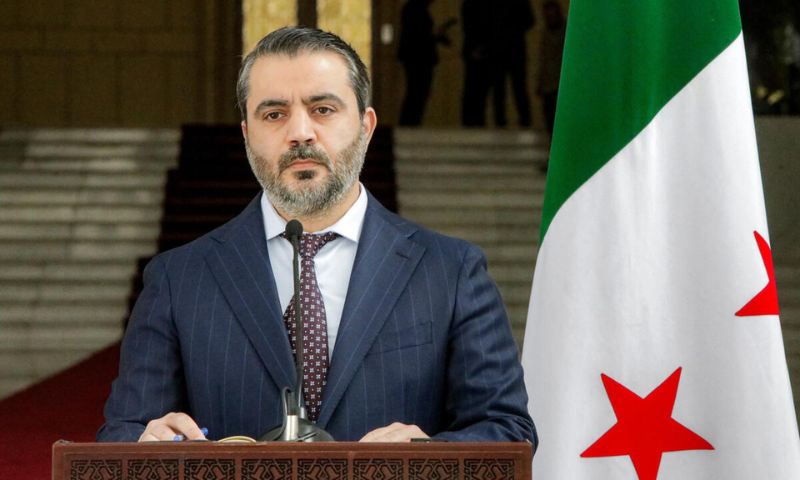
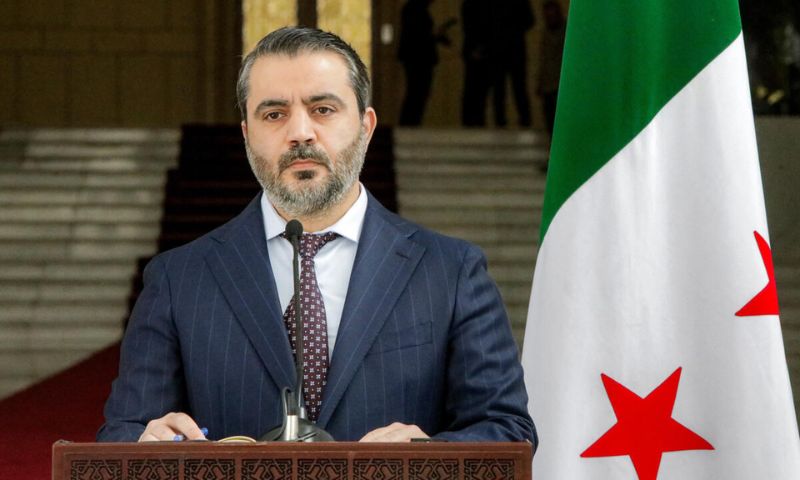
 Minister of Foreign Affairs and Expatriates Asaad al-Shaibani, January 30, 2024 (SANA)
Minister of Foreign Affairs and Expatriates Asaad al-Shaibani, January 30, 2024 (SANA)
The fallout from the Israeli strike that targeted the Abu al-Duhur military airport in the eastern Idlib countryside early Tuesday continues, as the escalation between Israel and Turkey inside Syria enters a new phase. Damascus said it had informed Israel in advance that there was no Turkish military buildup at the airport, while Tel Aviv said the strike was intended to prevent a Turkish military deployment at the site.
In remarks to the US news outlet Axios on Wednesday, August 19, Syrian Foreign Minister Asaad al-Shaibani said the Syrian government had made clear to Israel that Damascus was not working with Turkey to build up a military presence at the Abu al-Duhur base. He stressed that there had been no intention to establish a Turkish base, create a permanent Turkish military presence, or deploy Turkish forces at the site.
Al-Shaibani said the work underway at Abu al-Duhur was limited to rehabilitating the airport and facilities damaged during the years of war, in preparation for their use by the Syrian Air Force.
He added that the airport was “almost empty” at the time of the strike, rehabilitation work had not yet been completed, and the site had not become fully operational. He said that linking the Israeli strike to a Turkish military presence was not supported by the situation on the ground at the time.
Al-Shaibani said Israel “had no legitimate justification” for carrying out the strike, noting that Damascus had conveyed its position to the Israeli side before the attack, but Israel nevertheless proceeded with it.
At the same time, al-Shaibani acknowledged that Turkish military officers had visited the airport several days before the strike, but denied that the visit was connected to establishing a base or permanently deploying Turkish forces.
He said the visits were part of military cooperation between Syria and Turkey in training and the exchange of expertise, noting that Damascus cooperates militarily with a number of countries, not only Turkey.
In this context, he named Saudi Arabia, Jordan, Qatar, and Russia as countries with which Syria has cooperation and training programs. He stressed that Syria, as a sovereign state, has the right to establish cooperative relations with countries of its choosing, including Turkey.
The foreign minister said Syria and Israel had been in contact during the days preceding the strike, explaining that Damascus had informed the Israeli side about the nature of the activity at the airport.
He said Syrian officials had explained that the facility was Syrian and would remain under Syrian sovereignty and control, and that rehabilitation work did not mean the establishment of a Turkish military site or permission for a permanent Turkish presence there.
The remarks came after Israel said the strike was prompted by concerns over a Turkish military deployment at the site. The Israeli Prime Minister’s Office said Syria had been on the verge of violating the “existing security status quo” by allowing Turkish forces to deploy at the Abu al-Duhur base.
According to al-Shaibani, the Syrian government was in contact with the administration of US President Donald Trump before and after the strike. He said the purpose of the contacts was to convey Syria’s position and concerns over the escalation and to try to prevent it.
He added that Damascus had told Washington it did not trust Israel’s intentions toward Syria and believed current Israeli policy, including military operations inside Syrian territory, did not contribute to stability in Syria or the region.
Following the strike, the Syrian government contacted the Trump administration and several other countries, according to al-Shaibani, to protest the attack, contain its repercussions, and prevent its recurrence.
He stressed that Damascus wants to reduce escalation and prevent Syrian territory from becoming an arena for settling scores or expanding the regional conflict.
Despite the escalation, al-Shaibani said the Syrian government remained interested in reaching an agreement with Israel aimed at reducing tensions along the border between the two countries.
He said Damascus was not closing the door to negotiations and viewed political and security solutions as the most sustainable path toward stability.
Al-Shaibani said Syria had engaged for about a year in negotiations mediated by the Trump administration with the aim of reaching a security agreement with Israel. According to his account, the negotiations made significant progress and reached a written formula before Israel later backed away from its commitments.
According to al-Shaibani, several Israeli security concerns were taken into account during the negotiations. At the same time, he stressed that security “cannot be one-sided,” calling on Israel to also address Syrian security concerns related to Israeli military operations inside Syrian territory.
In the same context, Israeli statements concerning Turkey’s role in Syria have intensified. Israeli Defense Minister Israel Katz said on Thursday, August 20, in a post on X that Turkish President Recep Tayyip Erdoğan was “dragging Turkey into dangerous adventures in Syria,” warning that Israel “will not allow any entity to threaten its security.”
Katz’s remarks came one day after Israeli military Chief of Staff Eyal Zamir toured southern Syria, where he inspected Israeli forces deployed in the area and met reservists amid continuing tensions over the nature of Turkish military movements inside Syrian territory.
Zamir was accompanied during the tour by Northern Command chief Rafi Milo, commander of the 210th Division Yair Palai, commander of the 474th Regional Brigade, and several other military commanders. He also conducted an assessment of the operational situation and reviewed troop deployment and readiness in the area.
Zamir said Israel was operating in a “multi-front reality,” describing the security challenges as “constantly changing and evolving” and saying the Syrian arena represented one of those fronts. He added, “We see what is happening and are monitoring the changes on the Syrian front, and we must prepare accordingly.”
These positions come as Israel links its military actions in Syria to concerns over a growing Turkish presence, particularly in areas near its borders. Ankara, meanwhile, maintains its commitment to military and security cooperation with the Syrian government and rejects Israeli interventions, which it considers a violation of Syrian sovereignty and a factor increasing tensions in the region.
if you think the article contain wrong information or you have additional details Send Correction


 A
A
A
A
A
A





 More Politics