


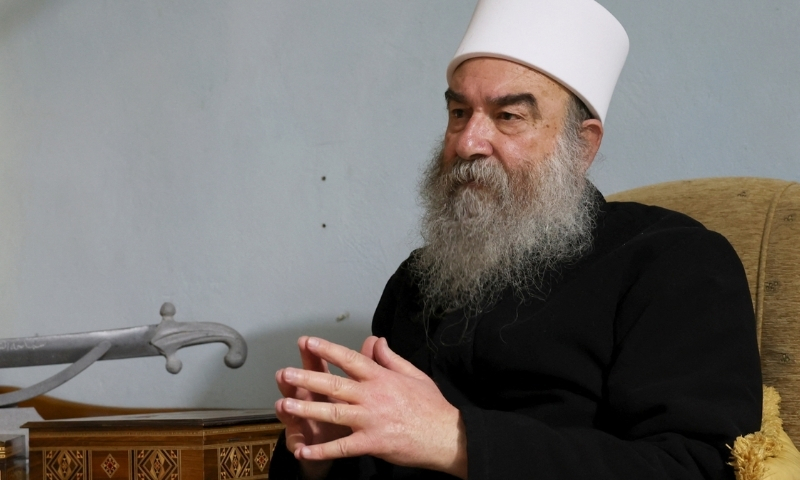
 Spiritual leader of the Druze community in Suwayda, Hikmat al-Hijri, during an interview with Reuters, February 20, 2025. (Reuters)
Spiritual leader of the Druze community in Suwayda, Hikmat al-Hijri, during an interview with Reuters, February 20, 2025. (Reuters)
Enab Baladi – Rkkan al-Khder
Statements made on August 24 by Hikmat al-Hijri, the spiritual leader of the Druze community in Suwayda (southern Syria), in which he praised Israel, have raised questions about his objectives, what he stands to gain from them, and how they could affect the future of the Suwayda issue, which has so far resisted a solution.
In a video recording, al-Hijri said that “the Druze are an integral part of the State of Israel and, together with its components, form one family.”
He added that the Druze had “returned to their historical roots,” pointing to “a shared doctrinal bond with the Israeli state” and describing it as “a state of institutions, science, civilization, and the proper development of the individual.”
Wael Alwan, a researcher at the Jusoor Center for Studies, told Enab Baladi that by praising the Israeli government in his latest statements, al-Hijri aims to create a general impression in Suwayda and send messages to Syrian parties and Israel that he remains steadfast in his original position. Alwan said this contrasts with the reality that al-Hijri is facing significant challenges from voices in Suwayda opposed to his approach.
Alwan did not rule out a connection between al-Hijri’s statements and comments made from time to time by some Israeli officials reaffirming their support for the Druze in Syria. He also said there could be coordination between al-Hijri and figures in Israeli Prime Minister Benjamin Netanyahu’s government ahead of an internal electoral contest, at a time when it needs supportive voices at home and abroad before the vote scheduled for October, particularly amid indications that Netanyahu faces major domestic challenges.
Kinan Masoud, media spokesperson for the “Third Current in Suwayda,” believes al-Hijri is trying through these statements to pull the entire Druze community behind him and use it as a shield to pursue his agendas, making his fate inseparable from that of the entire community after, in Masoud’s view, it became clear that he was no longer able to offer anything and that his project had definitively collapsed.
Masoud added that al-Hijri is seeking through his latest statement to bring a bloody scene back to Suwayda after his popularity reached rock bottom and abuses became apparent to everyone. He said the statements were al-Hijri’s last available card in the hope of prolonging a project that had already effectively collapsed, according to Masoud.
He said al-Hijri’s insistence on pursuing his project stems from the fact that he no longer controls the decision-making process after becoming, in his words, “a tool that carries out what it is ordered to do by its handlers.” Masoud added that Israel has historically had no allies, only tools that it discards once their mission is over.
Masoud cited examples including the fate of the “Lahad militia,” which collaborated with the Israeli occupation in southern Lebanon, as well as Yasser Abu Shabab, whom he said was handed over to Hamas after his role ended.
Kinan Masoud, spokesperson for the “Third Current in Suwayda,” said al-Hijri had burned all bridges, and that the practical question was no longer when he would climb down from his position or agree to possible political solutions, but when he would meet a fate similar to that of “Lahad.”
He said al-Hijri’s statements and demands had caused a major rift even within individual families in Suwayda, between those who align themselves with what Masoud described as an unattainable Israeli occupation project that amounts to betrayal and those who align themselves with the Syrian homeland. He said the two projects could not be reconciled regardless of the options proposed.
Masoud said he feared a Druze-on-Druze confrontation in which the community would once again pay with the blood of its young people. He added that current indications suggested such an “ominous scenario” could be approaching, particularly in light of the student issue and discussion of preventing them from attending examinations.
He expressed regret that these actions had transformed Suwayda from a governorate without illiteracy into one where, he said, the highest grade available was eighth grade. He added that there was no longer a tenth grade and that next year the governorate would lack eleventh-grade classes or first-year university students across all specializations.
Masoud concluded that preventing students taking certificate examinations from reaching their exams would be a dangerous scenario and a turning point, predicting that developments would then accelerate sharply.
For his part, Jusoor Center for Studies researcher Wael Alwan believes al-Hijri faces internal challenges and that the project he advocates is encountering resistance within Suwayda. He added that the high ceiling of demands al-Hijri is setting, which is far removed from Damascus’s vision and closes the door to national solutions, also faces regional challenges because of the difficulty of meeting the project and demands he is calling for.
Alwan attributed the lack of change in al-Hijri’s positions to his pursuit of zero-sum solutions that cannot be implemented, saying he had left no room for national solutions with the Syrian government.
Alwan said the success of al-Hijri’s project in the form he proposes remains unlikely. He suggested that the upcoming Israeli elections and their outcome could help accelerate efforts to reach a formula for understanding between the Syrian government and Israel, which in turn could change the situation even for al-Hijri and eventually force him to accept a settlement offered by the Syrian government.
Statements by Hikmat al-Hijri, the spiritual leader of the Druze community in Suwayda, saying that the Druze are an integral part of the State of Israel, prompted reactions in Syrian circles ranging from rejection to warnings over their implications.
Ahmad Muaffaq Zaidan, an adviser to the Syrian presidency, played down the significance of al-Hijri’s statements, saying the position did not represent the people of Suwayda or the Druze.
In an interview with al-Hadath on August 26, Zaidan said the steps taken by the Syrian state during the previous period were shaping Syria’s present and future. He added that some parties were still trying to invest in approaches other than construction and development.
He expressed regret that some parties were trying to align themselves with Israel or what he called the Israeli enemy. By contrast, he said the Syrian Democratic Forces, known as the SDF, in eastern Syria had joined the Syrian state and recognized that Syria could only be one, united country.
Zaidan said Suwayda includes patriotic elements, groups, and figures, adding that there are internal divisions within the governorate and that some there do not agree with al-Hijri’s positions.
Al-Hijri’s statements also drew rejection within Suwayda. Fadi al-Atrash, a resident of the governorate, wrote on Facebook that he rejected any infringement on the community’s Arab and religious identity. He said members of the Ma’rufi community, the Muslim Muwahhidun, take pride in their Arab identity, preserve their history and dignity, and do not allow anyone to reduce their identity or outbid them over their religion, Arab identity, or heritage.
Al-Atrash said anyone promoting positions that contradict this either does not know the region’s history or is adopting rhetoric that does not represent the people of the governorate, in an apparent reference to al-Hijri’s statements.
Khaldoun al-Nabwani, a professor of political philosophy, said al-Hijri’s words represented him alone and warned against relying on Israeli promises concerning Suwayda’s independence or its annexation to Israel.
In a Facebook post, al-Nabwani said al-Hijri was once again falling into what he described as the Israeli trap. He argued that promises made to al-Hijri could be tied to Israeli domestic and electoral calculations and did not necessarily represent a long-term commitment to the people of the governorate.
Al-Nabwani added that politics requires a realistic assessment of whether promises can be implemented before positions are adopted that may have consequences for the population. He called for a national and civic path that moves beyond polarization and narrow identities.
if you think the article contain wrong information or you have additional details Send Correction


 A
A
A
A
A
A





 More Politics