


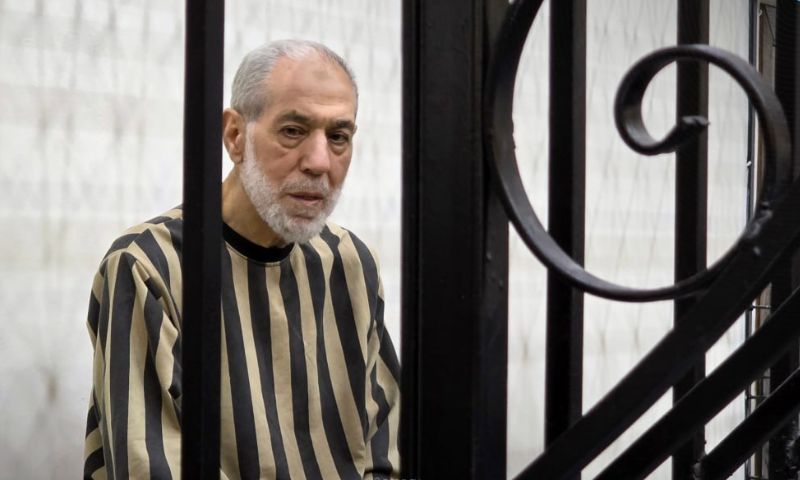
 Ahmed Badr al-Din Hassoun, former grand mufti under the former Syrian regime, inside the defendant’s cage while awaiting sentencing by the Fourth Criminal Court at the Damascus Palace of Justice, Aug. 24, 2026 (SANA)
Ahmed Badr al-Din Hassoun, former grand mufti under the former Syrian regime, inside the defendant’s cage while awaiting sentencing by the Fourth Criminal Court at the Damascus Palace of Justice, Aug. 24, 2026 (SANA)
The Fourth Criminal Court in Damascus sentenced former Grand Mufti of the Republic Ahmed Badr al-Din Hassoun to life imprisonment on charges related to incitement to murder and abuse of office.
Hassoun also received several fixed-term prison sentences during the sentencing hearing on Monday, Aug. 24, ranging from 20 years to six months. However, the judge ordered the penalties merged and ruled that the most severe sentence, life imprisonment, would be enforced.
The sentences were as follows:
The court found that Hassoun had contributed, through public verbal acts, to encouraging war crimes and crimes against humanity committed in the context of a widespread and systematic armed conflict.
The court decided not to grant Hassoun discretionary mitigating circumstances because of the “gravity” of the acts established against him, according to the court.
It also barred Hassoun from benefiting from any general or special amnesty, parole, suspension of sentence, or suspension of the enforceable judgment, according to the judge.
The court ordered Hassoun to compensate the civil plaintiffs whose claims it accepted, while preserving the rights of those harmed who had not filed claims. The judge indicated that victims’ relatives could pursue their cases before the competent judicial authority.
The court also upheld the precautionary attachment placed on Hassoun’s movable and immovable assets, converted it into an enforcement attachment, and ordered their confiscation for the public treasury.
The Public Prosecution had sought the death penalty for Ahmed Hassoun.
Ahmed Badr al-Din Mohammed Adeeb Hassoun was born in Aleppo on April 25, 1949. He served as Syria’s grand mufti under the former Syrian regime, which abolished the position in 2021 in favor of strengthening the role of the Scientific Jurisprudential Council and expanding its powers.
During his tenure, Hassoun became known for his unwavering support for the former regime and his alignment with Iran. He met with a number of leaders of Iranian militias that were fighting in Syria, particularly in Aleppo.
Because of his support for the regime, activists nicknamed him the “barrel bomb mufti.”
After the fall of the regime, Hassoun disappeared from public view for a period, leading to speculation that he had fled to a European country after an image widely circulated showing him in France. A recording later emerged documenting that he was still in Syria.
Following the appearance of the recording, a number of activists gathered around his home in Aleppo, demanding his arrest and prosecution.
According to his relatives, Syrian security forces arrested Hassoun while he was traveling to an Arab capital for medical treatment.
Hassoun studied at the al-Khusrawiyya Sharia School in Aleppo during his preparatory and secondary education before obtaining a doctorate from Egypt’s al-Azhar University.
He worked as a preacher and imam at several mosques in Aleppo, most notably the Umayyad Mosque and al-Rawda Mosque.
Hassoun’s first hearing began on June 25. He was presented with a list of charges that included incitement to murder, supporting the regime through statements and religious edicts, and exploiting his position as grand mufti for personal purposes.
Subsequent hearings included testimony from confidential and public witnesses. Some accused Hassoun of receiving money in exchange for helping secure the release of detainees by using his influence and position.
Hassoun was also accused of supporting the Liwa al-Quds militia, which operated alongside the former Syrian army, and financing it through regular payments.
Hassoun’s prosecution comes as part of a series of trials involving senior figures from the former regime, including Atef Najib and Wassim al-Assad, both relatives of ousted Syrian President Bashar al-Assad, who received death sentences.
if you think the article contain wrong information or you have additional details Send Correction


 A
A
A
A
A
A






 More Politics