


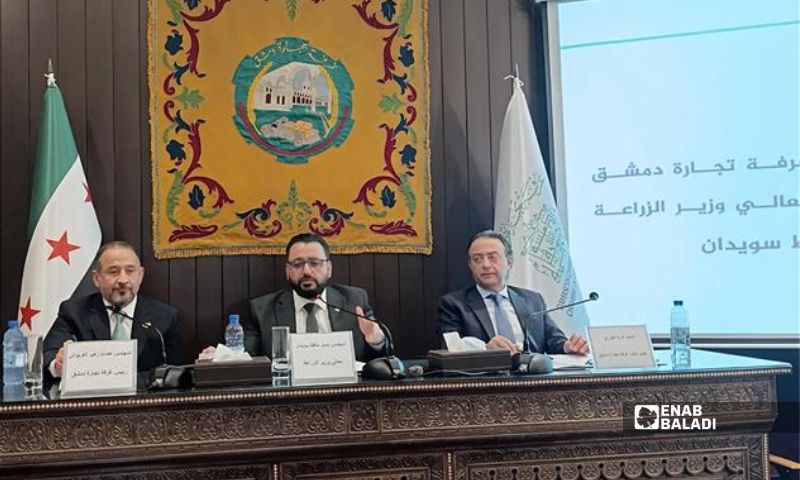
 During the meeting with the agriculture minister at the Damascus Chamber of Commerce, August 18, 2026. (Enab Baladi)
During the meeting with the agriculture minister at the Damascus Chamber of Commerce, August 18, 2026. (Enab Baladi)


 A
A
A
A
A
A
Agriculture and Agrarian Reform Minister Basel al-Suwaidan said the ministry is studying whether to resume imports of chicken meat while raising the customs duties imposed on them, to protect local producers and prevent a shortage in the market.
Speaking at a meeting held at the Damascus Chamber of Commerce on Tuesday, August 18, al-Suwaidan said the value of interest-free loans allocated to farmers would be higher this year. He added that the ministry is also working to amend 16 laws and regulations governing the agricultural sector and to strengthen partnerships with the private sector.
Responding to a question from Enab Baladi about the possibility of reopening chicken imports, al-Suwaidan said a study on resuming imports had begun two days earlier and that the move, if approved, would be accompanied by higher customs duties.
He explained that raising duties if imports resume is intended to protect local producers while ensuring the market’s needs are met and preventing shortages in available supplies.
Al-Suwaidan said the main problem in the poultry sector is the “widespread disorder” affecting it, as most small poultry farms operate without licenses and rely on basic production methods rather than modern technologies, weakening their ability to compete.
He added that the lack of accurate data on the poultry sector hampers decision-making, noting that the ministry holds regular meetings with the Import and Export Committee to discuss conditions in the sector.
According to al-Suwaidan, poultry farmers have been unable to meet domestic demand for chicken meat since imports were halted.
The ministry is calculating chicken production costs in Jordan and Turkey and comparing them with production costs in Syria, the minister said. The results will be used to determine the level of customs duties if a decision is made to resume imports.
Mohammad Samaqiya, the director of a poultry company, previously told Enab Baladi that the number of unlicensed poultry farmers is “very large,” resulting in unreliable statistics and sudden increases or decreases in chicken prices depending on the volume supplied to the market.
Fadel Haj Hashem, director-general of the General Poultry Establishment, also previously told Enab Baladi that there is a problem related to individual poultry farming.
Haj Hashem explained that unregulated individual farming raises production costs, increasing the price consumers pay while also causing losses for poultry farmers.
Regarding interest-free loans allocated to farmers, al-Suwaidan told Enab Baladi that the program began last year, when the value of loans provided reached about $300,000.
He added that the amount allocated for loans this year would be higher, noting that a proposal is being studied to provide interest-free loans linked to crops that will be identified later. The proposal would then be submitted to the relevant authorities for approval of the necessary funding.
The minister called on those interested in financing farmers to participate in a murabaha financing system under the supervision and guarantees of the Agriculture Ministry and to deal directly with farmers.
Al-Suwaidan said the government also intends to support several projects and is coordinating with Arab and international development funds to secure additional sources of financing.
Al-Suwaidan said Syria has about six million hectares of agricultural land and noted that the country has water resources despite the drought conditions it is experiencing.
He added that the ministry is currently working to amend 16 laws and regulations governing the agricultural sector, particularly legislation related to the production and import of agricultural inputs, including fertilizers, pesticides, and veterinary medicines.
He said these materials would undergo laboratory testing to ensure their safety and help produce safe agricultural products.
The ministry is also updating laws related to agricultural ownership, forestry, and land classification before submitting them to the People’s Assembly for discussion and approval.
Al-Suwaidan reviewed the state of the agricultural sector, the conditions it faced in recent years and their negative impact, as well as the plans and strategies the ministry is working to implement to support the sector’s recovery and development.
He stressed that the private sector would be an important partner in the coming period, particularly chambers of commerce, industry, and agriculture, with the aim of implementing these plans, developing agriculture, supporting farmers, increasing production, and achieving food security.
Discussing partnerships and the reorganization of the sector, al-Suwaidan said public institutions specializing in poultry, fisheries, and cattle operate separately and report directly to the minister, which, in his words, fragmented sector planning during the era of the former regime.
He said the ministry is currently working to separate administrative, regulatory, and supervisory responsibilities from production activities.
According to al-Suwaidan, the ministry will regulate and supervise the animal feed sector, while production responsibilities will be assigned to the relevant public feed institution or company.
He added that the same mechanism will be applied to the public fisheries and poultry companies, with production institutions grouped under a holding company called the Syrian Company for Agricultural Investments and Food Security.
Al-Suwaidan said state-owned arable land would be placed under this company and managed according to investment principles designed to generate financial returns for the state.
For his part, Damascus Chamber of Commerce President Issam Ghreiwati said agriculture is one of the most important sectors needed to achieve economic recovery.
Ghreiwati stressed the need for continued coordination between the Agriculture Ministry, traders, and industrialists to raise problems and develop appropriate solutions, achieve integration among sectors, contribute to economic recovery, and make use of the facilities provided by the government and the Agriculture Ministry.
if you think the article contain wrong information or you have additional details Send Correction


 More Economic Reports