


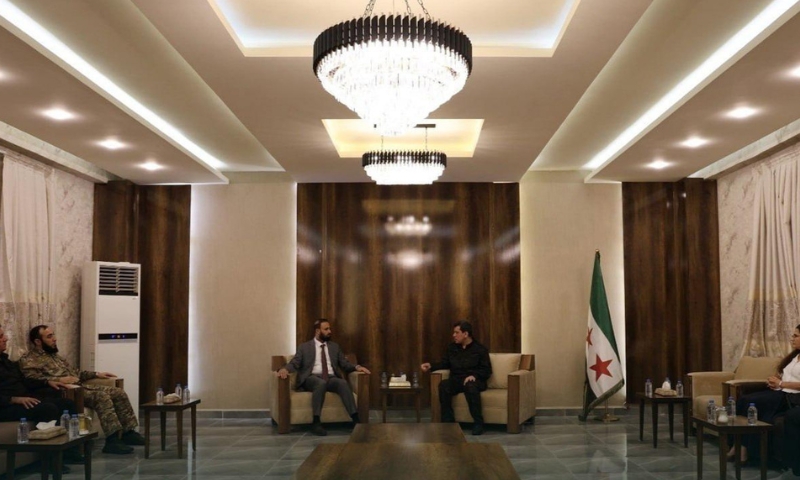
 Presidential envoy Ziad al-Ayesh meets Syrian Democratic Forces commander Mazloum Abdi in al-Hasakah city (northeastern Syria), August 13, 2026. (al-Hasakah province)
Presidential envoy Ziad al-Ayesh meets Syrian Democratic Forces commander Mazloum Abdi in al-Hasakah city (northeastern Syria), August 13, 2026. (al-Hasakah province)
Syrian Democratic Forces (SDF) commander Mazloum Abdi said his forces have drawn up a plan to complete the integration process in full during August.
Speaking to Rudaw on Saturday, August 22, Abdi said that although the January 29 agreement “did not rise to the level of our aspirations, it creates a place for Kurds within the Syrian state.”
He stressed that he does not want to use the term “dissolving the SDF,” but rather its integration into the Syrian army.
The SDF has handed over oil sites that were under its control, including Rmeilan (al-Hasakah province), al-Suwaydiyah, and others, to the Syrian state, Abdi added.
Abdi acknowledged that he had made a mistake by reducing his efforts to implement the March 10 agreement with the Syrian state, saying, “Therefore, I give our people the right to criticize me, but this time I promised to dedicate all my capabilities to implementing the agreement, even if it is not entirely satisfactory to us.”
He said this was intended to prevent war and establish stability, adding that the struggle would continue afterward.
Abdi said the way Syrian President Ahmed al-Sharaa has dealt with the Kurdish issue represents a good opportunity.
Regarding education in the Kurdish language, Abdi said that in the ongoing negotiations with the Syrian state, the language issue is the first and main item on the agenda, adding that progress was made on this point during the latest meeting with President al-Sharaa.
The Kurdish language cannot be treated only as an optional subject, and curricula must continue to be taught in Kurdish, according to Abdi.
Abdi had previously announced that the process of military, security, and administrative integration into Syrian state institutions had been completed, saying a new phase had begun that would focus on continuing political work to establish Kurdish rights in the Syrian constitution.
Meanwhile, Ahmed al-Hilali, deputy governor of al-Hasakah and spokesperson for the presidential team overseeing implementation of the January 29 agreement between the Syrian government and the Syrian Democratic Forces, said work is underway to complete the necessary technical and administrative arrangements for judicial operations to begin in the province at the start of September, following the end of the judicial recess.
This includes activating the Palace of Justice, judicial complexes, and courts, al-Hilali told the Syrian Arab News Agency, SANA, on Saturday.
The measures are intended to reorganize and reactivate judicial institutions in the province, ensure that the Palace of Justice, judicial complexes, and courts are ready to resume their work, and provide judicial services to residents of the province, according to al-Hilali.
The statements by al-Hilali and Abdi came alongside the appointment of Mahmoud al-Alish as director of the al-Hasakah city Security Directorate, according to a source at the Syrian Interior Ministry who spoke to Enab Baladi on Tuesday.
A security source in al-Hasakah also told Enab Baladi that a series of new appointments would be announced within the security apparatus across the province.
The appointments include changes to a number of leadership positions and the appointment of new Internal Security commanders. They also cover the province’s main cities, al-Hasakah, Qamishli, Amuda, al-Darbasiyah, and al-Malikiyah.
Al-Hilali had previously said that since the team began its assignment, it had completed dozens of humanitarian, administrative, and service-related files and contributed to addressing several issues connected to the integration process between the government and the SDF.
He explained that team members had been assigned specific files and areas of responsibility, including issues concerning displaced people, detainees, local administration, administrative appointments, and other matters, while coordination and cooperation among team members continued across the various files.
Al-Hilali added that the results achieved so far were the outcome of a “joint cumulative effort,” noting that the files that had reached their final stages were the product of work that began from the moment the team was assigned and continued for months.
Al-Hasakah province saw changes on the ground at the beginning of 2026, as the Syrian army took control of large areas of the southern and eastern countryside, as well as parts of the western countryside, while the SDF withdrew to the main cities, particularly al-Hasakah and Qamishli.
This created a divided administrative and security situation in the province before the Syrian government and the SDF reached an agreement on January 29 to begin integrating the military, security, and service institutions affiliated with the Autonomous Administration into Syrian state institutions.
The integration process began gradually in February and covered administrative, security, military, and service-related files as part of the implementation of the agreement signed by the two sides.
The integration process has been one of the main issues in relations between Damascus and the SDF, alongside the future of the SDF’s military forces, local administration arrangements, and the status of civilian and security institutions in northeastern Syria.
if you think the article contain wrong information or you have additional details Send Correction


 A
A
A
A
A
A


 More Politics