


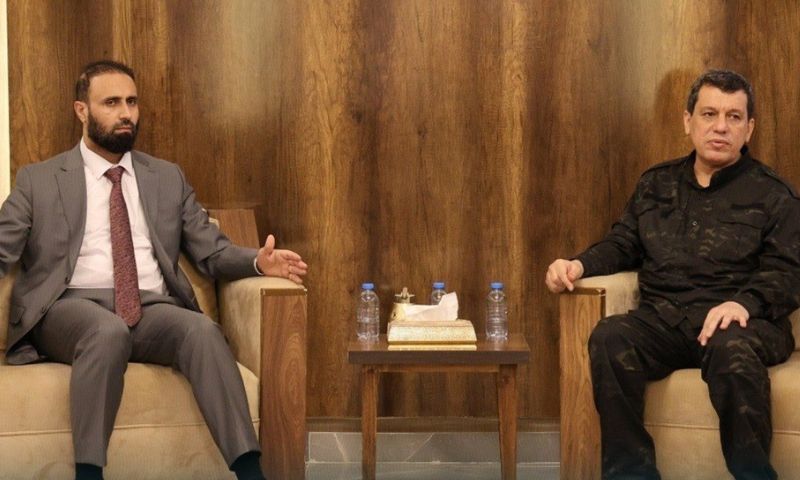
 Syrian Democratic Forces commander Mazloum Abdi meets presidential envoy Ziad al-Ayesh, August 13, 2026 (al-Ikhbariya)
Syrian Democratic Forces commander Mazloum Abdi meets presidential envoy Ziad al-Ayesh, August 13, 2026 (al-Ikhbariya)
Syrian Democratic Forces (SDF) commander Mazloum Abdi announced that he had reached, with presidential envoy Ziad al-Ayesh and Second Corps commander Awad al-Jassem, a set of solutions concerning several issues, most notably attacks on state institutions, matters involving displaced civilians, and efforts to accelerate and complete integration processes.
Al-Hasakah city (northeastern Syria) and Ain al-Arab, also known as Kobani, in the eastern Aleppo countryside, witnessed security tensions on August 10 following the return of hundreds of families to Ras al-Ain (al-Hasakah governorate, northeastern Syria).
Abdi said on his X account on Thursday evening, August 13, that the two sides discussed issues related to security and stability in al-Hasakah governorate.
He added, “We sensed a positive atmosphere and serious steps toward addressing these issues.”
Meanwhile, Syrian channel al-Ikhbariya said the two sides discussed mechanisms for activating the remaining government institutions and addressing the security file.
The discussions came as part of efforts to extend state authority and strengthen security and stability in the region, according to al-Ikhbariya, which added that the talks also addressed issues related to integrating the SDF into Syrian state institutions.
The developments began after assaults targeted a number of families returning to Ras al-Ain, before al-Hasakah, Qamishli, Amuda, al-Darbasiyah, Tell Tamr, and al-Mabada witnessed protests and road closures, including the storming of Internal Security headquarters and attacks on public and private property.
The developments ended on August 11 with local authorities announcing legal measures against a number of those involved, while the Internal Security command in Aleppo announced that calm had returned to Ain al-Arab after its forces deployed in the city.
Residents of Ras al-Ain began returning from al-Hasakah city on the morning of Monday, August 10, as part of the first group returning to the city and its countryside after years of displacement.
The first group included 410 families, with additional groups expected to follow, bringing the number in the current phase to around 610 families, according to officials organizing the return.
The families had been displaced from Ras al-Ain following fighting that broke out in October 2019 and ended with Turkish-backed Syrian National Army factions taking control of the city and large areas of its countryside.
Families from Ras al-Ain lived during the years of displacement in Twahina and al-Talae’ camps on the outskirts of al-Hasakah city, before arrangements began for their return to their areas.
However, the return of the first group was accompanied by tensions in Ras al-Ain after a number of returning families were assaulted.
The Internal Security command in al-Hasakah said its units intervened to break up a dispute in the city after families returned to their homes “without prior coordination,” leading to a disagreement with the current occupants.
The command denied reports claiming that displaced families from Ghuwayran or al-Hasakah had intervened to prevent the returnees from entering their homes.
Mahmoud Khalil Ali, deputy director of the Internal Security Forces in al-Hasakah, said security forces had arrested a number of people involved in assaults and acts of vandalism targeting returning residents.
Khalil said trips returning families to Ras al-Ain had been temporarily suspended as a precautionary measure to ensure their safety, and would resume after conditions stabilized and the necessary protection was provided.
Following the events in Ras al-Ain, protests spread to several cities and towns in al-Hasakah governorate.
Al-Hasakah, Qamishli, Amuda, al-Darbasiyah, Tell Tamr, and al-Mabada witnessed protests and the blocking of major roads, while demonstrators also held a gathering outside the al-Hasakah governorate building.
In al-Hasakah and Qamishli, groups stormed Internal Security headquarters, removed Syrian flags from some buildings, and raised Kurdish flags.
Some streets in Qamishli saw vehicles and property damaged, while roads were blocked in al-Hasakah, Qamishli, Tell Tamr, and al-Mabada.
The al-Hasakah Media Directorate said groups it described as “outlaws” attacked a number of Internal Security headquarters in al-Hasakah and Qamishli.
It added that groups in al-Hasakah city removed the flag of the Syrian Arab Republic from one Internal Security headquarters and attacked it, while other groups attacked security personnel at a headquarters in Qamishli, damaging a number of Internal Security vehicles.
Internal Security Forces reinforced their deployment at a number of locations in the two cities in an effort to contain the tensions, control the security situation, and protect residents and public and private property.
The protests then spread to Ain al-Arab in the eastern Aleppo countryside.
Enab Baladi’s correspondent reported that protesters stormed the district administration and Internal Security headquarters in the city and removed Syrian flags from the buildings they entered.
On August 11, the Internal Security command in Aleppo announced that calm had returned to Ain al-Arab after security operations ended, following attacks by a number of people on government headquarters in the area.
The command said its forces entered the city to prevent disorder and maintain security and stability, as well as to protect residents and secure government institutions and public facilities.
It announced that 19 security personnel were injured while carrying out their duties and that seven people accused of causing the unrest had been arrested for legal proceedings.
Internal Security Forces deployed in the city after security operations ended and the curfew imposed following the attack was lifted, with the aim of maintaining stability, according to al-Ikhbariya.
The Aleppo Media Directorate quoted the governorate’s Internal Security commander, Colonel Mohammed Abdul Ghani, as saying that “the Syrian state’s flag and its institutions are a red line,” and that security forces would pursue anyone who attacked Syrian state institutions in accordance with the law.
In al-Hasakah governorate, Deputy Governor Ahmad al-Hilali announced on August 11 that the relevant authorities had begun taking legal measures against those involved in the unrest, noting that a number of people had been detained in several areas.
if you think the article contain wrong information or you have additional details Send Correction


 A
A
A
A
A
A







 More Politics