


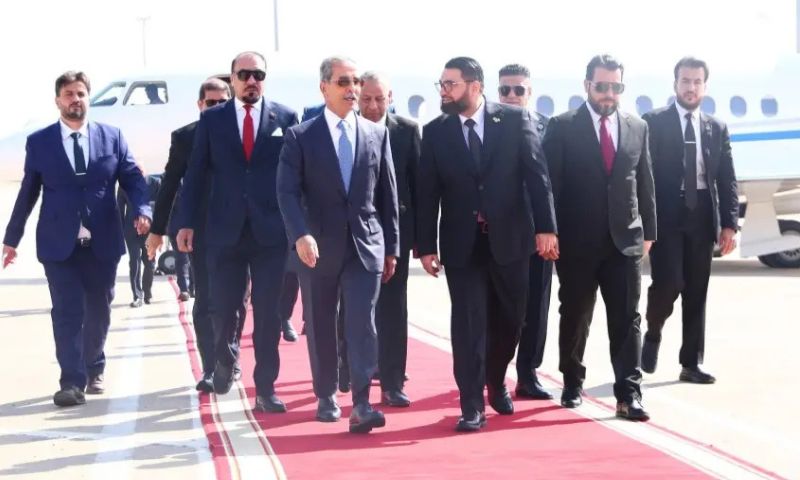
 Syrian Justice Minister Mazhar al-Wais receives Iraqi Supreme Judicial Council President Faiq Zidan in Damascus, August 13, 2026 (Syrian al-Ikhbariya)
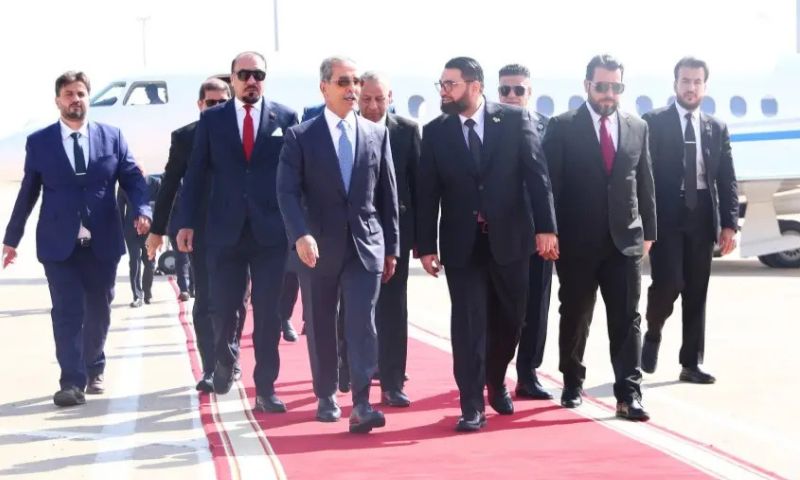
Syrian Justice Minister Mazhar al-Wais receives Iraqi Supreme Judicial Council President Faiq Zidan in Damascus, August 13, 2026 (Syrian al-Ikhbariya)
The issue of Syrians transferred from prisons in northeastern Syria to Iraq has returned to the forefront as Iraqi Supreme Judicial Council President Judge Faiq Zidan visited Damascus on Thursday, August 13, meeting Syrian officials led by Justice Minister Mazhar al-Wais.
The visit is particularly significant for the families of Syrian detainees in Iraq, as demands continue for information about their relatives and for the return to Syria of those against whom no criminal charges can be substantiated, where they could appear before Syrian courts under clear legal procedures.
Zidan arrived at Damascus International Airport at the head of an Iraqi delegation and was received by Justice Minister Mazhar al-Wais and Mohammad Taha al-Ahmad, adviser for Arab affairs at the Ministry of Foreign Affairs and Expatriates.
The Iraqi News Agency, INA, said the visit was intended to discuss several shared issues, most notably “the file of Islamic State detainees who were transferred to Iraqi prisons.”
Al-Wais and Zidan discussed judicial and legal cooperation between the two countries. Al-Wais said Syrian-Iraqi relations had developed in several areas during the past period, particularly in the economic and security fields, expressing Damascus’s desire to strengthen communication and coordination between the two countries’ justice institutions.
The visit comes within a broader context of Syrian-Iraqi rapprochement. Foreign Minister Asaad al-Shaibani met his Iraqi counterpart Fuad Hussein in Damascus on June 29, when the two sides agreed to establish a higher joint coordination committee chaired by the two foreign ministers to follow up on areas of cooperation between the countries.
However, the judicial dimension of the current visit has brought the issue of detainees transferred to Iraq to the forefront for Syrian families awaiting its outcome, particularly because Syrians make up the largest share of detainees transferred from prisons in northeastern Syria to Iraq.
On January 21, 2026, the United States began transferring detainees accused of belonging to the Islamic State group from detention facilities in northeastern Syria to Iraq amid military and political developments in the region.
On February 13, Iraq’s National Center for International Judicial Cooperation announced that 5,704 defendants had been transferred from Syrian prisons. They came from 61 countries and included 3,543 Syrians, 467 Iraqis and 983 non-Arab foreign nationals, while the total number of Arab detainees of various nationalities stood at 4,253.
According to the Iraqi announcement, the Karkh First Investigation Court, which specializes in terrorism cases, began questioning the detainees as soon as they arrived in Iraq. US Central Command, CENTCOM, meanwhile announced the completion of the transfer of more than 5,700 detainees from detention facilities in Syria to Iraq.
Iraqi authorities say those transferred are accused of belonging to the Islamic State group, placing them under Iraqi judicial procedures. Families of a number of transferred Syrians, however, offer a different account, saying their relatives were not members of the group and that some arrests were carried out arbitrarily or on the basis of suspicions for which clear judicial procedures were not completed.
Some of these demands have been concentrated in areas of the al-Hasakah countryside in northeastern Syria, particularly al-Hol and Tal Brak, where families of detainees have held protests and sit-ins in recent months. Participants called for information about their relatives’ fate, disclosure of their places of detention, permission to communicate with them and their return to Syria.
For the families, the issue is not limited to where their relatives are being held. It also concerns the nature of the charges against them, which authority should try them, and whether the rights to a defense and a fair trial are being guaranteed.
Journalist Ibrahim al-Halabi told Enab Baladi that calls from detainees’ relatives increased as the Iraqi Supreme Judicial Council president arrived in Damascus, with families hoping the visit would produce results concerning the fate of their relatives.
According to al-Halabi, the families’ demands focus on obtaining a list of the Syrians transferred to Iraq, determining the fate of people whose whereabouts remain unclear, and then returning to Syria those against whom charges cannot be substantiated so their cases can be referred to the Syrian judiciary.
Al-Halabi believes part of the problem lies in the lack of clarity over the grounds on which some Syrians were detained. He said families who contacted him reported that their relatives had been arrested for various reasons that were not necessarily linked to membership in the Islamic State group.
Among the cases he cited were people arrested for displaying flags associated with the Syrian revolution, displaying pictures of Syrian President Ahmed al-Sharaa, or having ties or communication with individuals in Turkey or areas of northern Syria. Others had relatives in the Syrian National Army or Syrian opposition factions.
He also said that, according to families’ accounts, some arrests were carried out arbitrarily during security campaigns in parts of the Deir Ezzor, al-Hasakah and Raqqa countryside. Some of those transferred had been minors when they were arrested, some of whom later turned 18 during their years in detention.
Al-Halabi said the families are not demanding the automatic release of all detainees. Instead, they first want to know their fate and then want the cases returned to the Syrian judiciary, so that those against whom no charges are proven can be released and those found to have committed criminal acts can be tried under legal procedures.
He added that, from the families’ perspective, the demand to return Syrians to their country is also connected to Syrian sovereignty. They believe that trying Syrian citizens in another country for acts alleged to have taken place in Syria raises legal and sovereignty concerns that require resolution.
Alongside the families’ demands, Syrian authorities have in recent months begun working on the issue of those transferred to Iraq, in parallel with the implementation of the agreement signed between the Syrian government and the Syrian Democratic Forces on January 29.
Al-Hasakah Deputy Governor Ahmed al-Hilali, spokesperson for the presidential team overseeing implementation of the agreement, previously told Enab Baladi that the General Intelligence Service was following the issue of Syrians transferred to Iraq in coordination with the Ministry of Foreign Affairs and Expatriates.
Al-Hilali said work was underway to receive a group of transferred Syrians after reviewing their files and preparing the necessary legal framework, allowing authorities to distinguish between people facing substantiated accusations and those who were arbitrarily detained.
Al-Hilali described the issue as “complex and intertwined at the security, legal and humanitarian levels,” reflecting the number of parties involved, from the authorities that managed detention facilities in northeastern Syria, to the international coalition that carried out the transfers, and finally the Iraqi authorities currently holding and questioning those transferred.
The debate over those transferred to Iraq extends beyond detention conditions to the question of which authority has jurisdiction to try them.
Lawyer Mohammad al-Nayef told Enab Baladi that trying people outside the country where the acts attributed to them allegedly occurred creates problems for the course of justice. He said defendants should, as a general principle, be tried within national judicial frameworks with the right to a defense and guarantees of a fair trial.
Al-Nayef said the presence of people who were minors when detained further complicates the case, as being a minor when an alleged act was committed or when a person was detained requires special legal considerations. Some of those detainees spent years in custody before being transferred to Iraq.
He also said suspicions surrounding the circumstances in which some people were arrested require their cases to be reviewed individually, rather than categorizing everyone transferred as a member of the Islamic State group.
According to al-Nayef, addressing the issue should begin with disclosing the names, charges and judicial files, followed by determining each person’s individual responsibility. Those against whom no charges can be substantiated should then be returned to Syria, while those for whom evidence of criminal offenses exists should be referred to the competent judiciary.
The transfer of detainees from Syria to Iraq has also raised concerns among international human rights organizations.
Human Rights Watch said on February 17 that transferring around 5,700 detainees accused of belonging to the Islamic State group from northeastern Syria to Iraq exposed them to the risk of enforced disappearance, unfair trials, torture, ill-treatment and violations of the right to life.
The organization said the detainees had been held for years without adequate respect for due process before being transferred to another country, warning that any trials must comply with legal standards and fair trial guarantees.
These warnings do not mean that all detainees are uninvolved in crimes, nor do they deny Iraqi authorities the right to investigate people accused of crimes linked to the Islamic State group. They do, however, place the procedures being followed and the rights of defendants at the center of the issue.
This point is particularly important to the families of the transferred Syrians, who are demanding that detainees not be treated as a single group, but that each person’s case be examined individually.
Faiq Zidan’s visit to Damascus comes at a moment when security, judicial and sovereignty issues between Syria and Iraq are overlapping. While Baghdad says the visit is addressing, among other matters, the case of Islamic State detainees transferred to Iraqi prisons, Syrian families hope it will open a path toward resolving the situation of their relatives, particularly those whose places of detention or charges remain unknown.
For the families, the immediate priority is to obtain reliable information about their relatives, publish lists of those transferred, identify the charges against each person, guarantee the right to legal defense and a fair trial, and then return Syrians whose guilt is not established to their country.
Although the results of the Iraqi Supreme Judicial Council president’s visit to Damascus have not yet been announced in detail, placing the detainee issue on the visit’s agenda raises the possibility that the case could move from public and human rights demands to formal judicial coordination between the two countries.
As families of those transferred continue demanding information about their relatives’ fate, the main test for any future Syrian-Iraqi understanding will be whether it can provide clear answers about the names of detainees, the charges against them, the fate of those whose connection to the Islamic State group cannot be established, and the mechanism for returning them to Syria and trying them under procedures that protect their legal rights.
if you think the article contain wrong information or you have additional details Send Correction


 A
A
A
A
A
A






 More Politics