


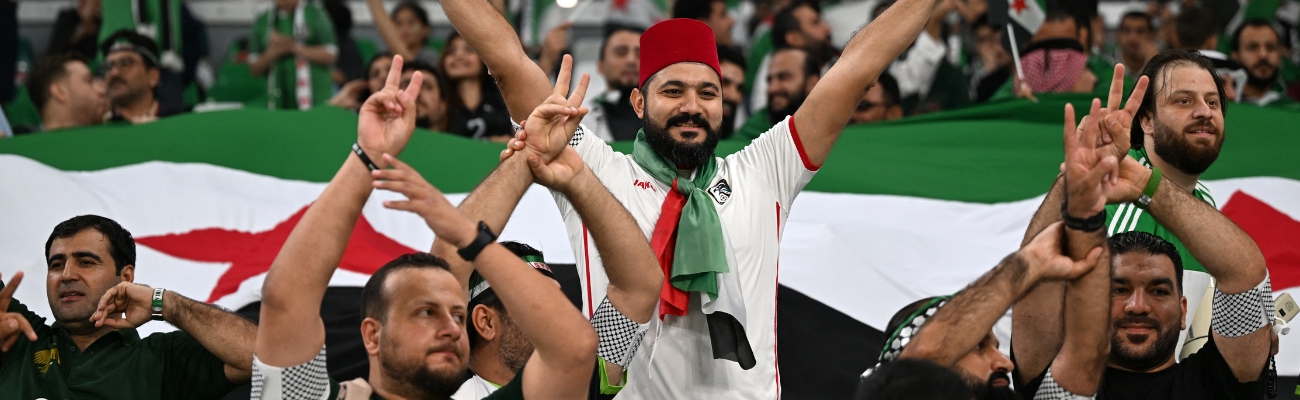

 Reactions from Syrian national team supporters before the 2025 FIFA Arab Cup group-stage match between Syria and Palestine in Qatar, December 7, 2025. (AFP)


 A
A
A
A
A
A

Mohammad Deeb Bazat | Yazan Kur | Ghena Jabr
For years, the Syrian national team has chased qualification for the World Cup as though pursuing a ball that continually rolls away from the net. Attempts were repeated, coaches changed, and generations came and went, but the outcome remained trapped between failure and planning mistakes, as though the final whistle always sounded before the attack could be completed.
When Asia’s allocation for the 2026 World Cup expanded, Syrian supporters believed the dream of qualification had moved closer. Yet the national team continued to fall into administrative and technical errors. Attacking moves broke down as soon as the team attempted to organize its play, and the build-up collapsed before reaching the penalty area. Amid technical instability, a weak football structure, and a fragmented vision for the sport, the postponed goal remained the defining feature of a long history of failure.
This failure is the result of years of accumulated problems, combining weak planning, the fragility of the domestic league, and declining investment in youth development. It has also produced a clear gap between Syrian players based inside the country and those playing professionally abroad. The entire football system appears to be operating without a midfield capable of linking defense and attack or creating a genuine opportunity for Syria to make its first World Cup appearance.
In this investigation, Enab Baladi examines the roots of the Syrian national team’s crisis, the reasons behind its repeated failures, and Arab experiences that succeeded in breaking similar cycles. It also looks at youth development as the starting point for any genuine football project.
Syria’s World Cup Failure Reflects a Systemic Crisis
Syria’s failure to reach the 2026 World Cup finals was not separate from the long-standing problems that have accompanied the national team across different periods, despite changes to the technical and administrative staff and the arrival of new generations of players.
With the World Cup expanding to 48 teams and Asia receiving eight direct qualification places, the opportunity appeared closer than ever. However, Syria failed to turn the change into a genuine opportunity and secured only qualification for the 2027 AFC Asian Cup finals in Saudi Arabia.
Lack of Direction Defines the Current Reality
The Syrian national team has experienced persistent fluctuations in both performance and results. In recent years, it has failed to establish a clear technical identity or build a stable playing system.
The team’s level has remained close to its previous pattern, with limited changes that have not fundamentally improved either performance or results. It continues to rely more on individual solutions than on an integrated collective project.
Kouteiba al-Refai, former secretary-general of the Syrian Football Association, told Enab Baladi that any assessment of the current national team must be considered within the broader context of Syrian football. He explained that the central problem is not the generation of players, but the continuation of the same administrative and technical approach.
al-Refai said the team’s main strengths include several players who compete professionally abroad. Its weaknesses, however, remain tied to technical instability and the absence of a clear vision, meaning the team requires genuine rebuilding at the administrative and planning levels, not only changes to the squad.
He believes Syria has players who could form the foundation of future progress. However, that depends on the existence of a clear football project and an administration that applies consistent standards to selection and planning, rather than relying on temporary solutions imposed by immediate circumstances. Under the current conditions, he said, the prospects for genuine progress remain limited.
Syria’s absence from the World Cup finals is the result of years of accumulated failures. It is not connected to one particular stage or qualifying campaign, but reflects broader instability in the national team’s management and preparation.
Although Syria came close to qualification on several occasions, including during the campaign for the 2018 World Cup in Russia, the absence of long-term planning and a lack of continuity in technical work caused those attempts to end without reaching the ultimate goal.
The former football association secretary-general said this absence should not be viewed as a temporary setback, but as the direct result of administrative, technical, and financial failures accumulated over many years.
He added that the weakness of the domestic league, limited resources, and administrative instability were all fundamental factors that reduced the national team’s ability to compete.
“An absence of long-term planning and a lack of continuity in technical work caused attempts to qualify for the World Cup to end without reaching the final goal.”
Kouteiba al-Refai
Former secretary-general of the Syrian Football Association

The Syrian national team poses for a commemorative photo before its match against Qatar in the FIFA Arab Cup, December 4, 2025. (SFA)
Organizational Difficulties
Al-Refai said the Syrian Football Association struggles even to organize training camps, both in selecting suitable preparation locations and securing friendly matches that meet the team’s technical needs. Syria often plays against national teams willing to face it, he explained, rather than the teams its coaching staff actually needs for preparation.
Major national teams arrange their friendly schedules years in advance, al-Refai said, making coordination difficult when there is no early planning. He considered the problem an administrative failure more than a technical one.
Even during periods when Syria came close to reaching the World Cup, the results were not produced by an integrated football project. Instead, they emerged under exceptional and unstable circumstances. According to al-Refai, repeating those achievements cannot be guaranteed without a comprehensive development vision based on clear and sustainable foundations.
Recruitment Problems
Sports analyst Mahmoud Khawam told Enab Baladi that the fundamental problem is the lack of planning and the national team’s dependence on “emotional moments” to produce results. Although such moments can have a temporary effect, he said, they cannot establish a sustainable football project.
Syrian football has produced distinguished players who achieved notable success abroad, including Omar al-Somah, Jehad al-Hussain, Firas al-Khatib, Mahmoud al-Mawas, and others. However, Khawam said this individual success has not been reflected adequately in the national team because Syria lacks an integrated domestic football environment.
A Syrian player competing abroad gains experience in an advanced professional environment with better planning, preparation, and technical structures. When he returns to the national team, however, he encounters a reality that lacks the basic requirements needed for any successful football project, limiting his ability to perform at his best, according to Khawam.
Syrian coach Nizar Mahrous said a player competing in a strong league provides genuine technical value to any national team. This also applies to Syria, which has several professional players, including Omar al-Somah, Omar Khribin, Mahmoud al-Mawas, and Alaa al-Dali, as well as other players based in Europe. The problem, Mahrous said, lies in how these players are recruited and how effectively the national team benefits from them.
Mahrous told Enab Baladi that the professional-player file requires continuous monitoring by the coaching staff and the football association to ensure the selection of players best able to strengthen the national team.
Deteriorating Infrastructure
Syrian football suffers from clear weaknesses in sports infrastructure, including stadiums, training centers, and player-development systems. This has directly affected the technical development of the national teams.
The lack of modern facilities restricts players’ ability to develop continuously and makes producing professional footballers more difficult than in countries with integrated training systems based on academies, properly equipped stadiums, and long-term preparation programs.
Mahrous said weak infrastructure, instability within the football association, and the absence of methodical and professional work have all negatively affected the national team. Syria’s stadiums and sports facilities, he added, remain far behind those in neighboring countries such as Iraq and Jordan.
Khawam said the effects of inadequate infrastructure are not limited to the senior national team, but extend to the foundations of the sport itself. Building a competitive national team without an integrated sporting base, he argued, is impossible.
Stadiums and training centers form the foundation of genuine progress, Khawam said, pointing to Asian national teams such as South Korea and Japan, which reached advanced levels after investing early in infrastructure.
The first step toward rebuilding Syrian football must be an organized search for talent through the establishment of training and evaluation centers across different regions. This should be accompanied by a clear philosophy and technical identity that can be developed across successive generations.
“International experiences have shown that investment in football’s foundations, despite its cost, is the only path to sustainable results at the national-team level.”
Mahmoud Khawam
Sports analyst
The Syrian League and Player Development
The Syrian football league is widely regarded as the weakest link in the country’s football system because of its declining technical and organizational standards and the absence of administrative and technical stability within clubs.
This situation has left the league unable to perform its natural role as the primary source of players prepared to join the national team, apart from isolated cases in which individual talent matters more than the existence of a clear development system.
Khawam described the level of the Syrian league as extremely poor in every respect, citing the lack of clear technical ideas and continuing disorder in performance and planning.
This environment does not help develop players capable of competing abroad. Instead, it makes the league little more than a brief transitional stage before players begin seeking opportunities outside the country.
Although the domestic league occasionally produces promising talent, it cannot guarantee that such players will continue to develop or receive the preparation they need. According to Khawam, playing professionally abroad has therefore become almost essential for Syrian players who want to reach a higher level and represent the national team more effectively.
A Direct Relationship
In most successful football systems, there is a direct relationship between the domestic league and the national team. The league forms the primary base for developing players and refining their abilities before they move to the international level.
In Syria, however, this relationship is insufficiently balanced because of the league’s technical and organizational weaknesses. These problems clearly affect the quality of options available to the national team’s coaching staff.
Khawam said the Syrian national team’s level partially reflects conditions within domestic clubs, but the clubs are not the only factor behind declining results.
In his view, the league helps determine the limits of players’ technical development, but it cannot be held solely responsible for the broader situation. Other factors include planning, administrative stability, and the absence of a long-term football project.
Khawam stressed the need for fundamental changes to the structure of Syrian clubs, based on the establishment of genuine technical academies and long-term development plans, rather than random work or temporary solutions.
“Any improvement in the national team must begin at the foundations, meaning the clubs, by building a modern training system capable of producing players who can compete domestically and abroad.”
Mahmoud Khawam
Sports analyst

Syrian national team supporters raise their country’s flag before the 2025 FIFA Arab Cup group-stage match between Syria and Palestine in Qatar, December 7, 2025. (AFP)
Learning from Arab Experiences
Syria’s national-team crisis is not limited to match results and performances. Repeated failures invite comparisons with Arab teams that have achieved significant progress at continental and international levels in recent years, despite facing similar circumstances or limited resources in some cases.
Morocco reached the semifinals of the 2022 World Cup, while Jordan and Iraq secured places at the 2026 World Cup finals after periods of gradual progress based on administrative and technical development, greater use of professional players, and investment in youth teams. Although neither qualification campaign was entirely flawless, Syria is still searching for a stable sporting project capable of producing results that reflect sound planning and administration.
These experiences raise questions about the differences between the successful Arab models and Syria’s reality, and whether Syrian football can benefit from countries that transformed long-term planning into tangible achievements. They also raise the question of whether professional experience abroad is sufficient to close the gap, or whether broader reform must begin domestically and include every part of the football system.
Making Use of Other Experiences
Mazen Alrays, a journalist and editor-in-chief of the al-Mawqif al-Riyadi newspaper, said Jordan and Iraq qualified for the World Cup after beginning carefully planned reform processes. These efforts coincided with the tournament’s expansion to 48 teams. Although both projects remain in their early stages, he said, the two countries benefited from the change and used it successfully.
Alrays told Enab Baladi that Syria remained far from contention because of continued administrative and technical confusion. The Syrian Football Association repeatedly changed its administrations and coaching staff between the beginning and end of the qualifying campaign, he said.
In his view, the contract of Argentine coach Hector Cuper was renewed after the Asian Cup without sufficient study, despite a heavy five-goal defeat against Japan. The team’s technical performance was also not evaluated after a difficult 1-0 victory over North Korea. According to Alrays, those decisions allowed mistakes to continue until the same team eliminated Syria after conceding a late goal.
Random Management
Players competing in foreign leagues are among the most important factors in the success of national teams. However, Alrays said Syria’s management of professional players and players of Syrian origin suffered from disorder, particularly before the political change in Syria.
The file was not managed through a carefully studied process, he said, and players were called up without considering whether the national team genuinely required reinforcements in their positions.
Recruitment of players of Syrian origin continued for almost 20 years without a clear mechanism for selecting or regularly monitoring them, or evaluating whether the national team needed them. Alrays also pointed to the absence of a permanent scouting network in Europe.
When comparing Arab experiences, Alrays said each country has its own circumstances. Jordan’s experience differs from Iraq’s, and both differ from Morocco’s. No model can therefore be copied in full. Syria must instead choose elements that suit its own administrative conditions, player-development needs, and football structure.
According to Alrays, Iraq’s experience is the closest to Syria’s, both in developing the domestic league and organizing the professional-player file. Iraq established specific requirements for signing foreign players and linked those requirements to the ranking of their national associations on FIFA’s list, while also recruiting players of Iraqi origin.
The Iraqi experience is not an ideal model, Alrays said, but it remains more organized than Syria’s existing system.
“Developing Syrian football requires a transition from random management to institutional work based on long-term planning, while drawing on successful experiences in ways that suit the particular conditions of Syria.”
Mazen Alrays
Editor-in-chief of al-Mawqif al-Riyadi
Missing Factors
Mahrous said Jordan and Iraq did not qualify for the World Cup by coincidence. Their success was the result of long-term institutional work based on infrastructure development, stable football associations, and national-team building under clear plans.
The Iraqi football association received government support that contributed to the development of stadiums and sports infrastructure, Mahrous said. It also operated within a stable system that strengthened the domestic league and attracted coaches and players of a good standard, helping build a team capable of competing.
Although Jordan has fewer stadiums than Iraq, Mahrous said, it succeeded in establishing a professionally managed association and a long-term project for developing talent and academies under the supervision of Prince Ali bin al-Hussein. This allowed Jordan to build a distinguished generation that developed gradually until it qualified for the World Cup. Mahrous said this achievement resulted from carefully considered and organized steps extending over many years, factors that remain absent from Syrian football.
Regarding professional players, Mahrous divided the issue into two areas. The first concerns Syrian players who moved to foreign leagues, while the second concerns members of the Syrian diaspora who compete in Europe.
Iraq benefited significantly from its diaspora players and included a large number of high-level professionals in its squad, Mahrous said. The team previously experienced some problems with cohesion between locally based and diaspora players, despite having a good coaching staff, before coach Graham Arnold eventually led it to qualification.
Mahrous identified Morocco as the most prominent successful Arab model at present, followed to varying degrees by Egypt and Algeria. In Asia, he cited Saudi Arabia, Qatar, the United Arab Emirates, and Iraq.
“Morocco’s progress was not achieved in only a few years. It resulted from a long-term strategy that included developing infrastructure and player-preparation programs and sending talented players to compete in major European leagues, giving them the experience and confidence needed to face the world’s leading teams.”
Nizar Mahrous
Syrian coach
Mahrous said Saudi Arabia chose to focus on building a strong domestic league. Although this positively affected the standard of the local competition, it did not produce the same level of improvement in the national team’s results. The success of any national team, he added, requires the integration of several factors, particularly long-term planning, infrastructure, professional experience abroad, and continuous physical and technical preparation.

Syrian national team players celebrate qualifying for the FIFA Arab Cup round of 16, December 8, 2025. (SFA)
Investing in Talent, the Longer Road
Developing youth age groups is the foundation of any project that seeks to build a competitive football system. Investing in players from an early age through sustainable, scientifically designed plans is the first step toward producing generations capable of representing clubs and national teams effectively and achieving long-term success.
Reform Begins at the Grassroots
Syrian coach Tarek Jabban told Enab Baladi that Syrian football cannot develop without an integrated, scientifically based system for preparing players across different youth age groups. He stressed that the foundation stage is the central pillar of future success for the national teams.
All advanced footballing countries rely on specialist schools to identify talent and develop players through consistent scientific methods supervised by specialist coaches and experts, Jabban said. This enables them to produce players capable of representing senior national teams at the highest levels.
Work with younger age groups is more difficult and important than coaching youth or senior teams because the early stages are responsible for developing players technically, physically, mentally, and in terms of individual skill. Players should reach the senior national team with a complete footballing identity that requires only further experience.
Jabban criticized the current approach to Syrian youth football, saying it lacks scientific planning and continuity. Work is often linked only to tournaments and competitions, while permanent national teams that prepare players continuously across the various age categories are absent.
Syrian clubs focus heavily on the results of their senior teams while clearly neglecting their youth sectors, Jabban said. Genuine investment should begin with academies and youth teams instead of spending large sums on annual signings to compensate for clubs’ failure to produce qualified players internally.
Jabban called for the appointment of a specialized technical director within the football association to oversee all youth age groups and establish a unified curriculum in coordination with clubs and local academies. The director should also develop a long-term strategy, select coaches, evaluate their performance, and hold them accountable to ensure quality and continuity.
Reforming Syrian football must begin at the grassroots by recruiting a highly qualified technical director, providing suitable infrastructure, and creating a comprehensive football school with a unified curriculum for developing players at every age level, Jabban said.
“Reforming Syrian football begins at the grassroots through specialized technical leadership, a unified curriculum, and a long-term strategy that guarantees continued development.”
Tarek Jabban
Syrian coach
Weak Talent Identification
Jabban said a shortage of pitches and infrastructure is among the greatest obstacles to player development. Other barriers include the absence of modern equipment for performance analysis and physical preparation, as well as weaknesses in some coaches’ methods of identifying talent.
Regarding technical staff, Jabban said Syrian coaches are best placed to understand the mentality of Syrian players. At the same time, however, foreign coaches specializing in youth development should be brought in to transfer expertise and develop local coaches until they can lead the system effectively.
He also called for an integrated support environment for players selected for national teams, including accommodation, transportation, nutrition, and educational support. This would allow players to continue their studies and reassure their families about their children’s futures.
Youth development requires continuous work throughout the year, including permanent training camps, ongoing preparation programs, and competitive matches against strong national teams and clubs, Jabban said. Preparing teams shortly before tournaments does not produce development. Every age group must remain ready at all times for any official competition.

A Syrian Football Association delegation meets FIFA President Gianni Infantino on the sidelines of the FIFA Congress in Canada, April 29, 2026. (Syrian Football Association)
Academies Struggle with Disorder
Developing football academies remains one of the main challenges facing attempts to improve Syrian football because academies form the essential base for discovering and refining talent. However, the absence of organization and technical and legislative support continues to limit their ability to provide clubs and national teams with players capable of making a difference.
Sports journalist Anas Ammo told Enab Baladi that the reality of football academies in Syria does not differ from the general condition of Syrian football. He described it as “extremely poor” and stressed that the sector needs organization, support, and clear legislation to perform its genuine role in discovering and producing talent.
The number of private academies has increased at an unprecedented rate in recent years, alongside a substantial rise in the number of parents enrolling their children. However, Ammo said, this expansion has not been accompanied by support or organization from the football association or other relevant sports authorities, limiting the academies’ ability to develop and prepare players adequately.
“Academies will not be able to perform their genuine role in discovering and refining talent unless they are regulated by a clear law that defines their responsibilities and guarantees the quality of their work. The football association must lead this process.”
Anas Ammo
Sports journalist
Private Academies Pursue “Commercial Goals”
Ammo said weak youth competitions are among the main reasons for the declining standard of young talent. Over the past two seasons, the youth league suffered major organizational problems, including the absence of a fixed calendar, repeated postponements, unstable match dates, and age-group competitions that failed to meet expectations.
The emergence of talent in Syrian football has become exceptional rather than routine, Ammo said. Although the Premier League includes 16 clubs and approximately 240 matches are played during a season, the competition has failed to produce a single prominent talent. He considered the level of the league and national teams a direct reflection of the condition of the academies.
Ammo criticized some private academies for focusing on financial considerations more than technical development. He called for a clear mechanism requiring academies to identify and develop talent, while assigning part of the responsibility to the football association, which has not yet issued a law regulating academy work despite having been formed several months ago.
Academies represent a valuable resource that could save clubs large sums previously spent recruiting players from outside, Ammo said. He cited the experiences of al-Ittihad, al-Karamah, and al-Hurriya, clubs that relied on their youth systems and helped supply national teams with talented players.
Ammo called for model training pitches, more weekly training sessions, and the development of youth coaches through specialized courses and camps. Many coaches currently working in academies are not qualified to work with children, he said, and coaching younger age groups should not be used as a testing ground for retired players seeking to become coaches.
He called on the football association to issue a dedicated academy system containing clear requirements and standards for classification. Youth competitions should be unified, and club academies should be allowed to compete against private academies. The system should also establish requirements for pitches, training hours, technical curricula, and coaching qualifications, while providing specialized courses and bringing in international experts to develop local staff.
Ammo proposed financial incentives for academies that provide players to national teams. Financial support for clubs and academies should also be linked to their compliance with standards established by the association, accompanied by a monitoring system that ensures implementation of the technical policy.

Al-Wahda Sports Club’s junior team during the Damascus Football Tournament, February 17, 2026. (Al-Wahda Sports Club)
Successful International Experiences
Ammo cited Morocco’s long-term project through the Mohammed VI Football Academy, which helped produce several Moroccan national-team stars. He also pointed to Senegal’s Génération Foot academy, which has become a major source of players for the Senegalese national team and the French league.
He also discussed the Japanese and Spanish experiences, saying their success resulted from early attention to youth development, scientifically based player preparation, links between academies and schools, and policies encouraging players to compete professionally abroad.
Developing Syrian academies should be accompanied by a strategy for marketing players internationally, establishing a technical database, and listing the Syrian league on international statistics platforms. Partnerships should also be built with European clubs and leagues, giving Syrian players access to professional opportunities that could contribute to the future development of Syrian football.
Anas Ammo
Sports journalist
Key Moments in Syria’s World Cup Qualifying History
1986: The Closest Historic Opportunity Against Iraq
Syria reached the Asian qualifying playoff before losing 3-1 to Iraq on aggregate, ending its World Cup dream in one of the closest qualification attempts in the team’s history.
2010: UAE Qualification and Technical Controversy
Syria’s third-round qualifier against the United Arab Emirates was temporarily suspended because of a power outage during the second half. Syria was leading at the time and eventually won 3-1, but the UAE qualified on goal difference.
2018: The Closest Generation and the Australia Shock
Syria produced its best World Cup qualifying campaign and reached the Asian playoff after recording strong results against major national teams. It then lost 3-2 on aggregate to Australia, once again ending its World Cup dream.
if you think the article contain wrong information or you have additional details Send Correction
النسخة العربية من المقال
-
Follow us :






 More In-Depth
 Most viewed
- Rights Report Documents Decline in Arbitrary Detention in Syria
- Al-Hasakah Protesters Call for Full Government Control
- Lebanon Extends Residency Waiver for Syrian Students to Enroll in School
- Regional Signals and Calculated Escalation: What Is Behind Attacks on Syria’s Energy Infrastructure?
- Syria Completes Final 186-Km Section of Arab Gas Pipeline