


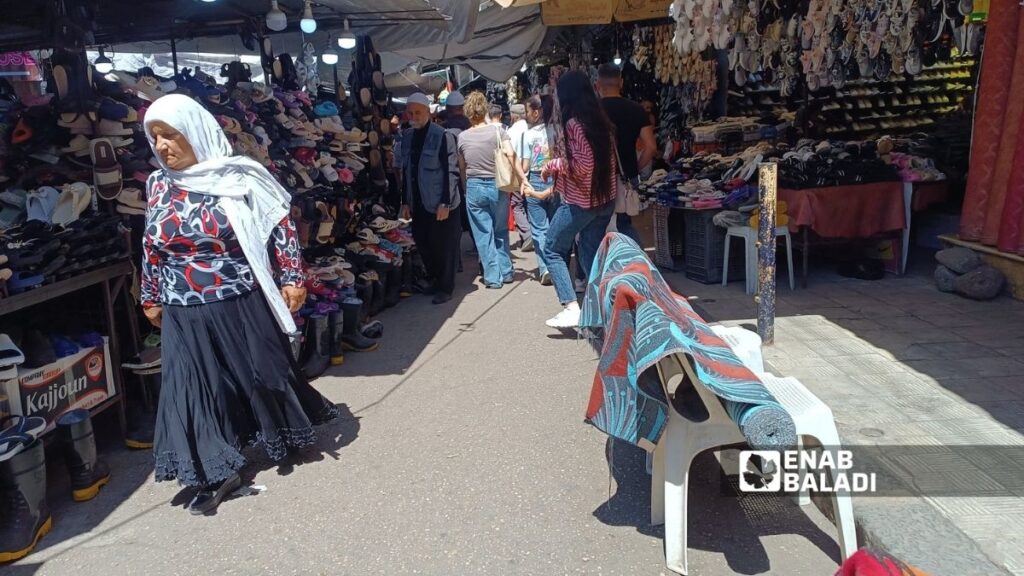
 Women walk through a market in Suwayda city on July 21, 2026. (Enab Baladi)
Women walk through a market in Suwayda city on July 21, 2026. (Enab Baladi)
Women in Suwayda (southern Syria) continue to find that securing their legal rights depends on more than legislation alone. Social customs and economic conditions impose restrictions that can turn the decision to claim those rights into one carrying consequences for women, their families and their wider communities.
This is particularly evident in matters such as inheritance, wills, child custody and maintenance. Many women face difficult choices between claiming their legal rights and preserving family relationships while avoiding social pressure, amid economic barriers and limited legal awareness.
Enab Baladi sought the views of women in Suwayda to identify the main challenges preventing them from fully exercising their rights and to examine how social customs and living conditions limit their ability to benefit from legal protections.
A lawyer who asked not to be named told Enab Baladi that inheritance is one of the clearest examples of the gap between law and reality. Syrian law grants women the right to inherit, but social customs in Suwayda frequently pressure them to relinquish their shares.
She said many women engage in what is known as “takharuj,” voluntarily relinquishing their share of an estate. This is often driven by the social belief that “a daughter should not take from her brother,” as well as a desire to keep land and property within the family out of concern that it could pass to an in-law from outside the family.
Civil society activist Yasmin al-Halabi, a pseudonym, said the problem lies less in the absence of legislation than in the failure to enforce it. She explained that religion clearly grants women inheritance rights without distinguishing between married and unmarried women, but social pressure leads many to relinquish those rights to preserve family relationships.
She added that a woman claiming her rights does not mean that she is offending her family or severing family ties. Rather, she is exercising a right guaranteed by religion and law. “The shame is not in a woman claiming her rights, but in turning injustice into a custom and using tradition to justify depriving her of those rights,” she said.
The debate extends beyond inheritance to wills. The lawyer said that Syrian law generally does not permit a bequest to an heir and limits bequests to one-third of the estate, while the remainder is distributed equally among all heirs. However, Article 307 exempts members of the Druze community, allowing a person to make a bequest to one of their heirs.
She noted that some fathers use this exception to ensure their daughters receive a fair share, while others allocate property specifically to their sons. A woman who demands her rights may face rejection or social ostracism, she added.
One woman from Suwayda said there was no longer any justification for the continuation of certain customs related to women’s rights. “The customs we inherited from our ancestors are not necessarily suitable for every era, and society needs to review and update some traditions that deprive women of their rights,” she said.
According to the lawyer, the problem is not limited to whether rights exist under the law. Enforcing those rights is itself a major challenge. Although access to the courts is legally guaranteed, the high cost of filing lawsuits prevents many women from pursuing cases, particularly when they have no independent income.
Women who have experienced physical or verbal violence are also reluctant to turn to the courts because they fear social judgment. Judicial and enforcement institutions also fail to provide an environment sufficiently sensitive to cases involving women.
In personal status cases, some women relinquish custody of their children after divorce, not because the law denies them custody, but because of their living and social circumstances. They may lack independent housing or a source of income, or their families may refuse to receive them with their children, leaving them compelled to give up custody.
In the lawyer’s view, “some legal provisions diminish women’s status and standing.” These include the mechanism used to reassess the value of a dowry set years earlier when a woman seeks payment. The calculation considers the dowries of female relatives or women regarded as comparable to her, along with social criteria such as education and employment. She described this mechanism as “the commodification of women” and said it undermines their dignity.
She also said that, in certain cases regulated by law, a woman may lose her right to maintenance if she moves or travels without her husband’s permission, which she described as a restriction on freedom of movement.
The lawyer also pointed to disparities in some financial rights. A widow may receive pension or compensation benefits through her late husband’s employment, but she loses that entitlement if she remarries. A widower, by contrast, continues to receive benefits through his deceased wife even if he marries again.
Following separation, a woman may have difficulty recovering furniture or household items she purchased unless she can prove ownership through receipts or witnesses. Items she contributed during the marriage may be regarded as gifts or voluntary contributions. If she takes them without evidence of ownership, her husband may file a theft complaint against her because the items are legally considered his property until proven otherwise.
The cases for which women most frequently seek legal assistance concern child custody and maintenance, according to the lawyer. These are followed by cyber extortion cases, which have increased as artificial intelligence tools have made it easier to manipulate images and other content.
She explained that fear of social stigma or of the incident becoming public makes many women reluctant to go to court or file a complaint. As a result, some prefer silence to claiming their rights, even though cyber extortion and related offenses are punishable by law.
Many women are unaware of the rights granted to them by law. Some believe that requesting a divorce automatically means losing their children or being deprived of financial rights. This belief stems from limited legal awareness, insufficient efforts by relevant authorities and rights organizations to spread legal knowledge, the absence of a culture of reading legal rights materials, and the difficulty non-specialists face in understanding legal texts.
The lawyer highlighted awareness campaigns she conducts with legal advocates and lawyers to educate women preparing for marriage about special conditions that may be included in the marriage contract. She explained that the law allows both parties to agree on additional conditions that protect a woman’s rights, such as officially registering certain furniture or property. Some women, for example, ask for a sewing machine to be included in the contract, in addition to the dowry, which is required for the marriage contract to be valid.
Although women across Syria, and in Suwayda in particular, have rights guaranteed by law, exercising those rights remains obstructed by social and economic barriers. Many choose silence or relinquish their rights to avoid family disputes or social stigma, highlighting the need to strengthen legal awareness and provide a more supportive environment for women seeking to claim their rights.
if you think the article contain wrong information or you have additional details Send Correction


 A
A
A
A
A
A






 More Society