


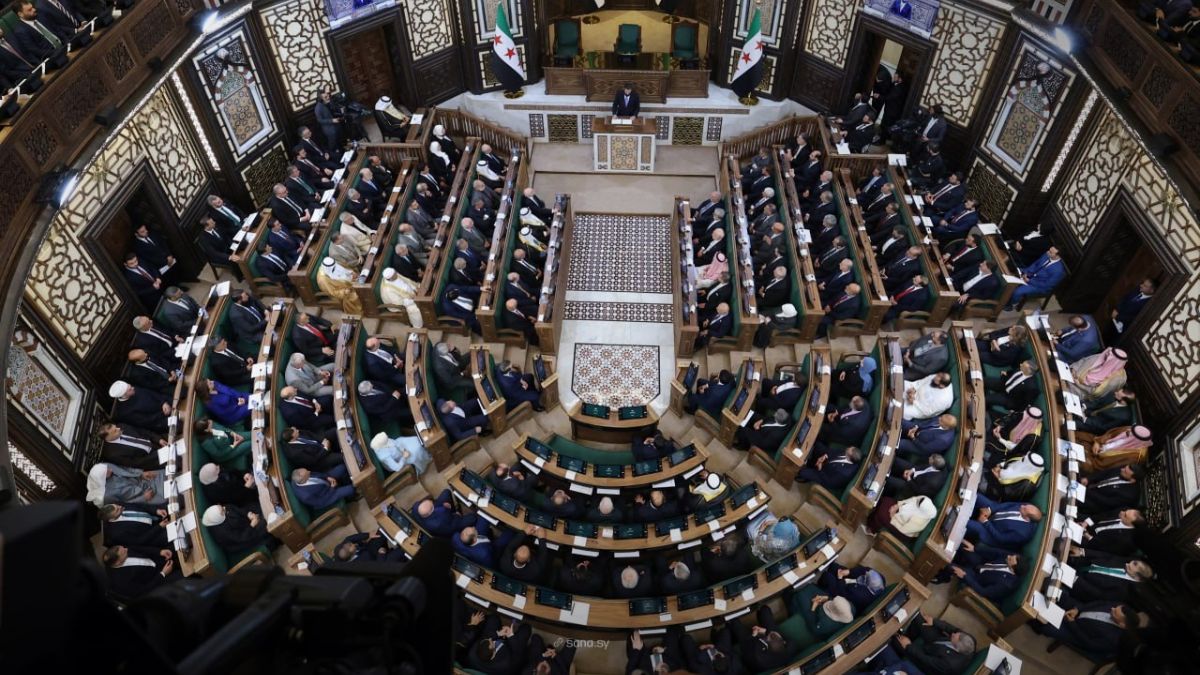
 Syrian President Ahmed al-Sharaa addresses members of the People’s Assembly in Damascus, July 12, 2026. (SANA)
Syrian President Ahmed al-Sharaa addresses members of the People’s Assembly in Damascus, July 12, 2026. (SANA)
The Syrian People’s Assembly held its first session in Damascus on Sunday, July 12, following the fall of the Assad regime, with President Ahmed al-Sharaa, Mohammed Taha al-Ahmed, chairman of the Higher Committee for People’s Assembly Elections, and assembly members in attendance.
The session followed the completion of the assembly’s formation under Decree No. 143 of 2026, which named the members of the new People’s Assembly, including the one-third appointed by the president.
The session’s agenda included administering the constitutional oath to members, electing the assembly speaker, two deputies, and the bureau, as well as forming parliamentary committees in preparation for legislative and oversight work.
The 210-member assembly is the first legislative body to convene in Syria since the fall of the Assad regime in December 2024. During the transitional period established by the Constitutional Declaration, it will exercise its powers until a permanent constitution is adopted and new legislative elections are held.
A total of 206 members attended the session. Three seats representing Suwayda governorate remained vacant because elections could not be held there, while a member representing Idlib governorate was absent following his death.
During the opening session, members took a collective oath before the president. Several Syrian government ministers also attended.
Lawmakers Ahmad al-Omar, Wissam Zaghloul, and Bishr Hawi were appointed to a temporary legal committee tasked with overseeing the electoral process to select the assembly’s leadership council.
Osama al-Assaf chaired the session until the selection process was completed.
President Ahmed al-Sharaa addressed members of the People’s Assembly, saying humanity had continued, since its beginnings, to search for the best way to manage its interests.
Al-Sharaa said acceptance and mutual consent are means of overcoming disagreement. He added that Syria was writing a new history reflecting its civilization, values, and heritage, and urged all assembly members to participate in building the history of modern Syria.
He said Syria was writing a “glorious history” reflecting its acts of heroism. He also stressed that the assembly must assume responsibility for building the country and serving its citizens, placing responsibility above all other considerations.
Al-Sharaa described the Syrian People’s Assembly as a “platform for truth and justice.” He called for it to become a model of responsibility and competence, and urged members to consolidate a culture of dialogue, the rule of law, and respect for institutions.
Mohammed Taha al-Ahmed, chairman of the Higher Committee for People’s Assembly Elections, described the session as “historic,” saying it represented the blood of those killed and marked “a decisive historical moment in which we announce to the world that Syria has shaken off the dust of war.”
Al-Ahmed said the true value of what had been achieved could not be measured in words, but by the scale of the sacrifices made by the Syrian people.
In early October 2025, the Higher Committee for People’s Assembly Elections conducted voting to select assembly members. Elections were postponed in some governorates that were then controlled by the Syrian Democratic Forces, or SDF.
The committee completed elections in northeastern Syrian governorates earlier in 2026 after the government took control of the region.
The committee therefore concluded voting in all electoral districts except those in Suwayda governorate. The remaining districts are Suwayda, Shahba, and Salkhad, each of which is allocated one seat.
The People’s Assembly has 210 members. Of these, 140 hold elected seats, while the Syrian president appointed the remaining 70.
if you think the article contain wrong information or you have additional details Send Correction


 A
A
A
A
A
A


 More Politics