


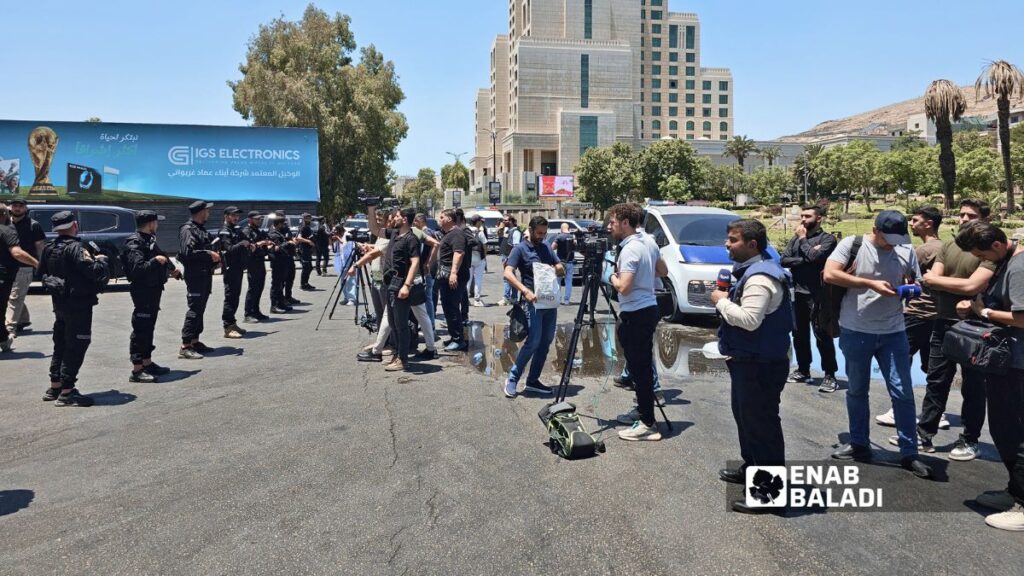
 Internal Security Forces imposed a security cordon around the site and began sweeping and securing the area, July 7, 2026. (Enab Baladi/Ahmad Maslamani)
Internal Security Forces imposed a security cordon around the site and began sweeping and securing the area, July 7, 2026. (Enab Baladi/Ahmad Maslamani)
The Syrian Ministry of Interior announced that members of a detained cell were responsible for the bombings in the capital, Damascus, during French President Emmanuel Macron’s visit to Syria on July 7.
Investigations established that the detainees, Diaa Shaker al-Qasem, Abdullah Younis al-Jubouri, and Mohammad Asaad Mohammad, belonged to the Islamic State group and were involved in planning acts the ministry described as “terrorist,” aimed at destabilizing security, undermining stability, and spreading chaos among civilians, according to a ministry statement.
The ministry said in the statement, published on Monday, July 13, that the investigation’s findings were supported by an analysis of surveillance camera footage and confessions from the detainees.
The ministry confirmed that investigations were continuing to identify everyone involved or cooperating with the cell, before referring them to the competent judiciary and taking the necessary legal measures against them.
It stressed that it would deal “firmly” with anyone proven to have participated in any “terrorist act,” whether through planning, support, or execution. It added that justice would reach all those involved and that there would be no leniency or impunity.
The Ministry of Interior had announced the arrest of the cell accused of carrying out the bombings in Damascus, following what it described as a complex security operation and “precise” intelligence surveillance.
At the time, Enab Baladi’s correspondent in Damascus reported two explosions near the French president’s residence. The first occurred near al-Naanaa Garage in the al-Halbouni area, close to the Ministry of Tourism, and the second near the Four Seasons Hotel.
The ministry said in a July 9 statement that Internal Security Forces, in cooperation and coordination with the General Intelligence Service, had arrested all members of the “terrorist” cell responsible for the recent Damascus bombings.
The arrests followed a series of simultaneous raids targeting the suspects’ separate locations in Damascus and its countryside, including al-Qutayfah, Sayyida Zeinab, Qudsaya suburb, and Esh al-Warwar.
Enab Baladi observed security movements in Esh al-Warwar but was unable to verify the nature of the operations in the other areas by the time the report was published.
According to the statement, investigations with the detainees were continuing to uncover the full details of what the ministry called the “terrorist plot” and the cell’s connections, before revealing the members’ identities and roles to the public.
Syrian Interior Minister Anas Khattab also announced on X that the cell responsible for the two Damascus bombings had been arrested.
Khattab pledged to disclose the identities, affiliations, and roles of the cell’s members to the public.
In a subsequent statement, the Internal Security commander in the Damascus countryside, Brigadier General Ahmad al-Dalati,, announced that preliminary investigations with the cell showed that it was affiliated with the Islamic State group.
Al-Dalati told Syrian state television that “preliminary investigations with the members of the cell involved in the Damascus bombings showed that it was affiliated with ISIS,” referring to the Islamic State group.
Two explosions occurred in Damascus near the residence of French President Emmanuel Macron during his visit to Syria. The bombings killed one person and injured 36 others, according to figures from the Ministry of Health.
The explosions caused several injuries, including among members of the Highway Security Police.
The Ministry of Interior told the Syrian Arab News Agency, SANA, that Internal Security Forces discovered two explosive devices during field operations. Specialized units began taking the necessary steps to dismantle them, but the devices exploded while preparations for the disposal operation were underway.
Internal Security Forces also established a security cordon around the site to protect civilians, while specialized units began sweeping and securing the area.
The ministry said an initial inspection showed that the two devices had been crudely manufactured. One was placed inside a car parked by the roadside, while the other was placed inside a waste container.
It confirmed that the explosion site was outside the security perimeter designated for the French president’s residence and posed no direct threat to the residence or the official visit’s program, which continued as planned.
The French president did not cancel his visit and continued with his schedule, which was nearing completion at the time.
if you think the article contain wrong information or you have additional details Send Correction


 A
A
A
A
A
A


 More Politics