


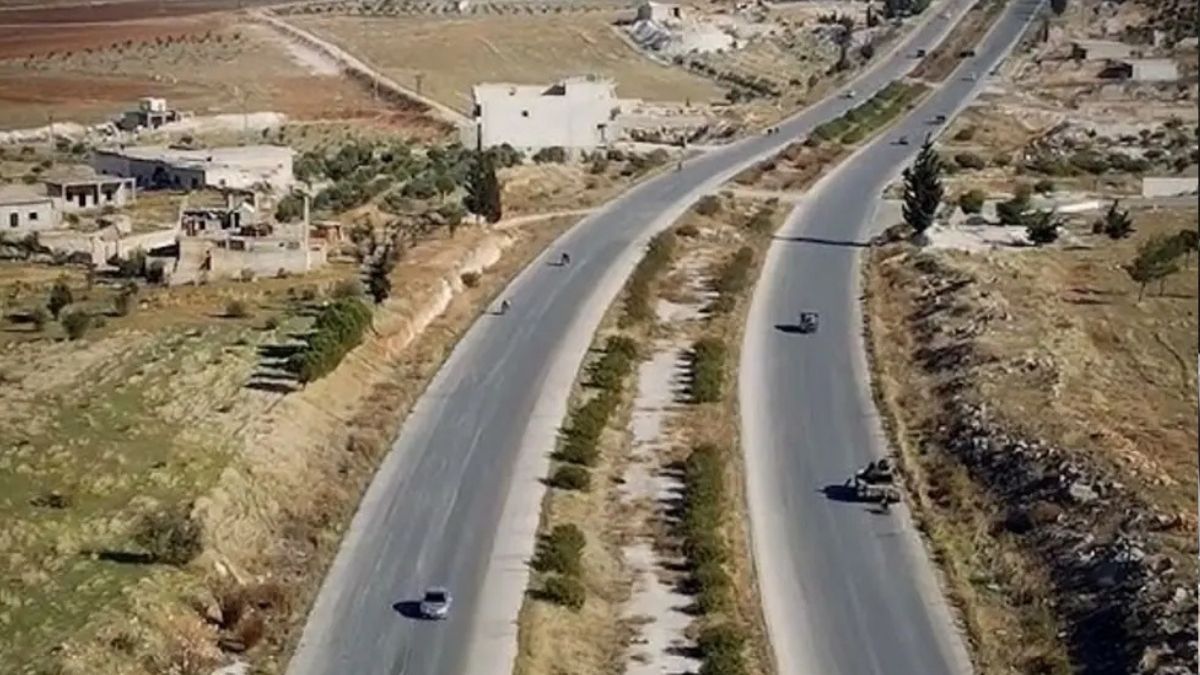
 The General Establishment for Road Transport is studying converting international transport corridors in Syria into paid roads, July 3, 2026 (Syrian al-Ikhbariya)
The General Establishment for Road Transport is studying converting international transport corridors in Syria into paid roads, July 3, 2026 (Syrian al-Ikhbariya)
The director general of the General Establishment for Road Transport, Moaz Najjar, said work is currently underway to update the economic feasibility study for the “North South” and “East West” roads as paid roads under the international Build Operate Transfer investment model, known as BOT.
The “North South” corridor extends from the Jordanian border in the south to the Turkish border in the north, along a route located several kilometers east of the current road. The “East West” corridor links Tartus port, on Syria’s coast, with the al-Tanf crossing on the Iraqi border.
Najjar said there is a project to establish a second branch of the international road extending between Damascus, Palmyra, and Deir Ezzor (eastern Syria).
He noted that the current road is a free road available to everyone, including citizens, economic activities, and transit traffic.
The second branch of the international road between Damascus and Deir Ezzor would contribute to reducing the costs of transporting raw materials, supporting reconstruction projects, and creating direct job opportunities for residents of the eastern regions, Najjar said in an interview with Syrian al-Ikhbariya at dawn on Friday, July 3.
The BOT system, Build Operate Transfer, is one of the investment models used in infrastructure projects. Under this system, a private company finances, builds, and operates a project for a specified period during which it recovers its costs and generates returns from revenues, before transferring ownership and management to the state at the end of the contract period, according to terms agreed by both parties.
Paid roads are roads implemented under the Build Operate Transfer system, BOT, in which a private company finances, builds, and operates the road for a specified period in exchange for collecting transit fees from users, before ownership and management transfer to the state after the contract ends.
The director general of the General Establishment for Road Transport, Moaz Najjar, explained that the corridor links Damascus with the eastern regions, which are rich in oil, mineral, and agricultural resources, accelerating internal trade exchange.
It also contributes to reducing the costs of transporting raw materials, supporting reconstruction projects, creating direct job opportunities for residents of the eastern regions, facilitating access to basic services, encouraging population stability, and paving the way for establishing new industrial and development zones along the route.
Regarding the impact of linking transport networks with neighboring countries, such as Jordan, Turkey, and Iraq, on local markets, Najjar said connecting these networks through roads with high technical specifications would encourage transit movement with neighboring countries. He added that it would directly contribute to reducing vehicle operating costs and travel time, thereby lowering the final cost of products.
He stressed that lower transport costs and increased supply of goods would create price competition inside markets, reflecting positively on citizens’ purchasing power and directly contributing to reducing inflation rates.
According to Najjar, the establishment is offering all possible facilities to interested companies, in parallel with current work in Syria to update all legislation and laws regulating investment in a way that creates a competitive environment encouraging all international companies to enter.
The Syrian Ministry of Transport had launched a new package of projects to rehabilitate the central road network, including soliciting local and international offers to carry out maintenance and development work on several main corridors.
The projects fall within a plan aimed at increasing the efficiency of transport infrastructure, improving traffic safety, and linking governorates and border crossings through a road network that meets international technical standards.
The announcement came during a press conference held by Syrian Minister of Transport Yarub Badr and the director of the General Establishment for Road Transport, Moaz Najjar, on June 28, which Enab Baladi attended.
The first phase of the projects will include rehabilitating the M45 international corridor, which extends from the Nasib crossing on the Jordanian border to the Bab al-Hawa crossing on the Turkish border, as one of the most important land corridors.
The minister said implementation work would be divided into several sections, including the Nasib Damascus road, the Damascus Homs road, and the Homs Aleppo road, in addition to rehabilitating the Saraqib Idlib Bab al-Hawa link, which would help improve internal transport movement and connect Syria with its northern and southern border crossings.
if you think the article contain wrong information or you have additional details Send Correction


 A
A
A
A
A
A


 More Economic Reports