
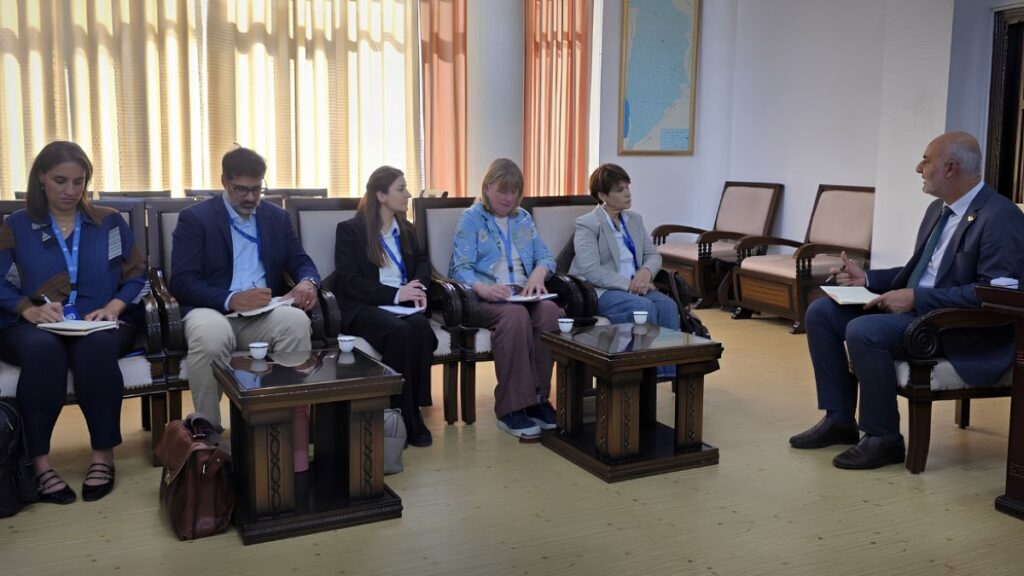

The Independent International Commission of Inquiry on Syria conducted a field visit to Quneitra Governorate (southern Syria) on July 4 to document reported Israeli violations and their impact on residents.
Enab Baladi’s correspondent in Quneitra reported that the commission met Governor Ghassan Ahmad, who presented a comprehensive briefing on the repercussions of Israeli violations on the local population.
The commission also conducted a field tour of Hamidiyah town, Umm al-Azam, and Jubata al-Khashab, and heard direct testimonies from affected residents and relevant parties, to document damage and prepare detailed reports on compliance with international law.
The correspondent explained that the commission’s main objective is to collect evidence and testimonies to submit objective reports to the United Nations, highlighting these violations and their repercussions.
The main points included Israeli violations that exceeded international agreements, especially the 1974 Disengagement Agreement.
They also covered the economic impact and negative effects of the violations on vital sectors such as agriculture and livestock, which form the backbone of the local economy.
The governor pointed to the deep psychological and social repercussions on residents as a result of continuing threats and the loss of security.
Conveying Residents’ Suffering
The head of the administrative unit in Hamidiyah town, Ahmad Suleiman, told Enab Baladi that a delegation from the international inquiry commission visited the village and met residents, especially those affected, and that the suffering caused to citizens by the Israeli occupation in Quneitra was conveyed.
The meeting also included an explanation of the material and human harm suffered by residents as a result of the occupation, most notably the demolition of homes in Hamidiyah town, where 16 houses were destroyed, in addition to eight other houses in Rasem al-Rawadi village.
Suleiman added that the commission listened directly to residents’ complaints, which included road closures and rising transportation costs. Residents called for reopening the main road between Hamidiyah town and al-Salam, as the closure has caused a sharp increase in transportation costs, in addition to higher food prices, because people have had to rely on longer alternative routes.
Residents also raised the interruption of basic services, including power outages that lasted three consecutive days in some villages, and the difficulty of repairing faults because Israeli forces control the al-Ruqad Bridge point, where the electrical transformer is located.
Residents explained to the commission the suffering of shepherds due to continuous restrictions and the seizure of large areas of village land, which threatens their basic sources of livelihood.
They called for the release of detainees, an end to arbitrary arrests of citizens, and protection for civilians in affected areas, stressing the need for international pressure to end these practices.
UN Meeting With Farmers’ Union
The visit by the Independent International Commission to Quneitra comes as part of movements by UN forces in the governorate, which lies in southern Syria on the edge of the occupied Syrian Golan.
A delegation from the United Nations Disengagement Observer Force, UNDOF, had previously held a meeting with the Farmers’ Union in Quneitra Governorate on June 1 to coordinate farmers’ access to their lands during the harvest season.
The head of the Farmers’ Union in Quneitra, Abdul Rahman Khalaf, told Enab Baladi at the time that the meeting came in response to farmers’ repeated demands for access to their lands as the harvest season for winter crops, including wheat, barley, vetch, and fava beans, approached.
He added that the meeting centered on harvesting the crops without any harm resulting from continuing Israeli incursions in Quneitra.
Khalaf said the union worked to facilitate and secure farmers’ safety while harvesting their crops, through an agreed mechanism that included submitting lists of their names, in coordination with heads of associations and mukhtars, local village leaders, so they could reach their lands safely without being subjected to harm.
Khalaf noted that the Farmers’ Union in Quneitra called for UNDOF intervention to prevent the arbitrary arrest of shepherds, land vandalism, and pesticide spraying.