


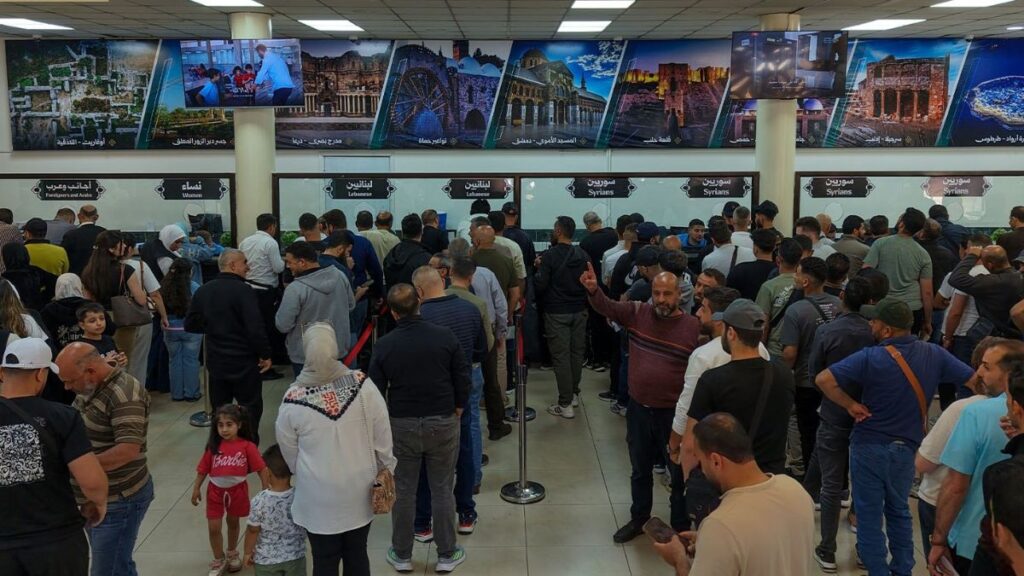
 Travelers arriving in Syria through the Jdeidet Yabous border crossing with Lebanon, May 24, 2026. (General Authority for Ports and Customs)
Travelers arriving in Syria through the Jdeidet Yabous border crossing with Lebanon, May 24, 2026. (General Authority for Ports and Customs)


 A
A
A
A
A
A
Questions have circulated about how much cash travelers may carry through Syrian border crossings, amid conflicting information shared on social media.
An informed customs source at the Jdeidet Yabous border crossing (Rif Dimashq, southwestern Syria), on the border with Lebanon, confirmed reports that the Central Bank of Syria had issued a circular setting limits on the amounts of old and new Syrian currency travelers may bring into or take out of the country.
The source, who spoke to Enab Baladi on condition of anonymity, said the crossing had received the circular from the Central Bank, along with all land, sea, and air border crossings. The circular introduced new rules governing travelers carrying old and new Syrian pounds into or out of the country.
According to the Central Bank circular:
Enab Baladi contacted the public relations department and media office of the Syrian General Authority for Border Crossings and Customs regarding the procedures for bringing old and new Syrian currency into or out of the country, but received no response.
A source close to the Central Bank of Syria who had reviewed the circular also confirmed to Enab Baladi that it had been issued by the bank.
According to the source, the decision aims to:
The Central Bank instructed border crossings to seize any undeclared amounts or sums exceeding the stated limits, using the forms and procedures approved by the Anti-Money Laundering and Counter-Terrorism Financing Commission.
The relevant border crossing must transfer the seized money, together with an official seizure report, to the Central Bank of Syria for the necessary legal procedures. The seizure does not prevent the traveler from completing the procedures for entering or leaving the country.
Regarding the rights of travelers whose money is seized, the customs source said the official report must contain several essential details:
The source at the Jdeidet Yabous crossing said the original seizure report is attached to the confiscated amount and transferred to the Central Bank of Syria’s General Administration. A traveler whose undeclared money was seized may then submit a request to the Central Bank to recover the funds.
The source close to the Central Bank said the bank and the Anti-Money Laundering and Counter-Terrorism Financing Commission have specific rules and procedures for handling seized funds, but did not provide further details.
Before the new Central Bank circular took effect, travelers could bring any amount of Syrian pound banknotes into the country. However, they were required to declare amounts equal in value to $10,000 or more, under a circular issued by the commission in 2023.
Before the replacement of the old currency began in Syria, the regulations governing the removal of old Syrian banknotes from the country remained unchanged. Before the fall of the former government, other countries generally did not accept the old Syrian pound as payment for services or commercial transactions with Syria.
Under the 2023 circular issued by the commission, travelers entering Syrian territory are subject to the following rule:
Travelers leaving Syrian territory are subject to the following rules:
Under Investment Law No. 18 of 2021, foreign investors may:
Presidential Decree No. 114 of 2025 amended provisions of Investment Law No. 18 of 2021. The amendments did not specifically address transferring investors’ profits or interest abroad in US dollars or their equivalent, but they permitted the transfer of court-awarded expropriation compensation in a convertible currency when it relates to foreign capital brought into Syria.
On July 26, the Central Bank of Syria settled the debate over whether the legal tender status of the old Syrian currency would be extended. It reiterated that the old banknotes It reiterated that the old banknotes would cease to be legal tender on July 31.
The Central Bank said the deadline for exchanging old banknotes through approved financial institutions would expire on July 30. It also announced that the currency replacement process had reached an advanced stage, without specifying a percentage.
Central Bank of Syria Governor Mohamad Safwat Raslan said on July 10, during a roundtable meeting involving public and private sector representatives in Damascus, that about 80% of the old Syrian currency had been replaced since the beginning of the year.
Beginning July 31, the term “Syrian pound” in official decisions, instructions, and transactions will refer exclusively to the new Syrian currency.
if you think the article contain wrong information or you have additional details Send Correction






 More Economic Reports