
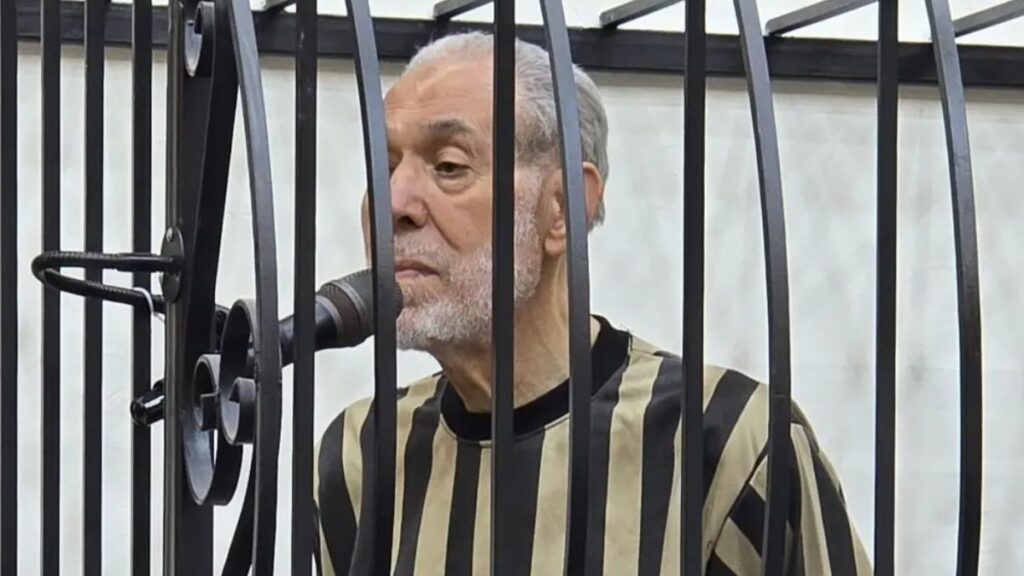

The fourth session of Ahmad Hassoun’s trial before Damascus’s Fourth Criminal Court on Thursday, July 30, heard testimony from an anonymous witness who accused him of extortion in connection with detainee cases. An attorney representing several plaintiffs also asked the court to convict Hassoun on charges of issuing religious rulings that sanctioned killing and exploiting his position.
The anonymous witness told the court that Hassoun had demanded thousands of dollars from him in exchange for securing the release of his sister, who was detained at a security branch under the former Syrian regime.
Hassoun served as Syria’s grand mufti under the Assad regime.
The National Commission for Transitional Justice said the witness, whose identity was not disclosed, accused Hassoun of demanding payments totaling approximately $65,000.
According to the witness, the alleged extortion also involved goods, including the purchase of 20 cloaks to be presented to the “Iranian brothers,” as Hassoun allegedly described them, and 100 kilograms of luxury sweets for Russians. The demands also included diesel fuel and everyday items delivered to Hassoun’s office.
The witness said Hassoun had acted as an intermediary between him and a judge at the former regime’s terrorism court. He added that he was forced to pay $20,000 before his sister was released after 58 days in detention.
Calls to Convict Hassoun
The National Commission for Transitional Justice said two attorneys representing a group of plaintiffs attended the session. One of them submitted a written memorandum asking the court to convict Hassoun for issuing religious rulings that sanctioned killing and for exploiting his position.
The session also examined a three-page technical expert report requested by Hassoun’s defense attorney concerning videos submitted as evidence in the case.
The commission said its Accountability Department reiterated that the expert report would not affect the evidentiary value of the videos presented in the criminal proceedings.
The department explained that editing or excerpting the videos did not alter their meaning or legal value as reliable evidence, particularly because the defendant had acknowledged them.
Part of the Transitional Justice Process
Hassoun’s trial is part of Syria’s transitional justice process, which seeks to hold officials and prominent figures from the former Syrian regime accountable.
Other defendants facing proceedings include Wassim al-Assad, a cousin of ousted President Bashar al-Assad, Atef Najib, the former head of the Political Security Branch in Daraa (southern Syria), who is accused of helping ignite the Syrian uprising, and Ibrahim Huwija, the former head of Syria’s Air Force Intelligence Directorate.
Damascus’s Fourth Criminal Court previously held three sessions in Hassoun’s trial.