
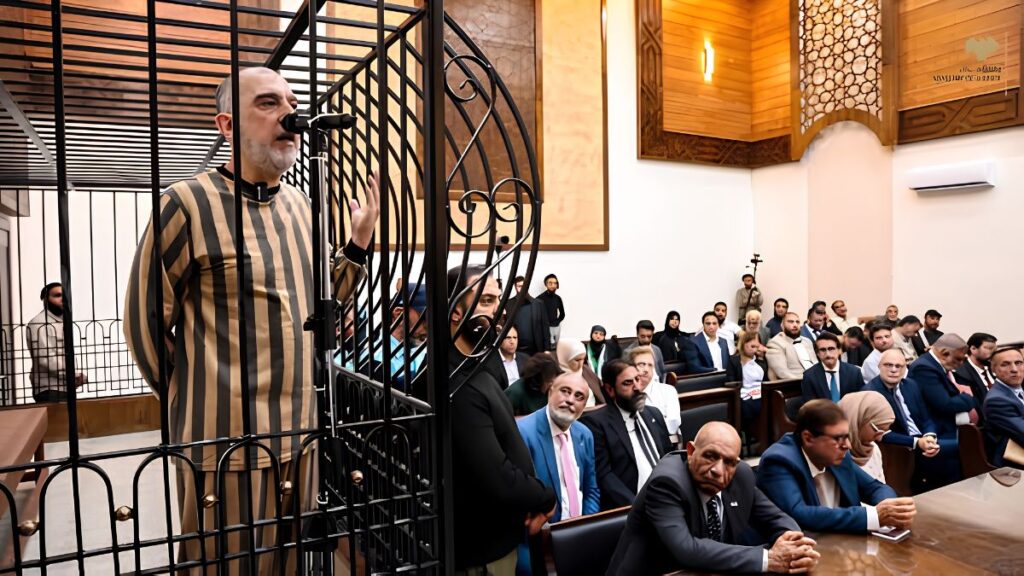

The Fourth Criminal Court at the Palace of Justice in Damascus held the fourth session today, 23 June, in the trial of defendant Atef Najib, a former brigadier general and former head of the Political Security Branch in Daraa governorate, southern Syria, at the start of the Syrian revolution.
The Syrian Arab News Agency, SANA, reported that representatives of international and rights organizations attended the session, which was closed to the media and fully dedicated to hearing statements from public prosecution witnesses.
The first session of Atef Najib’s trial began on 26 April, when the judge also brought charges against several figures from the Assad regime, starting with Bashar al-Assad, for trial in absentia.
The criminal court opened its first session to examine the charges against Atef Najib amid broad rights and media attention.
The second session saw an indictment linked to 2011 brought against Atef Najib, the cousin of the ousted regime president Bashar al-Assad.
The charges against Najib included suppressing peaceful protests in Daraa and causing detainees, including minors, to be subjected to physical torture, including nail extraction, electric shocks, threats against their families, and the use of excessive force during arrest operations.
They also included using detention as a means of extortion, issuing direct orders for arrest and torture in his capacity as the first official in charge of the Political Security Branch in Daraa, and bearing responsibility for the al-Umari Mosque massacre.
The session addressed torture practices inside detention centers affiliated with Political Security in Daraa, while emphasizing Najib’s command responsibility for those violations.
Defendant Atef Najib denied all charges against him related to committing violations against residents of the governorate.
According to a video recording of proceedings from the second session of his trial, released by the Syrian Ministry of Justice on 16 May, Najib denied that his branch arrested children who had written political slogans opposing the Assad regime on the walls of a school in Daraa, accusing the Military Security Branch of carrying out the arrests.
Najib also accused the State Security Branch, the Military Security Branch, and the Air Force Intelligence Branch of confronting protesters by opening fire, which led to the killing of two people during the first demonstrations that broke out in Daraa at the start of the Syrian revolution.
The third session was held on 19 May and focused on confronting the defendant with evidence and with answers he had previously given.
During questioning, Najib pointed to internal disputes with the then head of the National Security Bureau, Hisham Bakhtiar, over how to deal with the protests.
He also referred to what he described as disputes over an “ambush” targeting protesters coming from the Daraa countryside and the killing of two people in an earlier period.
Hassoun and Wasim al-Assad Trials
The National Commission for Transitional Justice had announced that the coming days would see a series of judicial sessions within Syria’s transitional justice process, including the trial of several figures.
The figures mentioned, in addition to Atef Najib, included Wasim al-Assad, cousin of the ousted regime president, and Ahmad Hassoun, the former grand mufti under the Syrian regime.
Radif Mustafa, director of the Accountability Department at the commission, said Wednesday, 24 June, will see the first trial session for Wasim al-Assad, while Thursday, 25 June, will see the first trial session for Ahmad Hassoun, the former grand mufti under the Syrian regime.
Mustafa stressed that the transitional justice process is not limited to holding defendants accountable but also aims to provide justice to victims, empower them, and guarantee their rights as part of efforts to address violations linked to the previous phase.