
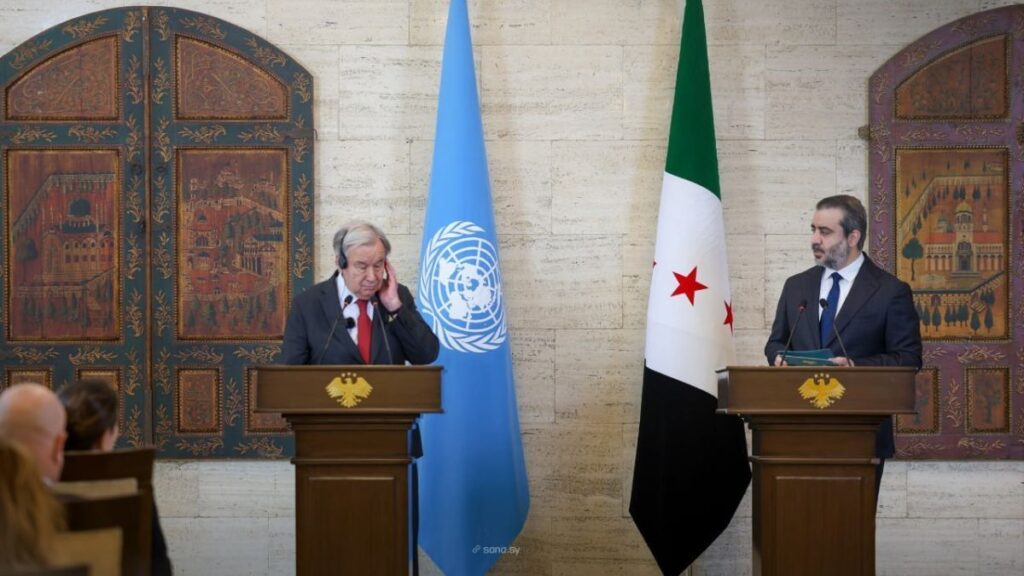

UN Secretary-General António Guterres called on the international community to support Syria during what he described as a pivotal phase, as he visited Damascus on July 25 marking the first visit to Syria by a UN secretary-general since 2009.
Syrian Foreign Minister Asaad al-Shaibani joined Guterres at a press conference in Damascus.
During the press conference, Guterres called for assistance to Syria as it demonstrates its determination and resolve to rebuild, noting that no country can emerge from a conflict of such severity and rebuild entirely on its own.
He said the United Nations looks forward to cooperating with Syria in all fields and working with the international community to support the country’s future and prosperity.
Guterres said Syria’s recovery represents “an important investment opportunity” after the Syrian people endured many years of hardship.

Syrian Foreign Minister Asaad al-Shaibani meets UN Secretary-General António Guterres in the presence of several Syrian government ministers, July 25, 2026. (AFP/Bakr Alkasem)
He added, “Syria is creating opportunities for everyone and laying the foundations for a better future for all Syrians. This is a process that requires leadership, vision and trust, so that every Syrian can see themselves in their country’s future.”
He said the previous years “did not deprive Syrians of their resilience, perseverance, capacity for innovation and creativity, or sense of belonging.”
Guterres affirmed that the Golan is Syrian territory, adding that the United Nations supports Syria’s territorial integrity, independence and sovereignty. He also called for an end to all violations in southern Syria.

UN Secretary-General António Guterres meets several Syrian government ministers in Damascus, July 25, 2026. (AFP/Bakr Alkasem)
A Success Story and Model for Peace
Al-Shaibani said Syria “is presenting a strategic model for peace today by focusing on securing its borders and ensuring that weapons are held exclusively by the state.”
He added, “The Syrian experience offers the world an exceptional success story after laying the foundations for unprecedented cooperation with the United Nations, moving beyond traditional political coordination toward transparent institutional openness.”
Al-Shaibani said the two sides discussed strengthening reconstruction efforts and developing the partnership between Syria and the United Nations during the country’s new phase of recovery.
Al-Shaibani said that 3.5 million Syrians had returned to the country in what he described as one of the world’s largest voluntary return movements.
During the press conference with Guterres, al-Shaibani also warned of the direct threat that Israeli violations of Syrian territory pose to regional security.
Guterres Meets al-Sharaa
Syrian President Ahmed al-Sharaa met Guterres at the People’s Palace in Damascus.
The Presidency of the Syrian Arab Republic said the meeting addressed ways to strengthen cooperation between Syria and the United Nations in humanitarian and development fields.
The two sides also discussed supporting early recovery and reconstruction efforts and stressed the need to respect Syria’s sovereignty, unity and territorial integrity.
Guterres also visited the Umayyad Mosque and toured the Old City of Damascus.
Syrian Foreign Minister Asaad al-Shaibani had received Guterres at Damascus International Airport at the start of his visit to Syria.
Guterres wrote on X that the United Nations stands with Syria at a “pivotal moment,” calling on the international community to spare no effort in supporting the Syrian people and expressing solidarity with Damascus.

Syrian President Ahmed al-Sharaa receives the UN secretary-general at the People’s Palace in Damascus, July 25, 2026. (AFP/Louai Beshara)
Transitional Phase Requires International Support
The UN secretary-general’s visit comes as Syria undergoes a transitional phase requiring international attention, amid UN reports highlighting the country’s continuing need for support across several fields.
Although UN reports have addressed positive developments in Syria since the fall of the Assad regime, they also indicate that these developments remain incomplete in several areas.
The reports state that Syria still requires assistance with food security, reconstruction and security because of low living standards, continuing instability and the destruction the country experienced during years of war.
Damascus is also counting on a greater UN role in curbing Israeli violations in southern Syria, including a more effective role for the United Nations Disengagement Observer Force, known as UNDOF, between Syria and Israel, and a return to the 1974 Disengagement Agreement.