


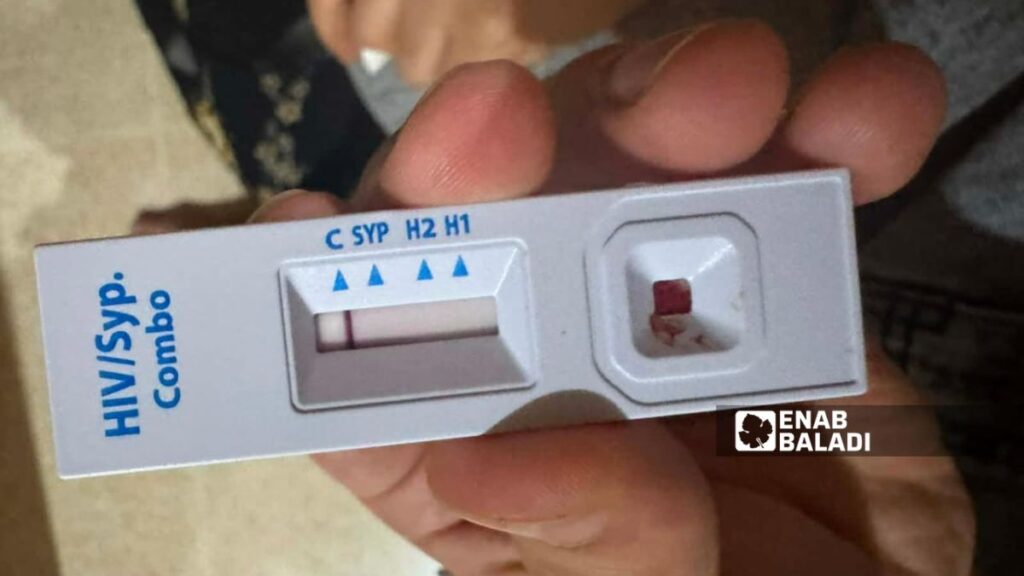
 A rapid HIV test offered by the Ministry of Health through voluntary counseling and testing centers, July 30, 2026. (Enab Baladi)
A rapid HIV test offered by the Ministry of Health through voluntary counseling and testing centers, July 30, 2026. (Enab Baladi)
Murad read a report about the rising number of detected human immunodeficiency virus, or HIV, infections in Syria, then turned to the comments. There, fears he thought he had left behind resurfaced, and he began wondering whether returning to Syria from Turkey would expose him to a society that still views people living with the virus through stereotypes.
Murad, 40, asked that his surname not be published. He discovered that he had HIV about two years ago and told Enab Baladi that living with the virus had not prevented him from marrying his wife, who does not have HIV. However, fear of social stigma remained his greatest challenge.
The figures on detected HIV infections in Syria have opened a discussion that goes beyond the number of registered cases. The discussion also concerns how people with HIV obtain a diagnosis and treatment, and the factors that may lead some to delay testing or avoid seeking medical assistance because of the stigma associated with the infection.
The National AIDS Control Program registered 212 new HIV infections last year. The cumulative number of registered people currently living with HIV reached 1,538 since 1990, not within a single year as had been circulated, National AIDS Control Program Director Omar Abu al-Naaj told Enab Baladi.
The human immunodeficiency virus, or HIV, attacks the body’s immune system. AIDS refers to the most advanced stage of the infection, when the virus severely weakens the immune system and certain opportunistic diseases or conditions emerge. Not everyone with HIV progresses to AIDS, particularly with early diagnosis and adherence to antiretroviral therapy.
World Health Organization
An increase in the number of detected HIV infections does not necessarily mean that the virus has become more prevalent among the population, according to the Ministry of Health. The ministry linked the recent increase to improved surveillance and detection mechanisms, as well as more people gaining access to health services.
Abu al-Naaj told Enab Baladi that the ministry had expected the number of registered cases to increase following the return of Syrians to the country. Some of those returning already knew they had HIV and had been receiving treatment outside Syria. After returning, they contacted the national program to obtain medication and medical services.
Abu al-Naaj said greater confidence in the services provided, along with guarantees of confidentiality and privacy, had also contributed to increased voluntary reporting of cases.
People with HIV do not all receive a diagnosis through the same route. The Ministry of Health uses several methods to detect cases, beginning with voluntary testing and not limited to people visiting health centers after developing symptoms.
According to the National AIDS Control Program, detection mechanisms include counseling and testing centers, premarital clinics, tests conducted at blood banks, hospital referrals, and health surveys targeting some groups considered more vulnerable to infection.
Program data show that counseling and testing centers identified the largest number of cases, with 399 infections. They were followed by 121 cases detected during hospital admission or medical follow-up, and 79 cases referred by hospitals.
Routine tests conducted at blood banks detected 61 infections. These tests are intended to ensure that blood units are safe before use and do not mean that the virus was transmitted through blood. Premarital clinics registered 55 infections, sexual contacts accounted for 51 cases, and health surveys detected ten. The program did not specify the period covered by these detailed figures.
The experience of living with HIV does not end when the infection is discovered. Diagnosis begins a new stage involving adherence to treatment, medical follow-up, and the ability to cope with the infection’s social and psychological effects.
The Ministry of Health says HIV medication is distributed free of charge to everyone diagnosed with the virus. Follow-up is not limited to dispensing treatment, but also includes regular tests to assess the body’s response, including viral load measurements and CD4 immune cell counts every three months.
For some people living with HIV, the challenge is not limited to obtaining medication. It also involves the need for psychological and social support, as well as dealing with fears that their HIV status may be revealed or that they may face discrimination.
Maher, 48, has lived with HIV in Syria since 2000. He told Enab Baladi that he communicates with dozens of Syrians living with the virus through a private group, where he listens to their medical and social concerns and tries to help by providing information or directing them to specialist doctors when needed.
Maher said the most common concern he encounters among people living with HIV does not relate to the infection itself, but to fear of society’s reaction. Many people hesitate to undergo testing or disclose their HIV status because they fear stigma or discrimination, he added.
Some misconceptions remain widespread, Maher said. Some people believe HIV can be transmitted through handshakes or by sharing food and drinks, although this is incorrect. He said these beliefs deepen the isolation of people living with HIV and increase their fears.
Maher also believes that television dramas that addressed AIDS in previous years, including the series “Barrier of Silence” and “Red Line,” helped reinforce stereotypes about people living with HIV by associating the infection with isolation and danger. This portrayal, he said, increased many people’s fear of undergoing testing or disclosing their HIV status. He believes that, in addition to treatment, people living with HIV need an organization that can provide psychological and social support and counseling, an area that still requires greater attention.
Many people continue to associate HIV with an outdated image based on fear and death. However, medical advances in recent years have changed how the virus is managed. Regular treatment can control the virus, which has become a chronic health condition requiring continued monitoring for many people living with HIV.
The Syrian man living with HIV in Turkey told Enab Baladi that much of the information circulated about the virus is still based more on fear than knowledge. He said his HIV status had not prevented him from marrying his wife, who does not have the virus.
He added that he has other health conditions requiring monitoring, including diabetes. His doctor told him that managing diabetes required greater attention in his case than the effects of HIV itself, because he adheres to treatment and his health is stable.
There is currently no definitive cure for HIV infection. However, antiretroviral therapy has transformed it into a manageable chronic health condition, allowing people living with the virus to live long and healthy lives when they adhere to treatment.
World Health Organization
Globally, HIV remains an ongoing public health challenge, with millions of people living with the virus and significant differences in prevalence rates between regions.
Syria is classified as a country with low HIV prevalence. International estimates indicate that the prevalence rate among the adult population remains below 0.1%.
Despite the low prevalence compared with other regions, Syria’s health challenge lies in the healthcare system’s ability to reach people with HIV, encourage early testing, provide treatment and follow-up, and confront social stigma.
if you think the article contain wrong information or you have additional details Send Correction


 A
A
A
A
A
A







 More Society