


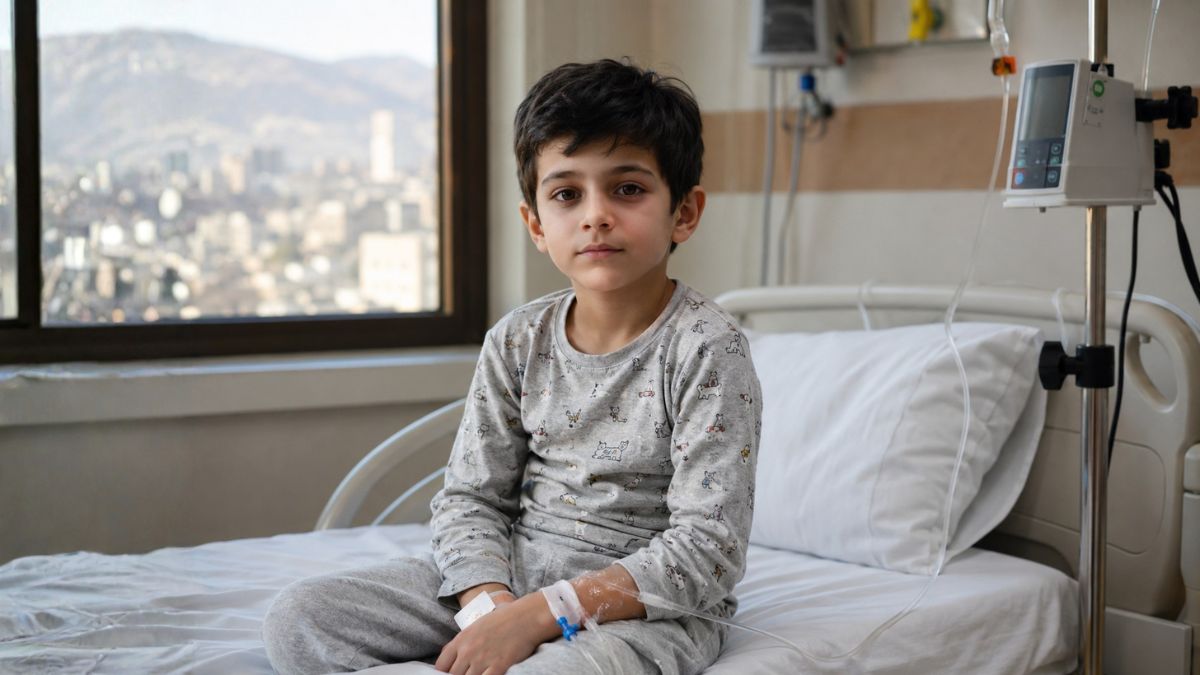
 Illustrative image (Enab Baladi, generated by artificial intelligence)
Illustrative image (Enab Baladi, generated by artificial intelligence)
Dozens of children at the Children’s Hospital in Damascus (Syrian capital) are waiting for high-cost, medically complex treatment that is not easily available inside Syria, namely bone marrow transplantation.
The number of children who need this treatment ranges between 50 and 60 boys and girls. Meanwhile, the Syrian American Medical Society (SAMS) signed a memorandum of understanding with the Ministry of Higher Education and Scientific Research on June 25, under which it will cover treatment for 25 cases within one year, while also rehabilitating the bone marrow transplant unit and supplying it with the necessary equipment.
Dr. Monzr al-Malki, a professor of hematology, oncology, and bone marrow transplantation in California and head of SAMS’ Hematology and Oncology Treatment Committee, told Enab Baladi that the agreement signed with the ministry gives SAMS scientific, administrative, and financial responsibility for the project for one year from the signing date.
Al-Malki explained that bone marrow transplants can be performed for 25 boys and girls during this period. He said the first phase will begin with rehabilitating and repairing parts of the bone marrow transplant unit at the Children’s Hospital, in addition to purchasing missing equipment for the center, so the medical staff will be fully prepared to begin treatment.
He said the first phase is expected to be completed within one month, with treatment for the children set to begin in August 2026.
According to al-Malki, the treatments include bone marrow transplantation, as well as treatment for blood cancers and some benign and genetic diseases with high recovery rates.
Specialized SAMS teams will also help develop the capacities of medical staff already working in Damascus by supervising education and training, especially for technicians responsible for equipment in the transplant unit.
Al-Malki added that bone marrow transplantation is a very costly and complex procedure that requires specialized teams, in addition to the different cadres already present in the hospital. Work will therefore focus on improving the quality of the service provided and building the capacity of human resources available in Syria in this specialty, helping ensure that treatment can continue later.
For this purpose, medical and nursing teams will travel to Syria to train local staff, alongside efforts to attract specialized laboratory technicians from abroad to join the team responsible for training and assisting laboratory staff.
The head of SAMS’ Hematology and Oncology Treatment Committee said the number of children waiting for this treatment at the Children’s Hospital ranges between 50 and 60 boys and girls, with 25 of them to be selected based on priority and severity of risk.
He noted that the speed of implementation will vary depending on available capacity, the presence of expertise, and how well staff absorb the training.
Questions have been raised about the possibility of extending the project for another year, which would allow the number of beneficiaries to increase.
Al-Malki said that if the project succeeds, a larger number of the announced cases could be covered, and the agreement could also be extended for an additional year.
He explained that success will be measured by the success of the operations on one hand, and by the good response of medical staff in Syria to training and education on the other.
He added that technical procedures and administrative transactions must be smooth and free of obstacles, noting that the Minister of Higher Education and Scientific Research had promised to provide suitable conditions in this regard.
Al-Malki continued that another factor in the project’s success is how the center is managed, particularly in terms of how funds are spent, given limited resources, in order to carry out high-cost procedures to very good standards and at lower costs.
Hospitals that perform this type of operation in the Middle East are very limited. There is only one specialized center in Saudi Arabia, along with King Hussein Cancer Center in Jordan and the American Hospital in Lebanon.
Al-Malki said these hospitals are among the most prominent specialized centers in the Middle East for this type of treatment, noting that the cost of a single operation is very high, ranging between $80,000 and $120,000.
He added that the patient care phase following a bone marrow transplant lasts about 100 days and requires expensive tests and medications, pointing out that SAMS will cover these costs.
Regarding the organizations supporting coverage of these expenses, al-Malki explained that SAMS has been working on the ground in Syria for about 14 to 15 years, since the beginning of the revolution. Most donations come from large associations concerned with patient care in disaster-stricken areas, in addition to donations collected from the Syrian community, mostly from Syrian doctors in the United States.
At the end of his remarks, al-Malki thanked the Syrian community, especially doctors in the United States, specifically in California, who supervised fundraising to treat the children and develop financial management for the bone marrow transplant center at the Children’s Hospital in Damascus.
In a previous statement to Enab Baladi, Dr. Jamil al-Dabl, director of the Cancer Diseases Administration at the Syrian Ministry of Health, revealed that the number of cancer cases among children in Syria reaches about 1,100 annually. He also noted that the total number of cancer cases ranges between 17,000 and 20,000 each year.
He explained that most cases are among patients with blood cancer, or leukemia, attributing this to weapons used during the war in Syria, whether chemical or otherwise.
During a visit by Jordanian Health Minister Ibrahim Al-Badour, accompanied by a number of Jordanian health sector officials, including the director of King Hussein Cancer Center, discussions were held on the possibility of sending a number of Syrian cancer patients to the center for treatment, especially cases that cannot be treated inside Syria.
Al-Dabl said an agreement was reached with the Jordanian side on two tracks. The first concerns determining the type of cases to be referred for treatment, while the second involves sending Syrian medical, nursing, and technical staff to King Hussein Cancer Center for training.
Regarding the cases covered by the agreement, al-Dabl explained that they include patients who need bone marrow transplants, in addition to some blood cancer cases, because this type of treatment is unavailable in Syria due to a shortage of specialized expertise.
He said the number of cases requiring bone marrow transplants in Syria is estimated at 150.
if you think the article contain wrong information or you have additional details Send Correction


 A
A
A
A
A
A



 More Society