


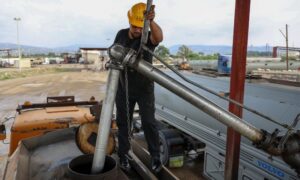
 Syrian Energy Minister Mohammad al-Bashir and a government delegation inaugurate the Alouk Water Station, July 22, 2026. (Al-Hasakah Media Directorate)
Syrian Energy Minister Mohammad al-Bashir and a government delegation inaugurate the Alouk Water Station, July 22, 2026. (Al-Hasakah Media Directorate)
Syrian Energy Minister Mohammad al-Bashir inaugurated the Alouk Water Station in the countryside of Ras al-Ain, northern al-Hasakah governorate, on Wednesday, July 22, marking the resumption of drinking water pumping to al-Hasakah city and its countryside. The station had experienced years of shutdowns and repeated interruptions, making it one of the most prominent public service issues linked to the conflict in northeastern Syria.
The opening was attended by al-Hasakah Governor Nour al-Din Ahmad, members of the presidential delegation, the director of the governorate’s water authority, and several People’s Assembly members representing al-Hasakah. The government said the step marked the beginning of efforts to restore one of the governorate’s most important public service facilities.
The energy minister wrote on X, “Today, we witnessed pumping resume from the Alouk Water Station after more than seven years of shutdown. This step will gradually restore water to more than half a million of our people in al-Hasakah governorate.”
The station’s reopening followed the start of trial pumping on July 16, after nine months of maintenance and rehabilitation. The work included repairing wells, the electrical system, and parts of the infrastructure in cooperation with the International Committee of the Red Cross, while coordination with the United Nations Children’s Fund, UNICEF, continues to bring the station to full operating capacity.
According to the official announcement, the station will initially operate 19 of its 34 wells to provide drinking water to al-Hasakah city and its countryside, as well as the al-Hol subdistrict. The remaining wells will be rehabilitated in later phases.
Civil society activist Mohammad al-Dawood told Enab Baladi that the Alouk Water Station, located in the Ras al-Ain area, “is the main source of drinking water in al-Hasakah governorate. It supplies al-Hasakah city and its countryside, Tal Tamr and its countryside, and the al-Hol area, serving around 500,000 people.”
He added that during the years of war, the station had been transformed “from a public service facility into one of the most prominent humanitarian and political issues in northeastern Syria.”
Al-Dawood attributed this to “its location in an area that experienced successive changes in military control, which created difficulties in operating the station and securing the electricity it required, in addition to damage affecting water transmission lines and infrastructure.”
During the station’s shutdowns, al-Hasakah residents relied on alternative water sources, particularly water tankers, local desalination facilities, and private wells, amid rising drinking water costs and declining available supplies.
The continuing Alouk crisis was linked to developments following Operation Peace Spring in northeastern Syria in 2019. Several organizations reported that the station’s complete shutdown followed the interruption of electricity supplies to the area in August 2020, after which the facility entered a prolonged cycle of temporary operation and repeated outages.
Since then, restarting the station has depended on several interconnected factors, including securing electricity, allowing technical teams to reach the facility, repairing infrastructure damage, and reaching security understandings among the parties controlling the area.
The Alouk Water Station received considerable attention from the United Nations and humanitarian organizations because hundreds of thousands of civilians depend on it.
In March 2020, UNICEF warned that the station was supplying water to around 460,000 people in al-Hasakah, Tal Tamr, and the al-Hol and al-Arisha camps. The organization said that continued disruption threatened to increase health risks and the spread of diseases associated with water shortages.
In July 2021, the United Nations also called for the sustainable restoration of water and electricity services, saying repeated interruptions at the station had placed around one million people at risk of water shortages. It said the station had stopped operating at least 24 times since November 2019 and had remained completely out of service since June 23, 2021, because of electricity cuts and difficulties faced by maintenance teams in reaching the site.
During those years, local institutions operated desalination facilities inside al-Hasakah city to reduce the effects of the water interruption, but these solutions remained limited compared with the scale of actual need.
Several initiatives were launched in previous years to restart the station, but none succeeded in ensuring stable pumping.
In September 2024, reports said an international understanding had been reached to reactivate the station, alongside a visit by a delegation from UNICEF and the International Committee of the Red Cross. Those efforts, however, did not produce permanent operations.
A delegation from the United Nations and the Syrian Arab Red Crescent also visited the station in June 2025 to assess its technical condition. The visit remained limited to a technical evaluation and did not lead to resumed operations.
Relevant authorities attributed the failure of previous solutions to three main factors: continuing security complications around the station, unstable electricity supplies, and damage to the main conveyance lines and pumping facilities.
Government efforts to restart the station began this year. On April 7, the Energy Ministry announced that it had taken control of the facility and begun a technical assessment in preparation for rehabilitation, as part of measures connected to monitoring the implementation of the January 29 agreement.
On June 30, al-Hasakah’s deputy governor and the spokesperson for the presidential team said a joint meeting with the ministerial committee and the General Water Company had discussed the reasons for delays in restoring pumping. He said removing mines and encroachments along the main conveyance line was among the most important steps required before operations could begin.
On July 15, the Energy Ministry announced the start of trial pumping following the completion of maintenance work. It said cooperation with the International Committee of the Red Cross and UNICEF would continue, while a mobile power station was being prepared in al-Darbasiyah (northeastern al-Hasakah governorate) to ensure a stable electricity supply for the station.
Local administration researcher Abdulrahman al-Ali said restarting the Alouk Water Station represented “a step that goes beyond the public service aspect, given that hundreds of thousands of residents in al-Hasakah governorate depend on it as their main source of drinking water.”
Al-Ali told Enab Baladi that “stable operations at the station would reduce the economic burden on families that were forced during years of interruption to purchase water from tankers or rely on costly alternative sources.”
He said the success of the step remained dependent on ensuring continuous electricity supplies, protecting the conveyance lines, and keeping public service facilities outside security and political disputes, preventing a recurrence of the outages experienced in previous years.
Al-Ali added that restoring stable operations “will improve health and environmental conditions in the governorate by expanding access to safe drinking water and reducing reliance on sources that may not meet required standards.” It would also strengthen confidence in the possibility of rehabilitating essential infrastructure in northeastern Syria after years of damage.
Al-Dawood said the inauguration of the Alouk Water Station was viewed as “a step toward addressing one of the most prominent public service crises that al-Hasakah governorate has faced in recent years.”
He added that “the sustainability of its operations will remain linked to preserving electricity supplies, continuing maintenance work, and securing the transmission lines and facilities connected to the station.”
if you think the article contain wrong information or you have additional details Send Correction


 A
A
A
A
A
A



 More Society