
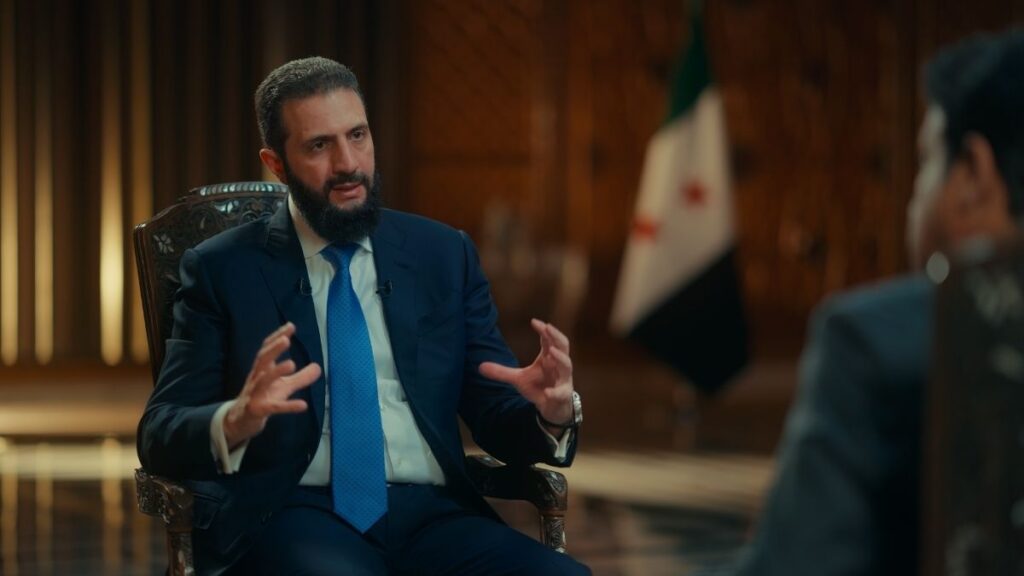

Syrian President Ahmed al-Sharaa said Syria is working to reach a security agreement with Israel with the involvement of several countries, adding that the success of this process could pave the way for comprehensive peace. He stressed that Syria would not relinquish its right to the occupied Golan Heights.
Al-Sharaa made the remarks in excerpts from an interview published by Al Jazeera. He discussed foreign policy and regional relations, developments in Lebanon, the agreement with the Syrian Democratic Forces (SDF), sanctions imposed on Syria, and the issue of missing persons.
Security Agreement With Israel
Al-Sharaa said Damascus is currently working to reach a security agreement with Israel with the involvement of several countries, expressing hope that it would lead to a new period of stability in the region.
He added that a successful security agreement could serve as a gateway to comprehensive peace, stressing that it would not come at the expense of Syrian rights or mean abandoning Syria’s claim to the occupied Golan Heights.
The Syrian president said his government was seeking to avoid confrontation with Israel. He added that Damascus saw no benefit in entering a military confrontation and that its priority was to spare Syria and the region further tensions while addressing security issues through political and diplomatic channels.
The remarks came amid continuing regional and international contacts concerning the situation in Syria, as the region has witnessed increased political and security activity in recent months.
UN Secretary-General António Guterres was also visiting Damascus at the time, amid statements affirming Syria’s right to the occupied Golan Heights and rejecting violations in southern Syria.
Damascus Rules Out Military Intervention in Lebanon
On Lebanon, Al-Sharaa stressed that Syria did not intend to intervene militarily in the country. He said the Syrian government was monitoring developments there out of concern for the stability of both countries.
He said Damascus was discussing with the Lebanese government ways to help overcome the current crisis and steer Lebanon to safety. Any security or political instability in Lebanon would have direct repercussions for Syria because of the countries’ geographical proximity and their closely interconnected economic and social ties, he added.
Al-Sharaa said the Lebanese crisis could not be resolved through security measures alone, but required a comprehensive approach addressing its political, economic, and institutional causes.
He also declared Damascus’ support for ensuring that arms and decisions on war and peace remain exclusively under Lebanese state authority. Strengthening state institutions was a fundamental condition for achieving stability, he said, amid concerns that the war could expand and have broader regional repercussions.
Slow Implementation of SDF Agreement
On domestic affairs, the Syrian president acknowledged delays in implementing the agreement reached between the Syrian government and the SDF on January 29, 2026. However, he said the government was still seeking to ensure the agreement’s success and complete the implementation of its provisions.
Al-Sharaa said Damascus continued to view the agreement as the appropriate framework for addressing outstanding issues.
The Syrian government and the SDF reached an agreement providing for the integration of civilian and military institutions in northeastern Syria into state institutions. Implementation has slowed in recent months, while consultations between the two sides over implementation mechanisms have continued.
Sanctions and Missing Persons
Al-Sharaa also addressed the economic sanctions imposed on Syria, saying that lifting them would not have their full effect unless Syria was removed from the list of state sponsors of terrorism.
He said Syria’s removal from the list was a necessary step to support the recovery of the Syrian economy, create suitable conditions for investment, and facilitate the country’s reintegration into the global economy.
On missing persons, Al-Sharaa said the authorities had formed a special committee to manage the issue in accordance with international standards and in cooperation with countries with relevant expertise. He added that the committee would continue working on the issue in line with international standards.
Al-Sharaa also said relations between Syria and Iraq were steadily improving.
Al-Sharaa’s remarks came amid rapid regional developments involving several political and security tracks. Regional and international efforts are continuing to reduce tensions, address Syria’s relations with neighboring countries, implement the agreement with the SDF, and tackle humanitarian issues, foremost among them the issue of missing persons. The Syrian government is also seeking to remove the political and economic restrictions imposed on the country.