


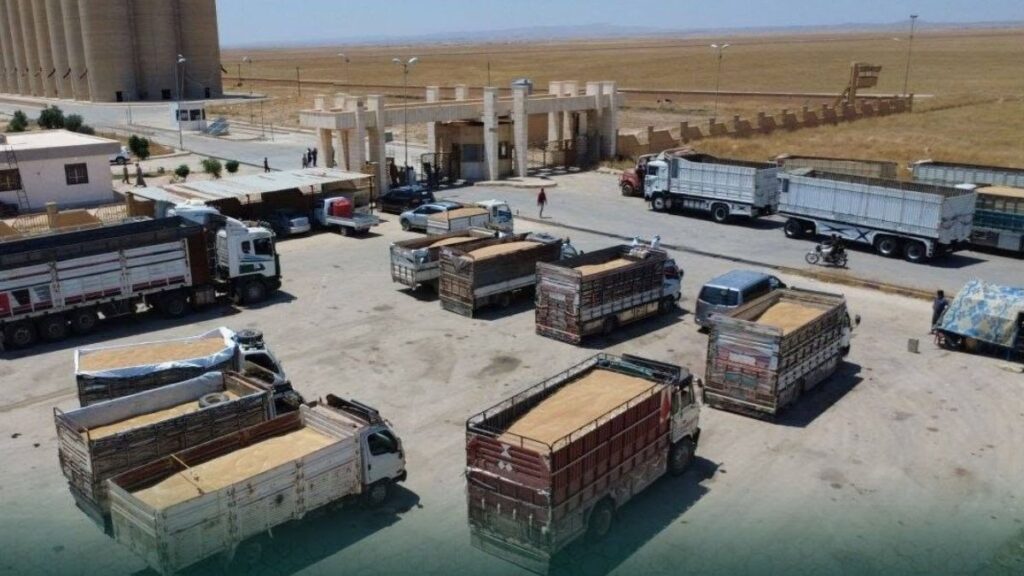
 Wheat deliveries continue at collection centers in al-Hasakah, June 14, 2026. (Syrian Grain Establishment)
Wheat deliveries continue at collection centers in al-Hasakah, June 14, 2026. (Syrian Grain Establishment)


 A
A
A
A
A
A
Al-Hasakah governorate (northeastern Syria) has completed the harvest of winter crops for the 2025-2026 agricultural season, recording one of its highest production levels in recent years. Abundant rainfall increased wheat and barley yields, reduced farmers’ need for irrigation, and raised expectations that marketed wheat will exceed one million tons.
Ezz al-Din al-Hassou, deputy director of agriculture and agrarian reform in al-Hasakah, said the harvest of winter crops for the current season had ended with good production indicators compared with previous years. Wheat deliveries to collection centers across the governorate are continuing.
Al-Hassou told Enab Baladi that the amount of wheat marketed through collection centers had exceeded 863,000 tons as of July 12. Marketing operations remain underway, and the total marketed production is expected to reach at least one million tons by the end of the season.
He said the harvestable area this season included approximately 373,500 hectares planted with wheat, 289,000 hectares of barley, and around 24,000 hectares planted with different varieties of lentils, reflecting the large area devoted to winter crops in the governorate.
He added that collection centers continue to receive wheat in both bagged and bulk form. Marketing procedures have become smoother after authorities resolved problems some farmers faced at the beginning of the season when using the electronic platform established to organize deliveries.
Al-Hassou said the difficulties related to electronic registration had ended and that crop deliveries were now proceeding smoothly, helping accelerate collection and reduce congestion at the centers.
He added that crop deliveries would continue until the end of August, or until the last quantities registered on the platform had been received, to ensure that all production designated for sale could be marketed.
Regarding certificates of origin, the deputy agriculture director said their issuance had stopped following the end of the harvest season, in accordance with a circular from the Agriculture Directorate. Marketing remains open to farmers who had previously obtained appointments through the electronic platform.
In the same context, al-Hasakah’s director of agriculture and agrarian reform, engineer Hayel Ahmad Khleif, issued a circular suspending certificates of origin after the end of the 2026 wheat harvest. Farmers who were unable to obtain certificates during the season are exempt from the suspension, but the documents will be issued exclusively through the Agriculture Directorate.
The decision coincides with the season entering its final marketing stage. Collection centers will continue receiving crops registered on the electronic platform through the end of August, allowing the remaining quantities held by farmers to be delivered.
Farmers described the current season as a turning point compared with previous years, when drought and declining rainfall affected production. The abundant rain recorded across the governorate last winter improved crop growth and reduced production costs.
Farmer Abdullah al-Muhaimed, from the Tell Brak subdistrict northeast of al-Hasakah city, said winter rainfall was the most important factor behind the season’s success. Most rain-fed farmland produced good yields without requiring large quantities of irrigation water.
He told Enab Baladi that farmers relied mainly on rainfall this year, significantly reducing the number of hours that water pumps had to operate and lowering fuel consumption. This directly reduced cultivation costs.
Al-Muhaimid said the plentiful rainfall also helped wheat and barley heads fill out more fully, increasing average production in many fields compared with previous years marked by repeated droughts.
He said the current season had restored hope to many farmers who suffered losses in previous years because of high irrigation costs and weak production. Favorable weather conditions this year played the largest role in compensating for part of those losses, he added.
Farmer Mohammad al-Mukhalaf, from the al-Arisha subdistrict south of al-Hasakah city, said regular rainfall from the beginning of the agricultural season through the spring reduced the need for supplementary irrigation, particularly on land that usually depends on wells.
He told Enab Baladi that many farmers had to operate water pumps only in limited cases. This saved substantial sums previously spent on fuel and the maintenance of wells and agricultural equipment.
Al-Mukhalaf added that improved soil moisture throughout the season helped crops grow naturally and enhanced both grain quality and production quantities. Most farmers in the area regard the current season as one of the best in recent years, he said.
He said the continuation of marketing operations after the harvest gives farmers the opportunity to deliver their entire production without rushing. He called for maintaining the current pace of collection to ensure the season ends without delays.
Al-Hasakah is Syria’s largest producer of wheat and barley and is regarded as the country’s main breadbasket. Large areas of its farmland depend on rainfall, making precipitation levels a decisive factor in determining seasonal productivity.
In recent years, the governorate’s agricultural sector has faced accumulating challenges, most notably drought, declining water levels, and rising prices for fuel and agricultural inputs. These conditions reduced production during some seasons and increased reliance on irrigation across large areas.
The current season, however, brought a noticeable improvement in weather conditions, with good rainfall recorded during the winter. This supported the growth of winter crops, reduced the need for irrigation, and improved the productivity of rain-fed farmland, which had been particularly affected by drought in previous years.
As marketed wheat approaches one million tons, collection centers continue receiving crops from farmers. The electronic platform will remain in operation to organize deliveries through the end of August and complete the marketing of the season’s production.
Farmers hope the success of the current season will mark the beginning of more stable agricultural production in the governorate, provided favorable weather continues, production inputs remain available, and marketing operations proceed smoothly. These factors would strengthen al-Hasakah’s position as Syria’s main source of grain.
if you think the article contain wrong information or you have additional details Send Correction




 More Economic Reports