
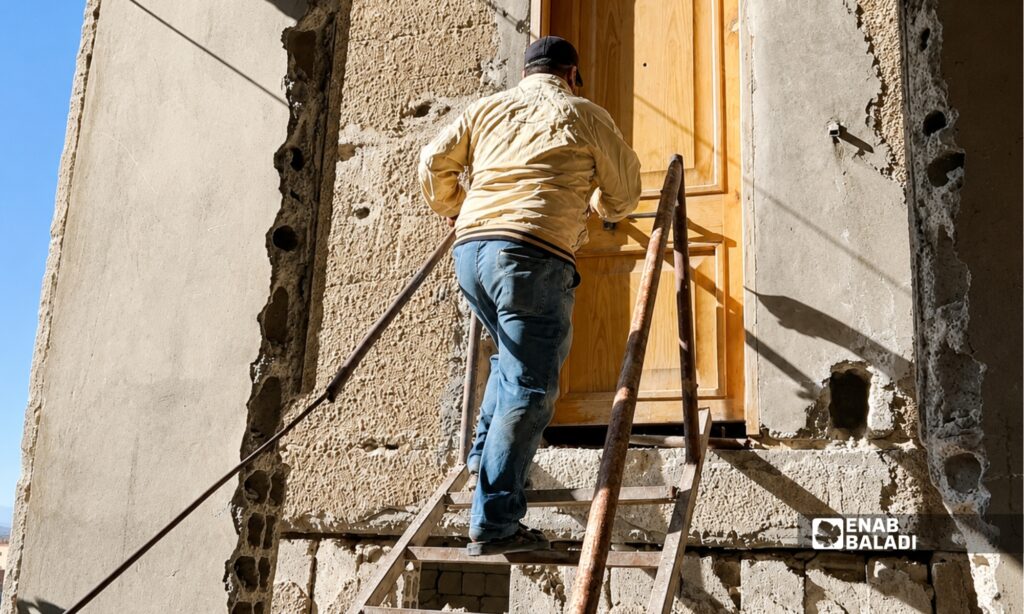

Only a few meters separate Mahmoud Yahya from his apartment in Darayya, in Rural Damascus Governorate, southwestern Syria, but reaching it requires passing through several buildings, climbing onto rooftops, and crossing iron bridges and suspended stairways before he can finally enter his home.
Behind Osama bin Zaid Mosque in Darayya, Mahmoud stands in front of a five-story building where his family owns several apartments.
From the inside, the apartments appear habitable after restoration work he carried out over the past years, but the problem is not inside the apartments. It is how to reach them.
The building has lost its entrance and entire stairwell, leaving the apartments standing in place without a normal path leading to them.
Mahmoud Yahya told Enab Baladi, “We enter our homes like thieves, from one rooftop to another until we arrive.”

Risk Is Better Than Rent
Inside an apartment he recently restored on the fifth floor, Mahmoud points to the place and says, “We are now in my grandmother’s house.”
The walls have been replastered, the floors repaired, and the doors and windows reinstalled. The apartment looks as if it has overcome the years of war, but reaching it remains an unusual journey.
Mahmoud said the return to the building was not an easy decision. It came under the pressure of need, after the owners of the homes the family had been renting in Jdeidet Artouz, in Rural Damascus Governorate, began asking them to vacate.
He added, “Homeowners started wanting their houses back, and we have apartments here. We had no choice but to return, even if there are no stairs.”
Mahmoud’s grandmother owns the apartment he is preparing on the fifth floor, but reaching it first requires passing through the living room of another apartment owned by his uncle on the same floor.
Mahmoud, meanwhile, continues preparing his own apartment on the fourth floor in preparation for moving into it after years spent in a rented home.

Only Two Months Before Displacement
Before the revolution, the building was one of the new buildings in the neighborhood.
According to Mahmoud, family members had lived there for only two months when they were forced to leave Darayya in 2012 as military operations escalated.
He said the building was completely new when they left and had no structural damage or significant problems.
During the years of displacement, the building remained empty after it was looted and stripped of all its contents, like hundreds of other buildings in the city.
The Stairwell Remained Until 2018
Mahmoud managed to enter Darayya again in 2018 through the neighboring orchards of Sahnaya, in Rural Damascus Governorate, using a motorcycle to reach his neighborhood.
He said he filmed videos on his phone at the time, which he still keeps today, showing the building standing despite the apartments having been looted and stripped.
According to the clips he showed Enab Baladi, the entrance and stairwell were still there at the time, and the videos clearly show both.
He added that the clips were filmed before the period that saw widespread filming of television series in Darayya, and before the building later lost its entrance and stairs.
How Did the Stairs Disappear?
Mahmoud links the beginning of the problem to the period when Darayya hosted filming for the Syrian series Fawda (Chaos), directed by Najdat Anzour, which was produced in 2018 and addressed the consequences of the war in Syria through the stories of displaced people and residents living in neighborhoods damaged by the conflict.
He said the neighborhood where the building is located was chosen as a filming location for a number of scenes in the series, and that the section containing the building’s stairwell was blown up during the execution of one scene.
The filming took place at a time when large parts of Darayya were still almost empty of residents, after years of forced displacement and destruction that hit the city during the siege and military operations.
The production team used a number of damaged neighborhoods and buildings in Darayya as filming locations for scenes simulating the battles and destruction that various Syrian areas witnessed during the war, making use of the urban landscape left behind by years of shelling and clashes.
According to Mahmoud, the impact of filming was not limited to the scene in which the stairwell was blown up. The remaining parts of it were later removed, before quantities of iron disappeared from the site during the following years.
This period overlapped with a time when media and human rights reports documented wide-scale operations to extract iron, scrap, and building materials from destroyed areas in Rural Damascus Governorate, including Darayya, while residents’ return to the city was still limited.
Local and international journalistic investigations also addressed economic networks linked to the trade in metals extracted from rubble, with some reports linking these activities to influential figures in the former Syrian regime, including networks that investigative reports said were connected to businessman Mohammad Hamsho.
Mahmoud said all of this took place before large numbers of residents returned to the city, leaving many buildings vulnerable to dismantling or the removal of parts of them in the absence of their owners.

The Home Exists, but the Entrance Is Missing
Today, most of the family’s apartments in the building still stand. Some have been restored and are ready for habitation, while others need additional work.
But the main problem, Mahmoud said, is not the apartments themselves, but reaching them.
At first, he tried to find a solution through the neighboring building.
He opened a passage connecting the two buildings and installed iron stairs and walkways that allowed the family to enter its apartments through the neighbors’ building.
This solution worked for a while, but it caused repeated problems with some neighbors because of daily passage through the building and the entry of workers and the movement of furniture and building materials through entrances that do not belong to the family.
As objections and complaints increased, Mahmoud was forced to search for an alternative route.
A Long Road to the Front Door
Reaching the apartment today has become more complicated than before.
Instead of entering directly through the neighboring building, Mahmoud begins his journey from another nearby building, climbing its stairs to the roof, then crossing an iron bridge to the roof of his own building.
From there, he moves across another iron bridge to the roof of the neighboring building he had previously used, before descending through the rooftop stairway to the fourth floor.
From the fourth floor, he crosses an iron passage that leads directly into the living room of his apartment in the original building, entering the home through the sitting room instead of the entrance that disappeared years ago.
The journey into the home has thus turned into a route that passes over several rooftops and metal walkways before reaching the apartment door.
Fragile Bridges and Passages
To reach the apartments, the family installed a set of iron stairs and bridges connecting the surrounding buildings.
For the grandmother’s and uncle’s apartment on the fifth floor, the family designated a separate iron stairway, while also installing an additional staircase leading to the building’s roof, where water tanks require regular monitoring and maintenance.
According to Enab Baladi’s inspection of the site, the bridges installed by the family appear temporary and unprepared for permanent use. They are fixed with simple means between buildings and at a height between the fourth and fifth floors, increasing the danger of using them daily.
Mahmoud said these bridges and stairways were not built according to a studied plan. They came as a result of successive attempts to find any route allowing the family to enter its homes.
Workers are currently using these passages to move building materials, furniture, and other items needed for ongoing restoration work inside the apartments.
He added that one worker nearly fell while moving some materials because of an opening in the stairway of the neighboring building, showing the scale of the risks involved in using these temporary routes.


Complaint to the Municipality
The problems did not stop at the absence of the stairwell and the difficulty of reaching the apartments.
According to Mahmoud, the use of neighboring buildings to reach his building prompted objections from some neighbors, who filed a complaint with the Darayya City Council.
He said the municipality requested an engineering inspection of the building to verify its safety, and the inspection found a problem in one of the retaining walls that needed reinforcement and treatment.
He added that he is currently working to repair the wall at his own expense, alongside finishing and restoration work inside the apartments.
Over the past years, Mahmoud tried to find a way to rebuild the stairwell and entrance, and contacted a number of contractors and people with construction experience.
He said high costs were the main obstacle to carrying out the project, noting that some offers he received included taking shares in the property in exchange for the work, while others saw the project as economically unviable.
Because of this, he was forced to rely on temporary iron bridges and stairways to reach his family’s apartments, while waiting to find a solution that would allow the entrance to be rebuilt properly.
A Simple Right
At the end of his tour with Enab Baladi, Mahmoud stands near the empty space that once contained the stairwell.
For him, the question today is no longer who destroyed the stairwell or who removed its iron, but how his family can reach its homes normally, and how he can enter his apartment through its door, not from the neighbors’ rooftops.