
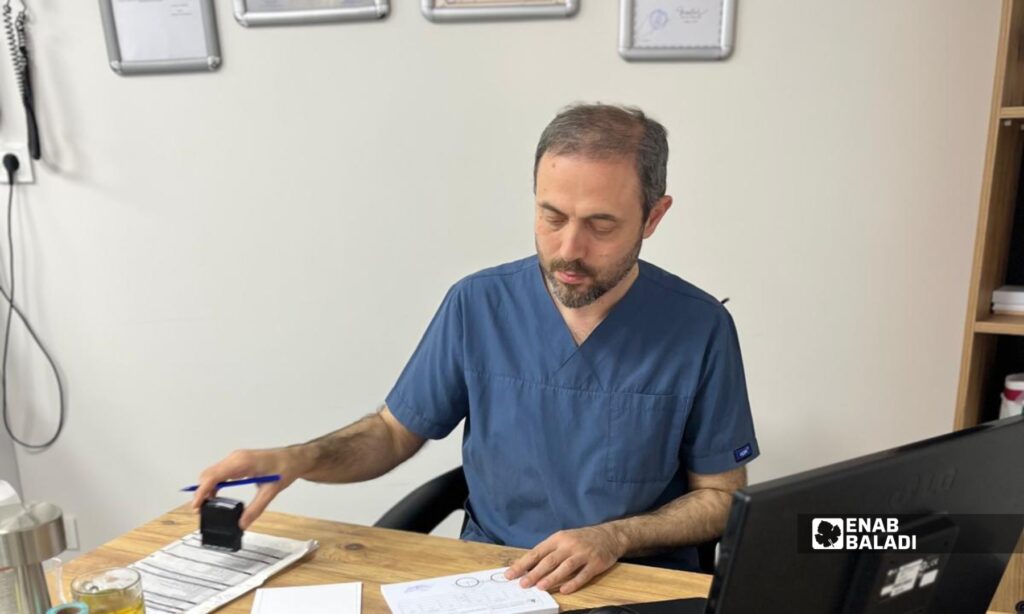

Suleiman Shihadeh was 10 years old when he had his first work experience, at the clinic of Dr. Ihsan al-Hussein in Darayya (Damascus countryside).
The child sat at the clinic entrance, receiving patients and organizing their turns, at a time when the general practitioner was the main destination for residents with most illnesses, before specialist clinics became widespread in the city.
Suleiman later moved between a pharmacy, a photography studio, and workshops for carpentry, construction, plumbing, and electrical work.
In 1994, he entered the Faculty of Medicine at Damascus University, then specialized in ophthalmology and opened his clinic in Darayya in 2003, becoming one of the doctors who witnessed the expansion of specialist medical services in the city in the late 1990s and early 2000s.
In interviews conducted by Enab Baladi, ophthalmologist Suleiman Khaled Shihadeh, born in 1977, recalls his upbringing, education, early work experiences, activity at Anas bin Malik Mosque, two periods of detention, and what remains in his memory of Darayya’s orchards, schools, doctors, and the transformations the city experienced.
Before University
Suleiman Shihadeh grew up in Darayya at a time when family life, relatives, neighbors, friendships, schooling, and work largely revolved around the city itself.
During his childhood, his connection to Damascus rarely extended beyond visiting his maternal grandfather’s home in the al-Midan neighborhood once or twice a month.
He says Darayya provided residents with a large share of their daily needs, and a child could be born there, study there, build social relationships, and pursue activities without regularly needing to leave the city before reaching university age.
In his estimation, the proportion of government employees and army volunteers was limited compared with some other areas, while most residents depended on agriculture, independent trades, and work carried out inside the town.
Part of his memory of that period is tied to the home of his father, teacher Khaled Shihadeh, particularly its eastern entrance and garden, from which the minaret of Anas bin Malik Mosque could be seen before neighboring houses were transformed into multistory buildings.

Entrance to Dr. Suleiman Shihadeh’s family home in Darayya in the 1990s, Enab Baladi, Suleiman Shihadeh Archive.
Orchards Surrounding the City
Darayya’s orchards remain present in Suleiman Shihadeh’s memory as part of the city’s everyday landscape during the 1980s, when agricultural land surrounded it from different directions.
He remembers the orchards of the areas known as “Mashreq” and “Maghreb,” grape arbors, and walnut, mulberry, fig, and green plum trees, alongside fields of vegetables, broad beans, wheat, and corn.
Small rivers and channels ran between the agricultural lands to supply irrigation water, and he says he drank from that water as a child and remembers it as clear and fresh.
After school, during summer holidays and on Fridays, children headed to the orchards, while some boys spent their time in the vineyards looking for green plums and other fruit.
Among the recreational places that remained in his memory was “al-Masna,” a concrete basin used to store water and irrigate farmland, where children went swimming before modern swimming pools became common in Darayya.
Agriculture was still a central pillar of the city’s economy, but Suleiman witnessed the beginning of its decline as successive years of drought, rising irrigation costs, increased dependence on pumps and fuel, and falling returns from farming made working the land less economically viable.
A Conservative Society and Direct Relationships
Suleiman Shihadeh describes Darayya society during the 1980s and 1990s as conservative in its general customs, including among people who were not visibly religiously observant.
Respect for religious values and social norms prevailed across segments of the local community. He remembers that the few people who did not fast during Ramadan felt embarrassed to show that publicly.
Relationships, according to Shihadeh, were also marked by considerable directness in expressing both affection and disagreement. He remembers some school classmates openly telling him that they did not like him because he outperformed them academically or because teachers paid attention to him.
The environment was not free of negative behavior, and he speaks of forms of bullying among children, some of which targeted newcomers from Damascus or displaced people arriving from other areas.
From Agriculture to Tailoring and Carpentry
As agriculture gradually declined, many Darayya residents sought other sources of income.
During the 1980s, tailoring workshops spread throughout the city. In the 1990s, carpentry and furniture manufacturing became among its most common trades, alongside the expansion of shops and independent professions.
Darayya also experienced extensive construction activity in both formally planned areas and informal housing districts, and large numbers of young people entered trades connected to construction, finishing work, plumbing, and electrical installation.
Suleiman Shihadeh believes the city’s reliance on self-employment gave it a different economic character from areas where government jobs or volunteering in the army were more prominent.
Education Within the Family
Education held a central place in Suleiman’s life from childhood, as his father was a teacher and educational inspector, which was reflected in the family’s early attention to his studies.
He learned to read and write at home and entered school at the age of six. He remembers sometimes answering questions a teacher directed at students in higher grades.
Education in Darayya during the 1980s and 1990s, however, was not stable in terms of teaching staff. Schools suffered shortages of teachers because of low salaries, deteriorating economic conditions, and transportation difficulties, and some subjects went for weeks or months without a teacher.
University students or recent graduates sometimes taught classes to fill the gaps instead of more experienced teachers.
Shihadeh remembers that the number of secondary school students was limited relative to Darayya’s population, and that in 1994, when he received his high school certificate, the city had only one science-track class for male students.
Teachers Remembered
Despite his criticism of the educational conditions, Suleiman Shihadeh remains grateful to a number of teachers who contributed to his academic development.
He particularly mentions Abdul Azim al-Masri, an Arabic-language teacher whom he saw as a model educator combining attention to knowledge with personal development.
He also remembers teacher Malak Izmashli, who encouraged him to read and explore and gave him books, including *Entertaining Physics*, which remained in his memory because of its influence on his interest in science and way of thinking.
He also names several teachers associated with his school years, including Abdul Hakim Baqla, Abdullah al-Adawi, Abdul Qader al-Abbar, Fathi al-Anzi, and Jawdat Ziyada.
To Ibn Khaldoun School
Because of the shortage of teachers in Darayya, Suleiman transferred to Ibn Khaldoun School in Damascus, where he encountered for the first time a clear difference between the level of education and academic organization in the capital’s schools and what was available in Darayya.
At the school, he found teachers experienced in teaching scientific subjects and preparing students for examinations, while some subjects in Darayya went untaught for long periods or were taught by people with little experience.
He says the number of students from Darayya who entered medical school in his year was limited, and he remembers only Ghassan Yahya and Marzouq Mdawar entering the faculty with him.
Marzouq Mdawar was about a year older than him and retook the high school examination to raise his score and qualify for admission to medical school.
Ghassan Yahya, meanwhile, was, according to Shihadeh, the only one among them who completed his entire schooling in Darayya and, despite teacher shortages and difficult educational conditions, achieved the score required to enter medical school, something Shihadeh considers an important accomplishment at the time.
Working at Age 10
Suleiman’s upbringing was not limited to education. His mother encouraged him to work and acquire practical skills from an early age.
He began at the age of 10 in Dr. Ihsan al-Hussein’s clinic, where he received patients and organized their turns.
He later worked at Ali al-Ahmar’s pharmacy near al-Abbas Mosque, then moved to the Petra photography studio, and later worked in carpentry, construction, plumbing, and electrical workshops.
His moves between the clinic, pharmacy, studio, and workshops generally took place during summer holidays.
Suleiman Shihadeh believes these experiences introduced him to people’s professions and circumstances and gave him practical knowledge of society alongside what he learned at school.
From Memorizing the Quran to Managing Study Circles
Suleiman’s relationship with Anas bin Malik Mosque began years before university.
After the institute attached to the mosque was licensed in the late 1980s, he began attending it to memorize the Quran around 1989.
Several teachers at the mosque listened to and checked his recitation, including Sheikh Abdul Akram al-Saqqa, Abu Mahmoud Shamshan, Abu Ahmad al-Zarda, Abdullah al-Adawi, Abu Iyad al-Basrak, and Bashir Shuaib.
He also attended lessons with teachers and sheikhs in other mosques, including Sheikh Fayyad Wahbi, Shams al-Din Khawlani, and Mahmoud Khawlani.
During middle and secondary school, he moved from receiving lessons to listening to younger children recite the Quran as a study-circle instructor.
When he entered medical school in 1994, his role at the institute expanded, and he participated in the administrative and educational management of the study circles alongside Abdul Akram al-Saqqa, who represented the institute’s religious and educational leadership.
Shihadeh does not remember that period only as religious education, but also as a stage of intellectual and social debate inside the mosque and around it.
He says the institute’s young people tried to present more than one interpretation of Quranic texts and encourage students to think and derive meanings, while several sheikhs preferred adherence to a single interpretation and direct instruction out of concern that students might make mistakes.
The disagreement extended to jurisprudential and social questions, including moving between different Islamic schools of jurisprudence rather than limiting teaching to the Shafi’i school dominant in the city, as well as issues concerning women’s role in mosque activities, coordination between the administrations of boys’ and girls’ study circles, and female teachers entering the mosque and teaching there while menstruating.
Suleiman Shihadeh says some opponents of this approach accused those running the institute of distorting religion, and in some cases threatened to appeal to the security services to stop the activity.
Al-Ghazali, al-Qaradawi, and Jawdat Said
These debates were linked to Shihadeh’s reading during that period.
He says he was influenced by the books of sheikhs Yusuf al-Qaradawi and Muhammad al-Ghazali because they addressed social and political issues alongside traditional religious questions.
In the late 1990s, he met Sheikh Jawdat Said in Darayya and also visited him in his village of Beer Ajam (Quneitra, southwestern Syria), where he learned about his ideas on nonviolence.
Suleiman Shihadeh believes, for example, that the conclusion reached by Muhammad Said Ramadan al-Bouti in his book *Jihad in Islam* converges in its outcome with Jawdat Said’s advocacy of nonviolence and his view that the use of force requires the existence of a state and the fulfillment of specific conditions, despite differences in method and starting point.
He says his later experience made him more convinced that intellectual change requires gradualism and consideration of the surrounding social environment, and that the expansion of media and greater openness to the world gradually helped reduce the intensity of many disputes that had generated wide controversy in Darayya during the 1990s.

A corner of the garden at Khaled Shihadeh’s home in Darayya, with the minaret of Anas bin Malik Mosque visible before neighboring houses were replaced by multistory buildings, Enab Baladi, Suleiman Shihadeh Archive.
Between Religious Activity and Security Surveillance
The debates inside mosques were not separate from the security services’ surveillance of religious and social activity.
Shihadeh remembers that the authorities restricted celebrations of the Prophet Muhammad’s birthday because such events created space for guidance and awareness, before changing their approach toward them around the beginning of the 2000s.
He says the authorities then moved toward containing such occasions and encouraging their public manifestations, including decorating markets and holding official celebrations, rather than relying solely on direct restrictions.
He also recalls an attempt by several young people from the Anas bin Malik Mosque institute in the late 1990s to visit sheikhs in Darayya and Moadamiya (Rif Dimashq) and propose unifying the Friday sermon, as well as contacting the Ministry of Information about the content of certain television dramas broadcast on state television.
The sheikhs refused to act, according to Shihadeh, out of fear of a reaction from the security services, at a time when the older generation among them had greater knowledge of what had happened during the 1980s and of the limits on what could be said or done publicly.
Choosing Medicine
During school, Suleiman was inclined toward history, Arabic, and the humanities, but he chose to study medicine after receiving his high school certificate.
He says medicine was then one of the paths aspired to by middle-class families because it offered social standing and better opportunities for employment and stability, while prospects for professional advancement in many humanities fields appeared limited.
He entered the Faculty of Medicine at Damascus University in 1994, graduated in 2000, and then continued his specialization in ophthalmology at al-Mouwasat Hospital until 2004.
During his studies, he did not stop working, but shifted toward jobs related to medical education, including transcribing and translating lectures, then translating parts of students’ theses and scientific research.
The work provided him with additional income and helped him develop his language skills and knowledge of scientific and medical terminology.
Political Questions at University
His university years were not separate from his social and religious activity or from surveillance by the security services.
Suleiman Shihadeh remembers being summoned and questioned more than once because he refused to join the Baath Party.
During one incident in a lecture hall at Damascus University, everyone present stood and applauded enthusiastically when Hafez al-Assad’s name was mentioned, as was customary, while Suleiman remained seated alone and refused to stand or clap.
He says the incident frightened those around him.
Around the time of his graduation in 2000, as Bashar al-Assad assumed power, Shihadeh believes his sometimes indirect and sometimes explicit criticism of corruption contributed to keeping his name under security surveillance.
Activism Ends in Arrests
In 2003, the activity associated with Abdul Akram al-Saqqa’s students became more public and organized.
The initiatives included distributing leaflets against bribery, organizing street-cleaning campaigns, and holding a protest march against the US invasion of Iraq.
Suleiman Shihadeh says the security services treated those activities as independent political action and a challenge to their authority, launching an arrest campaign that targeted 24 young men from Darayya, including him.
He was taken to the “Area Branch,” where he spent about a month and a half in detention.
In the branch’s basement, alongside harsh interrogation methods that he says he endured, some investigators told the detained young men: “This is how parties are formed and then become armed movements. We are arresting you now to put a stop to you.”
During questioning, Suleiman said his role had been limited to listening to Quran recitations and administrative work at the institute, and that his hospital work and medical shifts had left him no time for political activity. He was released with the first group following local interventions and mediation.
Another group of detainees, including his brother Mohammad Shihadeh, Yahya al-Shurbaji, Motaz Murad, and Haytham al-Hamwi, were transferred to the “Palestine Branch.”
Suleiman says they refused to ask for “pardon and mercy” and instead demanded “justice.” They remained detained for about two and a half years and were also stripped of their civil rights.
The campaign was followed by other measures affecting activity around the institute, including the closure of Abdul Akram al-Saqqa’s publishing house, the withdrawal of his license to run the Anas bin Malik Mosque institute, and a ban on his delivering sermons.
The group’s activities during the following years were reduced to limited meetings and personal visits.
Translating an Ophthalmology Reference
During his years of study and medical work, Suleiman Shihadeh completed a translation of the well-known ophthalmology reference commonly known as “Kanski.”
He says the work took about a year of daily effort and staying awake until the early hours of the morning, and that he completed the translation alone, even though medical projects of that size are usually handled by teams of doctors, translators, and reviewers.
Shihadeh connects the project to his desire to establish his academic standing, particularly after his plan to pursue postgraduate academic studies faltered, something he attributes to favoritism governing some academic opportunities.
According to Shihadeh, the World Health Organization sent him a letter of thanks and invited him to its regional office in Damascus to honor him for the translation.
He also says specialists in Turkey later expressed admiration for the work, given the book’s size and the fact that it had been completed by a single person.

Kanski’s Clinical Ophthalmology, translated by Dr. Suleiman Shihadeh, Enab Baladi, Suleiman Shihadeh Archive
Medical Care in Darayya Before Specialist Clinics
When Suleiman was a child, Darayya’s medical landscape was limited in terms of the number of doctors and specialties.
He recalls Dr. Ihsan al-Hussein as the most prominent medical reference for most city residents during the 1980s and early 1990s.
Residents sought him out for children’s illnesses, internal medicine conditions, and general health problems. His long experience, residents’ trust in him, modest manner, and low fees helped make his clinic a primary destination for patients.
It was in that clinic that Suleiman had his first work experience, organizing patients’ turns and watching how the doctor dealt with different cases.
Alongside Ihsan al-Hussein, he remembers several doctors who were present in the city during that period, including Omar al-Namous, Zuhair Yahya, who worked at the dispensary or health center, pediatrician Rana Khanji, and dentist Abdul Ghani al-Sheikh Fadli.
Health services depended heavily on general practitioners because of the limited number of specialists.
When residents needed a specialty unavailable in Darayya, some traveled to Damascus and visited doctors who had gained wide reputations, including Edwar Hawaweeni in pediatrics, Rida Said, Faisal Fahham, and ophthalmologist Akram al-Anbari.
Spread of Specialist Clinics
By the late 1990s and early 2000s, specialist clinics gradually began spreading in Darayya, as specialized doctors opened practices inside the city after patients had previously been forced to travel to Damascus for many medical services.
Suleiman Shihadeh remembers several doctors who worked in the city at different stages of this transformation,including Zuhair Yahya, Mahmoud Ziyada, Abdul Sattar al-Qasim, Rana al-Khanji, Hanaa Karkaji, Akram khoulani, Hossam Jammous, Elias Shihadeh, Imad Abdul Baqi, Zuhair Uday, Ibrahim al-Asimi, Nour al-Din Bayraqdar, Jihad Abidin, Mamoun al-Abbar, and Mohammad Khair al-Abbar.
He also mentions the brothers Salim Assad, Mamoun Assad, and Mohammad Assad.
The city was also home to married couples in which both spouses were doctors, including Taysir Khawlani and his wife, Raghda al-Noufi; Akram Ziyada and his wife, Basima Darwish; Omar Nakkash and his wife, Basma Jamal al-Din; and Mohammad al-Hu and his wife, Batoul Nasser.
As the number of specialties expanded, patients gradually changed how they approached medical services, moving from consulting a general practitioner for different conditions to seeking a specialist according to the nature of the illness.
In 2003, Suleiman Shihadeh opened his private ophthalmology clinic in Darayya while still in the final stage of his specialization, which he completed in 2004.
He thus became part of a generation of doctors who brought specialist services into the city as its population grew and the number of university graduates and medical professionals increased.

medical examination prescription from Dr. Suleiman Shihadeh’s clinic in Darayya in 2010, Enab Baladi, Suleiman Shihadeh Archive.
The Language of Patients
Shihadeh’s memories of the clinic were not limited to medical cases. They also included the everyday language patients used to describe their symptoms.
The phrase “my eye hurts” did not always mean that the patient was experiencing physical pain in the eye. Some patients used it to describe poor eyesight or blurred vision.
Doctors’ use of the word “deviation” caused confusion among some residents because of a mix-up between strabismus, meaning that the eyes are not aligned and do not point in the same direction, and astigmatism, a defect in the way light is refracted inside the eye.
The word for strabismus was also sometimes used in jokes or social taunts, so some patients were sensitive to it or confused it with other diagnoses.
The dialects of people arriving from other Syrian governorates also left their mark on the language of the clinic. Some patients from Deir Ezzor and eastern Syria who worked in Darayya used the word “jawwa” to indicate the downward direction during an eye examination.
Shihadeh remembers receiving a late-night call from an Iraqi patient who asked, “Doctor, can I bathe?”
At first, he thought the patient was asking whether he could go to a swimming pool, before realizing that in Iraqi dialect the word meant taking a shower at home.
Between Staying and Leaving
After completing his specialization in ophthalmology, professional opportunities outside Syria began opening to Suleiman Shihadeh.
He says he received offers to work in Gulf countries for salaries higher than he could earn inside Syria, at a time when he had already opened his clinic in Darayya and begun building professional relationships with his patients.
For him, the decision was not based only on the difference in income. He had settled with his family in Darayya, his clinic was expanding, and remaining close to his relatives and social surroundings remained a central factor in his decision. He therefore chose to stay in Darayya and continue working in the city.
Military Service After Marriage
That stability did not last long, as Suleiman was called to compulsory military service in late 2006.
He was over 28 years old, married, and a father of two children, so military service represented a burden at a stage when he was seeking family and professional stability.
Shihadeh views that experience critically and believes it was part of a system that drained the time and energy of Syrian young people.
He says the service introduced him to the nature of the military institution and the mechanisms of authority at the time, as well as the extent to which conscripts’ lives were consumed for the benefit of officers and officials.
He refused to resort to bribery or mediation to avoid service or reduce its burdens, despite the prevalence of such methods among some conscripts.
Operations at the Military Hospital
Suleiman served as an ophthalmologist at a military hospital, where he had the opportunity to perform a large number of surgical operations.
He says he carried out dozens of operations, which helped develop his surgical skills and strengthen his professional confidence, as daily work exposed him to a wide range of cases.
During his service, he also met people from different Syrian governorates and social backgrounds, expanding his circle of relationships beyond Darayya and Damascus.
According to Shihadeh, the experience combined his objections to the nature of military service with the medical experience he gained through work at the hospital.

Suleiman Shihadeh performs a corneal transplant operation in 2009, Enab Baladi, Suleiman Shihadeh Archive.
The Revolution After Experience With the Security Services
When protests began in Syria in 2011, Shihadeh and his companions were not facing the security services for the first time.
He says the 2003 arrests made them more cautious during the first weeks, and they avoided taking leading roles so that their early participation would not give the authorities a pretext to link the popular protests to their previous activity.
He nevertheless participated personally in peaceful demonstrations, including the “Great Friday” protest.
Before the protests expanded, he and his brother Ahmad were beaten with sticks by men he describes as “shabiha” on al-Thawra Street, and Ahmad suffered a broken foot.
During 2011, a security force raided the building where he lived while searching for activist Majd Khawlani, but mistakenly arrived at Shihadeh’s home.
Shihadeh went out to meet them to avoid frightening his children. He says they left after discovering there was no warrant or security request against him, while a rumor then spread through Darayya for several days that he had been arrested again.
Late that same year, the authorities simultaneously raided five locations belonging to the family.
His brother Ahmad was arrested, while Suleiman was taken from his clinic and ordered to call his brother Mohammad, who was involved in media activity, and persuade him to turn himself in.
Suleiman was released after the officer learned that Ahmad was also being held, according to his account.
The Darayya Massacre
In August 2012, Shihadeh was inside Darayya during the military campaign in which the city witnessed a large-scale massacre.
He initially moved to his family’s home to escape mortar shelling, then joined the field hospital to help treat the wounded and remained there until the afternoon, before the hospital was evacuated as forces approached.
He then moved to his sister’s home in the southern quarter.
He says forces entered the house and questioned those inside, while taking away three displaced young men from the al-Qadam neighborhood in southern Damascus who were staying there, then summarily executing them near the house.
During another stage of the incursion, Suleiman and his wife remained trapped for five days in their home near the roundabout at the city entrance after forces used the building as a military position.
He says he watched from the windows as summary executions were carried out, shops were looted, and stolen goods were transported in ZiL trucks.
After five days, an officer allowed the couple to leave and told them to hurry before another military group arrived, warning them, according to Shihadeh’s account, that civilians could be killed.
The Second Arrest
When the prolonged battle for Darayya began in late 2012, Suleiman moved with his family to a rented home in Kafr Sousa (Damascus).
He says he continued providing whatever financial, medical, and emergency assistance he could to Darayya until his brother Ahmad was killed in 2013.
In 2015, the security services arrested him at his clinic in Kafr Sousa over accusations related to financing and communications and transferred him to the “Area Branch,” Branch 215.
There, he says an investigator offered to use Shihadeh’s name and reputation as a doctor to register real estate companies and properties in his name, making him the public front for financial activities, in exchange for his release from prison, money, and protection.
He says the alternative, if he refused, was transfer to Branch 227 and then Saidnaya Prison, accompanied by a threat of execution.
According to his account, Shihadeh pretended to agree to the offer to avoid being transferred. He was then referred first to the military judiciary and later to the civilian judiciary, before a decision was issued acquitting him because the charges had not been proven and canceling the outstanding warrants against him.
About a week after his release, officers called him to arrange a dinner meeting at the Sheraton Hotel in Damascus to begin preparations for the company.
The following morning, Shihadeh left Syria with his wife and children, heading to Lebanon.
He says his name later returned to wanted lists after the authorities discovered that he had left the country.
Four Years in Lebanon
Suleiman Shihadeh spent about four years in Lebanon, between 2015 and 2019.
Legal restrictions prevented him from practicing medicine normally, so his medical work was limited to relief and humanitarian activity within a restricted scope.
While there, he began preparing to move to Turkey and build a professional path he could continue if his time outside Syria became prolonged.
He later moved to Turkey, where he worked in medical institutions providing services to Syrians before beginning the process of obtaining recognition for his medical degree and specialization.
Between Istanbul and Damascus
Suleiman Shihadeh’s transition to practicing medicine in Turkey was not immediate.
He says recognition of his medical degree and ophthalmology specialization required obtaining official documents from Syria, and he faced difficulty securing them through Syrian consular authorities.
In late 2024, he was able to complete the required documentation and began the final stages of the recognition process for his degree and specialization.
The process required him to spend months working in Turkish public university hospitals under considerable pressure and in a language he had learned only after moving to the country.
At the end of the process, he obtained the medical license required to practice ophthalmology and eye surgery in Turkey, coinciding with the political changes Syria witnessed and the fall of the Assad regime at the end of 2024.
Shihadeh now practices ophthalmology in Istanbul, both at his private clinic and in private hospitals, receiving Arab, Turkish, and other international patients.
He also travels between Istanbul and Damascus after becoming able to visit Syria again, while continuing his medical work in Turkey.