


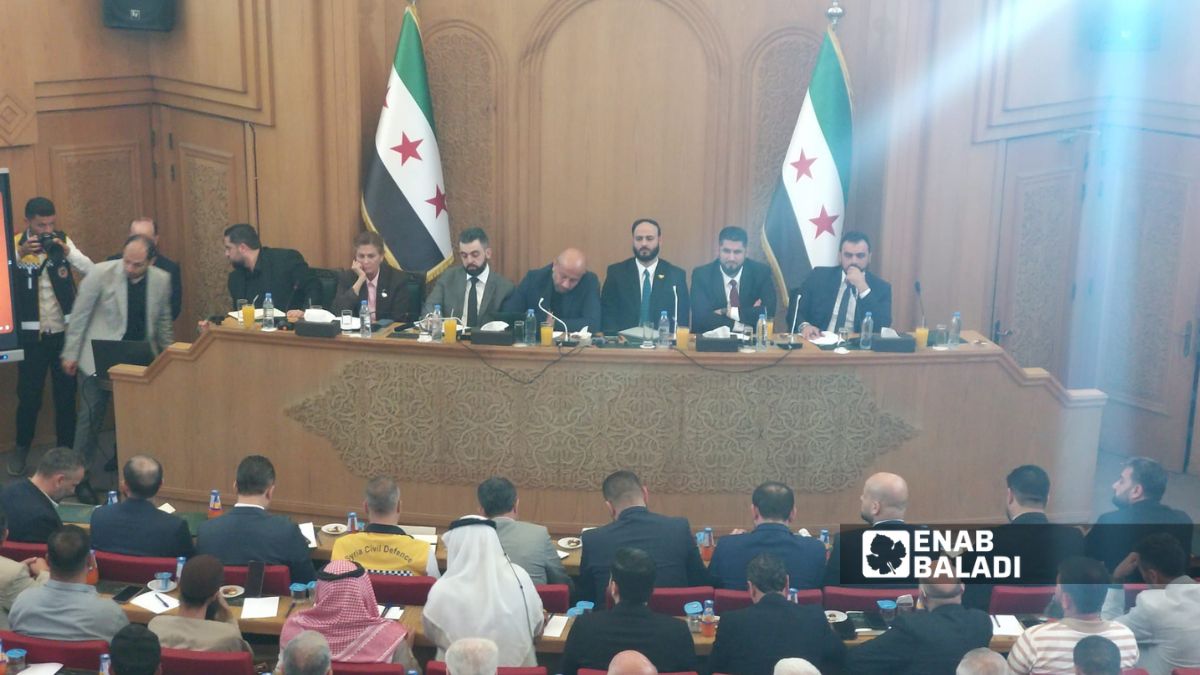
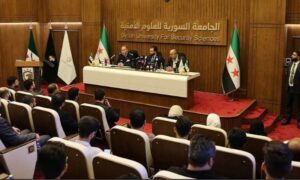
 A meeting at Aleppo Governorate to discuss conditions in Syria’s camps with official attendance, 18 June 2026. (Enab Baladi/Muwaffaq al-Khouja)
A meeting at Aleppo Governorate to discuss conditions in Syria’s camps with official attendance, 18 June 2026. (Enab Baladi/Muwaffaq al-Khouja)
Aleppo Governorate (northern Syria) held a meeting on Thursday, 18 June, with the committee formed by presidential decree to work on rehabilitating damaged areas, returning forcibly displaced people and IDPs, and ending the camps file.
The committee discussed its vision under the “Syria Without Camps” project, which is expected to begin by the end of the current year.
Minister of Emergency and Disaster Management Raed al-Saleh revealed during the meeting, attended by Enab Baladi, that work is underway on a project to repair 60,000 homes for camp residents, noting that the number could increase.
For his part, Aleppo Governor Azzam al-Gharib said the repair of 60,000 homes would be carried out according to those most in need, based on surveys of residents, area officials, and mukhtars.
Al-Saleh said the committee had identified a set of priorities, noting that launching them depends on the feasibility of the proposed plans. He said several projects had been approved, but they were awaiting disbursement.
He added that $1.8 billion had been allocated to implement these projects.
He explained that priority in reconstruction and repair would go to “martyrs’ households,” adding that coordination had been carried out with the Syrian Ministry of Defense on this file.
He added that families formed inside the camps, or those who did not own homes, could be granted rent allowances limited to several years.
Aleppo Governor al-Gharib promised that the government would cover transportation costs from the camps. He also said an “honor card” would be granted to residents who remained in tents, which could give them additional benefits.
Minister of Public Works and Housing Mustafa Abdul Razzaq explained that the committee’s work mechanism consists of addressing infrastructure and services first, then providing financial grants.
The committee’s criteria include counting the population in each gathering, the place of return, and the services available there, including roads, infrastructure, schools, and health centers.
After collecting the data, it became clear that 60% to 70% of the problems could be solved by repairing infrastructure and providing services, while the remaining share lies in home repairs.
Abdul Razzaq explained that home repairs are linked to limited capabilities, as revenues do not cover expenses, but the committee is trying to address this by obtaining loans from some parties and providing them under government supervision.
Minister Raed al-Saleh said 60% of camp residents had returned to their areas, noting that their return was linked to infrastructure rehabilitation operations. The weakest segment of displaced people remained, he said, because their homes were destroyed or because the number of families had doubled.
He added that the committee has an integrated map of the number of camps and the motives for return.
For her part, Minister of Social Affairs and Labor Hind Kabawat said the committee had surveyed camp residents, which showed that return is linked to three main factors: education, health, and work. She added that she wants a “dignified return” for residents that guarantees these factors are in place.
Aleppo Governor Azzam al-Gharib noted that the committee would hold a meeting with its presidency after surveying the opinions of the “people of determination,” referring to camp residents.
He said the committee has many problems, but also many solutions, adding that it chose the most difficult path because it is the “most beneficial for residents.”
He added that return is the first step, but it will be followed by many programs that benefit residents, away from what he called an “emotional response.”
For his part, Minister of Local Administration and Environment Mohammad Anjarani pointed to another problem facing the committee, related to integration processes in northern Syria, Hasakah and Raqqa (northeastern Syria), stressing that it would end soon.
Some camps have also turned into urban gatherings, and the Ministry of Local Administration is studying the possibility of organizing them and annexing them to the nearest administrative unit.
He noted that capabilities are being directed to serve needs, and that some humanitarian organizations will contribute to supporting the “Syria Without Camps” vision. He said the session gave the committee some indicators for implementing this vision, stressing that the direction is moving toward permanently reducing the number of camps.
Housing Minister Mustafa Abdul Razzaq said Syria needs 1.5 million housing units to meet Syrians’ population needs.
These needs are to be secured through several tracks, including encouraging the private sector to invest. Part of this relates to social housing, which the government must adopt, but the obstacle is the lack of funding. The other track is housing cooperatives.
The government must set policies to cover population growth, which the ministry is currently working to address, according to Abdul Razzaq.
Several speakers, including camp officials, complained about the withdrawal of associations and organizations and the suspension of support to them, including water, food, and other aid, during the period after the fall of the former Syrian regime.
For his part, Director of International Cooperation at the Ministry of Foreign Affairs Qutaiba Qadish explained that funding differs according to the policies of organizations and donor countries. At the same time, he stressed that this withdrawal is not final, and that other organizations could enter, emphasizing the need to compensate for projects that had been operating.
Minister of Social Affairs and Labor Hind Kabawat said the ministry now has the capacity to guide organizations toward establishing suitable projects for camp residents.
She stressed that there is no suspension of emergency services provided to camps, and that nothing prevents the provision of these services. However, she said the ministry is working to balance service delivery inside and outside camps.
The Aleppo governor pointed to the possibility of working on an emergency service program due to the shrinking role of organizations and municipalities’ inability to provide services, in parallel with the work of the “Syria Without Camps” vision.
Syrian President Ahmed al-Sharaa issued Decree No. 59 of 2026, which provides for forming a committee tasked with supervising the rehabilitation of infrastructure in areas destroyed by the war, as a prelude to the return of displaced people to their original areas.
Under Article 1 of the decree, issued on 8 March, the Minister of Emergency and Disaster Management chairs the committee. Its members include the ministers of finance, public works and housing, social affairs and labor, and local administration and environment.
The committee also includes the governorates of Aleppo, Hama, and Idlib, as well as the director of the International Cooperation Department at the Ministry of Foreign Affairs and Expatriates.
Article 2 of the decree defined the committee’s tasks along two main tracks. The first is to prepare basic infrastructure in destroyed areas, paving the way for residents to return and ensuring the requirements of a dignified life.
The second track includes taking all possible methods and means to improve the level of services for citizens living in areas of internal displacement, and providing the necessary support to ease the effects of displacement and humanitarian suffering.
Article 3 states that the committee meets periodically every 15 days, or whenever necessary, at the invitation of its chair. The committee may also seek assistance from experts and relevant bodies it deems appropriate to complete its tasks.
As part of performance monitoring, Article 4 states that the committee must submit monthly periodic reports to the presidency, including the results of its work and achievements on the ground.
Minister Raed al-Saleh said during today’s session in Aleppo that the “Syria Without Camps” vision had been discussed last year after the formation of the current government.
He considered the challenge of completing this vision by the end of the current year difficult, and said efforts must be doubled to end the state of camps.
Syrian decree forms committee to rehabilitate infrastructure in war-damaged areas
The head of the UN cooperation section within the International Cooperation Department at the Syrian Ministry of Foreign Affairs and Expatriates, Mohamad Bathish, had previously stated that Syria received Saudi support worth $1.5 billion, in a step to support the “Syria Without Camps” vision.
The Syrian official’s remarks came on the sidelines of a workshop held by the Ministry of Emergency and Disaster Management on 13 May, in cooperation with the UN High Commissioner for Refugees, to highlight support for and implementation of the “Syria Without Camps” vision.
Today’s meeting comes amid an annual humanitarian crisis for camp residents in Syria, especially in the northwest, where crises worsen with the onset of winter and the cold weather that accompanies it.
According to the committee, around 152,000 families live in these camps. UN statistics also indicate that more than one million people remain in camps, despite the end of military operations in the country.
if you think the article contain wrong information or you have additional details Send Correction


 A
A
A
A
A
A


 More Society