


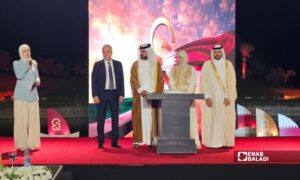
 Part of the sessions of the first National Conference for Dialogue with the Syrian Private Sector, held at the Conference Palace in Rural Damascus, June 2, 2026. (Enab Baladi/Ahmed Muslimani)
Part of the sessions of the first National Conference for Dialogue with the Syrian Private Sector, held at the Conference Palace in Rural Damascus, June 2, 2026. (Enab Baladi/Ahmed Muslimani)
At the Conference Palace in Rural Damascus governorate, Syrian ministers of finance, transport, and agriculture met today, Tuesday, June 2, with businesspeople and representatives of international organizations, as part of the second day of the first National Conference for Dialogue with the Syrian Private Sector, in an attempt to outline a new economic phase in Syria after more than 14 years of war and destruction.
The conference is organized by the Ministry of Economy and Industry in cooperation with the United Nations Development Programme and the Japanese government, to hold talks on the role of the private sector in reviving the Syrian economy and rebuilding infrastructure and productive institutions that sustained extensive damage during years of conflict.
The discussions come as the United Nations and World Bank estimates indicate that Syria faces one of the largest reconstruction processes in the world. According to the World Bank assessment issued in 2025, direct damage to physical assets, infrastructure, and residential and non-residential buildings reached about $108 billion.
The cost of reconstruction is estimated at about $216 billion, with nearly one-third of the physical capital that existed before 2011 damaged.
Syrian Finance Minister Mohammed Yisr Barnieh said in a speech that the government views the private sector as the “main partner” in leading economic growth during the coming phase, stressing that the experience of past years showed Syrian companies’ ability to maintain a minimum level of productive and service activity despite exceptional circumstances.
According to UNDP estimates, about 90% of Syrians live below the poverty line. In a report issued on February 20, 2025, the program said nine out of every 10 people in Syria live in poverty, and one out of every four is unemployed, but the country’s economy can regain its pre-conflict level within a decade under strong growth.
The finance minister referred to the launch of the 2026 to 2030 transformation strategy, which aims to turn the Ministry of Finance into an institution more open to the private sector, with a focus on financial stability and improving the business environment.
He added that the government has begun a tax reform program aimed at moving from the traditional collection model to a more transparent and efficient tax administration.
He pointed to a package of measures taken over the past months to support damaged facilities, including tax exemptions and facilities for taxpayers in the most affected areas, along with decrees exempting taxpayers from accumulated fines, interest, and financial penalties, intending to encourage the return of capital to the economic cycle and stimulate investment.
Minister Barnieh stressed that the resumption of cooperation with international financial institutions such as the World Bank, the International Monetary Fund, and the Islamic Development Bank represents an indicator of the restoration of a degree of international confidence in the Syrian economy, at a time when Syria is seeking to attract the financing and expertise needed for the reconstruction phase.
The Syrian presidency issued Decree No. 275 in 2025, granting broad exemptions from tax interest and fines for the years before 2024, with the aim of settling financial arrears.
The decree at the time covered taxpayers subject to many direct financial taxes and fees, most notably:
In a session dedicated to the transport sector, Syrian Transport Minister Yarub Badr presented a picture of the scale of challenges facing the country’s transport infrastructure, explaining that more than half of Syria’s railway network remains out of service due to damage sustained during the war.
Before the conflict broke out, Syria had a railway network more than 2,700 kilometers long, linking coastal ports with industrial and agricultural centers and main cities. However, large parts of this network were destroyed or completely stopped operating, making its rehabilitation one of the most prominent files in economic recovery.
Badr called on the private sector to contribute to restarting suspended lines, noting that the ministry is also working to prepare a comprehensive assessment of Syria’s road network in cooperation with the Islamic Development Bank and UNDP, as part of a broader plan to formulate a national policy for sustainable land transport.
Reconstruction challenges are not limited to transport alone. According to a report issued by the International Committee of the Red Cross in August 2025, about 50% of Syria’s infrastructure was destroyed or partially disrupted during the years of war, including electricity, water, roads, and basic service networks. The energy sector also lost more than 80% of its production capacity compared with pre-war levels.
In the agricultural sector, which has long been a main pillar of the Syrian economy, Agriculture Minister Basel Hafez al-Suwaidan affirmed that Syria still has major opportunities to attract agricultural investment despite current challenges.
He said the government is working to review the laws regulating agricultural investment and simplify administrative procedures to attract local and foreign capital, announcing a plan to launch the Syrian Holding Company for Agricultural Investments, which will manage a number of productive facilities and develop partnerships with investors and producers.
The Syrian agriculture minister had revealed during his meeting with acting representative of the UN Food and Agriculture Organization, Tommaso Pieri, in May that work was underway to prepare a holding company headed by him, including agricultural land and productive projects, with the aim of strengthening public-private partnership and linking the private sector to the ministry through this company, according to what the Syrian Arab News Agency, SANA, reported at the time.
The UN Food and Agriculture Organization, FAO, says in its latest reports that 14.5 million people in Syria suffer from severe acute food insecurity, and that Syria remains one of the world’s largest and most complex humanitarian emergencies. As the economic crisis worsens and food prices rise, vulnerable Syrian families are adopting negative coping mechanisms, such as selling productive assets and reducing the quantity and quality of meals to survive.
In his speech yesterday at the opening of the sessions of the conference for dialogue with the private sector, Minister of Economy and Industry Mohammad Nidal al-Shaar spoke about the importance of the government adopting the concept of a “guided free economy,” encouraging investment, production, and competition, and ensuring fairness of opportunity, through a “smart” partnership between the state and the private sector, as he put it.
He said the government does not seek to replicate external economic experiences, but rather to develop a special Syrian model that benefits from successful international experiences while relying on the country’s comparative advantages, foremost among them its geographic location, human resources, and Syrian expertise spread inside and outside the country.
Minister al-Shaar denied that the state has any intention or goal to sell people-owned assets to the private sector, meaning assets such as real estate belonging to public bodies. He said that “national assets are a trust that must be preserved, developed, made more efficient, and opened to investment while preserving the rights of the state.”
The solution in dealing with these assets, according to al-Shaar, lies in partnership with the private sector, not “privatization,” through investment contracts or concessions without relinquishing state ownership of the assets. He explained that the real value of assets does not lie in their “price,” but in the ability to increase their productivity and returns.
Regarding consumer goods prices and consumer protection, the economy minister believes that “a market economy is not based on administrative pricing, but on supply and demand.”
Minister al-Shaar said adopting a market economy does not mean the state is absent from the economic scene, noting that successful development experiences were based on a balance between freedom of economic initiative and regulated government intervention.
He revealed a government direction to develop modern industrial cities, integrated logistics zones, and technology and innovation incubators, allowing Syria to become a center for manufacturing, reassembly, and logistics services linked to regional trade.
He affirmed that the government is working in parallel to update the legal and regulatory environment for investment, strengthen the principles of governance and institutionalization, improve transparency, and develop the banking sector and payment systems, alongside efforts aimed at maintaining monetary stability and fighting inflation.
if you think the article contain wrong information or you have additional details Send Correction


 A
A
A
A
A
A


 More Economic Reports