


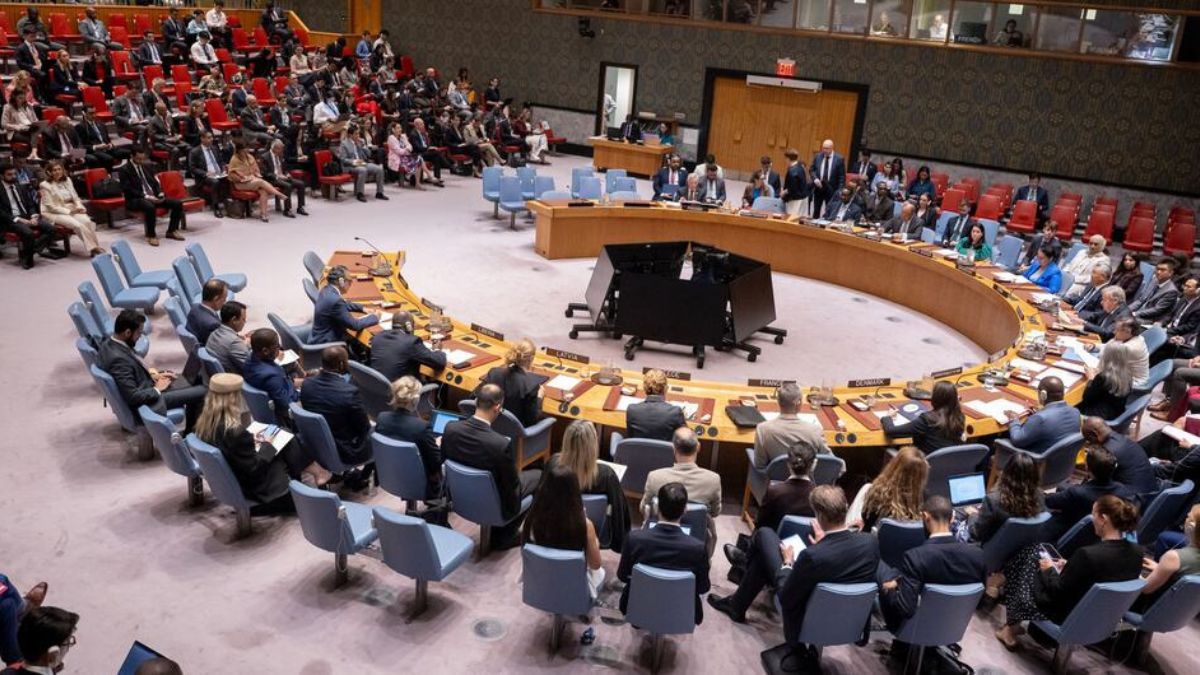
 The UN Security Council holds a session on Syria, June 22, 2026. (United Nations)
The UN Security Council holds a session on Syria, June 22, 2026. (United Nations)
The UN Security Council held a briefing session on Syria on Monday, June 22, discussing political, security, and economic developments amid warnings that the transitional phase is entering a “critical moment” with both opportunities and challenges. The session also included calls to increase international support for the humanitarian response plan, which has so far received only 20% of its funding.
UN Deputy Special Envoy for Syria Claudio Cordone said the political transition in the country is passing through a “critical phase in which opportunity and fragility exist side by side,” stressing the need to move forward with forming the legislative authority, consolidating state institutions, and establishing the rule of law.
He added that engagement between the Syrian authorities and the United Nations is moving forward “tangibly and constructively.” Still, he warned that the continued delay in forming the Transitional People’s Assembly “raises concern.” He stressed that women and the various components of Syrian society must be represented “genuinely and effectively” in the assembly and in all aspects of public life.
Cordone emphasized the importance of achieving transitional justice “swiftly and fairly,” and holding all perpetrators of atrocities and heinous crimes accountable, “not only those linked to the Assad regime.” He also called for addressing conflict-related sexual violence.
He referred to violations documented in the UN Secretary-General’s 2025 report on conflict-related sexual violence, which affected women from the Alawite community during the events along the Syrian coast in March, “at the hands of armed elements and some members of government security forces.” He urged the Syrian government to ensure that these crimes are addressed through transitional justice mechanisms and to take appropriate measures for accountability, protection, assistance to survivors, and prevention.
Syria’s Permanent Representative to the United Nations, Ibrahim Olabi, said, according to the Syrian state news agency SANA, that Israel is “the main obstacle to stability in Syria, despite appreciated US mediation.” He pointed to statements by Israeli Prime Minister Benjamin Netanyahu, who announced that Israel would not withdraw from the areas it had entered, adding, “Netanyahu is escalating and defying the world, while Syria is choosing wisdom and diplomacy.”
For her part, Anna Evstigneeva, Russia’s acting permanent representative to the United Nations, said that “Israeli aggressive actions against Syria remain the main factor destabilizing the situation.”
The Russian diplomat condemned “West Jerusalem’s plans to entrench its illegal presence in the occupied territories, as well as its continued incursions deep into Syrian territory, whether through ground or air operations.”
UN Deputy Special Envoy for Syria Claudio Cordone confirmed that Israeli military activity in southern Syria is continuing, including violations of the 1974 Disengagement Agreement. He referred to almost daily incursions, the establishment of temporary checkpoints, searches, and arrests of civilians. The United Nations renewed its call on Israel to respect Syria’s sovereignty and territorial integrity.
US Deputy Ambassador Tammy Bruce said Washington expects Syria to play “a greater regional and international role” in combating terrorism.
The United Kingdom, through its chargé d’affaires James Kariuki, welcomed the memorandum of understanding between Washington and Tehran, expressed concern over Israeli military activity, and affirmed that the Golan Heights are “occupied Syrian territory.”
Regarding the agreement between the Syrian government and the Syrian Democratic Forces (SDF), Cordone confirmed that the agreement signed in January remains in force. He pointed to the integration of four brigades into the Syrian army, the release of about 1,300 detainees, and the return of some displaced Kurdish families. However, he noted that issues related to integrating security apparatuses, local governance, and education still need to be addressed.
By contrast, the Suwayda (southern Syria) road map for confidence-building and reintegration has made “little progress,” according to Cordone, who pointed to continuing mistrust between local and central authorities, as well as ongoing kidnapping cases and factional conflicts.
He added that kidnapping incidents and internal rivalry among Druze factions continue to affect the governorate. No solution has been reached over the issue of Suwayda students taking national exams.
Acting Assistant Secretary-General for Humanitarian Affairs Indrika Ratwatte said that more than 13,000 students were unable to take their final exams this month because of access restrictions and administrative disruptions.
Ratwatte revealed that Syria’s 2026 humanitarian fundraising plan, worth $2.92 billion, has so far received only 20% of its funding. He called on the international community to provide “flexible and predictable” funding and to increase investment in recovery and reconstruction.
Anna Evstigneeva, Russia’s acting permanent representative to the United Nations, said in her intervention that the humanitarian situation had deteriorated following the recent floods in the Euphrates River basin, which affected tens of thousands of people and caused severe damage to vital infrastructure. She stressed that humanitarian assistance must be accompanied by investments in recovery.
Ratwatte said that since December 2024, about 1.6 million refugees and around two million internally displaced people have returned to their homes. However, he stressed that return “must be based on safety, voluntariness, dignity, and sustainability.” He noted that about 80% of residents in Quneitra (southern Syria) need humanitarian assistance, and that the recent violence in Suwayda has worsened the situation.
Olabi revealed that the number of detainees from the “former regime” has reached about 6,000, including dozens of senior officers. He called on the international community to support the path of transitional justice “without trying to replace it, in a way that could threaten civil peace.”
Olabi reviewed five basic features of the path of the new Syria. These include completing the implementation of Decree No. 13 by collecting citizenship applications from Kurdish Syrians, progress in economic efforts, including the first national conference for private sector dialogue, the return of tourism activity, and the signing of investment partnerships with international companies.
He confirmed that more than 3.5 million refugees and displaced people have returned to the country, noting that Syria “continues to fight battles on behalf of the world against the Islamic State group, arms and drug smuggling, and transnational crime.”
Olabi affirmed the Syrian government’s commitment to continue working to uncover the fate of the missing and forcibly disappeared. He said the case of Dr. Rania al-Abbasi and her family “represents one wound among around 200,000 Syrian wounds,” after the National Commission for the Missing announced that it had reached findings indicating the killing of her children.
if you think the article contain wrong information or you have additional details Send Correction


 A
A
A
A
A
A





 More Politics