


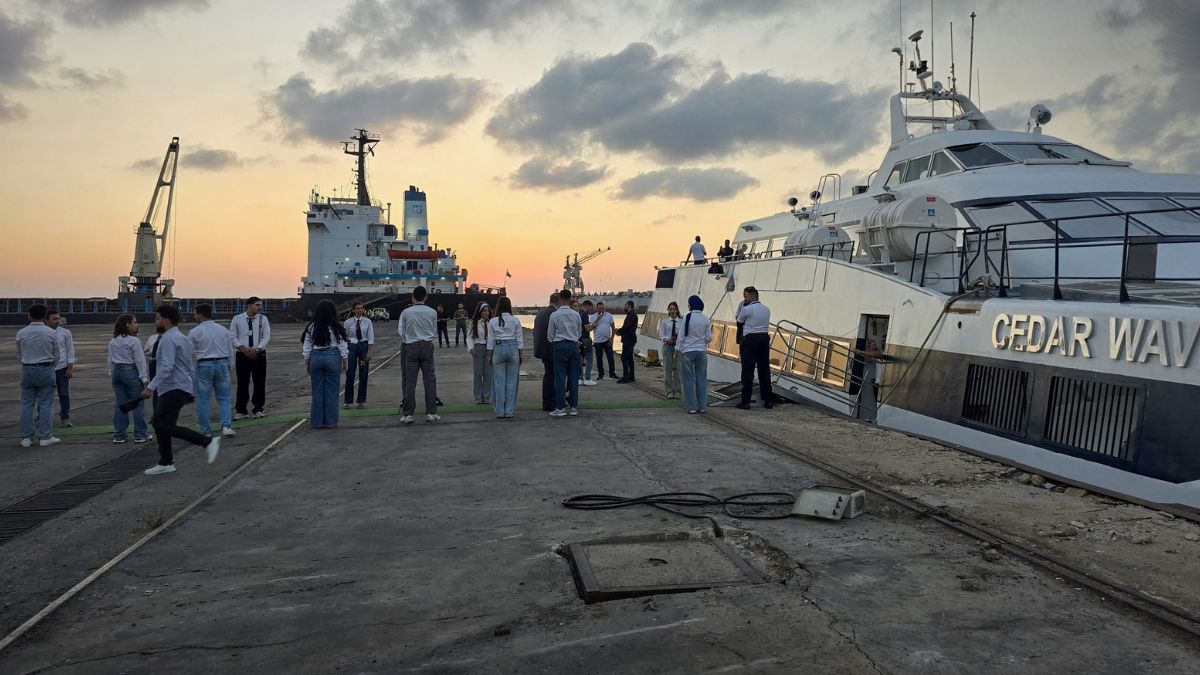
 The CEDAR WAVES tourist ship arriving from Lebanon’s Jounieh to Latakia port on its first trip after years of suspension, June 22, 2026. (SANA)
The CEDAR WAVES tourist ship arriving from Lebanon’s Jounieh to Latakia port on its first trip after years of suspension, June 22, 2026. (SANA)
The CEDAR WAVES tourist passenger ship docked at Latakia port (western Syria) on Monday, June 22, arriving from Lebanon’s Jounieh port and marking the resumption of regular sea passenger trips between the two ports after years of suspension, according to the Syrian Arab News Agency (SANA).
The step comes about six months after Lebanese businessman Merhi Abou Merhi announced the launch of a regular maritime route linking Jounieh, Tartus, Larnaca, and Mersin, with the aim of boosting travel and tourism between Syria, Lebanon, Cyprus, and Turkey.
Speaking to journalists during the ship’s reception at Latakia port, Syrian Tourism Minister Mazen al-Salhani said the arrival of CEDAR WAVES represents the first maritime tourist trip from Lebanon to Syria after years of suspension. He considered the resumption of the sea route a step toward revitalizing tourism activity and facilitating passenger movement.
He added that the concerned authorities worked to prepare the service infrastructure for receiving passengers at the port, including entry, inspection, and clearance procedures within a unified point, to speed up transit and reduce waiting times. He also pointed to plans to expand tourist maritime transport in the coming phase.
According to SANA, the ship departs from Jounieh port in Lebanon toward Latakia port and then to Mersin in Turkey, while the concerned authorities expected the frequency of trips to increase during the coming period in parallel with the tourist season.
George Hanna Sayegh, a member of the board of the Tartus Tourism Chamber and executive director of Abou Merhi Tourism Group in Syria, told Enab Baladi in December 2025 that the project is the first of its kind in the history of Syrian maritime transport in terms of regular passenger trips. He noted at the time that the required licenses had been completed, along with studies of prices, trip routes, and coordination with the relevant authorities.
According to previously announced information, the maritime route aims to facilitate passenger movement between the four countries, boost tourism, reduce reliance on land transport, and provide lower-cost travel options compared with some other means of transport.
For her part, Madonna Hoyek, director of the CEDAR WAVES ship project, said the new route currently links Jounieh, Latakia, and Mersin, with plans to expand toward other destinations in the region.
She added that the ship can accommodate about 350 passengers and includes services for families, children, and people with disabilities. She expressed hope that the project will contribute to revitalizing tourism and strengthening movement between Syria and Lebanon.
Hoyek had explained that trips will operate at a rate of two to three trips per week, with plans to expand the service in the future in cooperation with travel and tourism offices.
The ship is scheduled to link the ports of Jounieh in Lebanon, Latakia in Syria, Mersin in Turkey, and Larnaca in Cyprus, in a step that is being counted on to stimulate maritime and tourism activity in the region.
Economic adviser Ziad Ayoub Arbache said in a previous interview with Enab Baladi that operating a regular maritime route between Syria, Lebanon, and neighboring countries constitutes a strategic step toward reviving activity at Syrian ports and strengthening their role as a main maritime gateway in the eastern Mediterranean.
According to Arbache, the route contributes to reducing travel costs by about 30% to 50% compared with air transport, which could increase passenger movement and boost intra-regional tourism. He also noted that the nature of maritime passenger transport allows for expanding the exchange of goods carried by travelers, which could strengthen a pattern of informal trade by as much as 20% to 40%.
He said the project’s importance is not limited to transport, but extends to reconnecting Syrian ports with regional networks in Lebanon, Turkey, and Cyprus, reducing logistics costs, supporting export activity, and helping stimulate the local economy by increasing the flow of visitors and tourists.
if you think the article contain wrong information or you have additional details Send Correction


 A
A
A
A
A
A





 More Economic Reports