


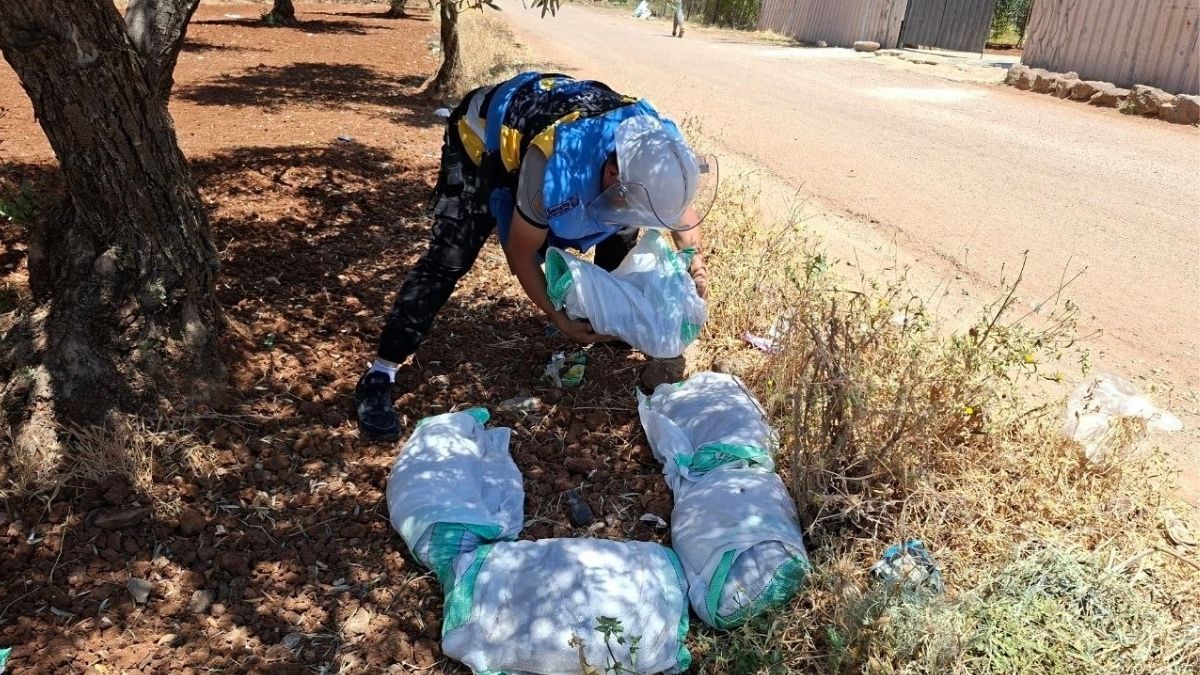
 War remnants removal and mine action teams from the Emergency and Disaster Management Directorate respond to reports in Daraa governorate, June 17, 2026. (Syrian Civil Defense)
War remnants removal and mine action teams from the Emergency and Disaster Management Directorate respond to reports in Daraa governorate, June 17, 2026. (Syrian Civil Defense)
The United Nations Mine Action Service (UNMAS) and the Food and Agriculture Organization of the United Nations (FAO), with support from the government of Japan, launched a joint project to restore agricultural livelihoods and strengthen resilience in northwestern Syria.
FAO said the project is the first of its kind globally to bring the two organizations together. According to the organization, the project is dedicated to clearing mines and unexploded ordnance and rehabilitating agricultural infrastructure in conflict-affected areas, with funding from Japanese grant assistance estimated at $4.4 million.
The project aims to strengthen the role of mine action in supporting food security and accelerating recovery efforts in rural areas affected by the conflict in the governorates of Aleppo, Hama, and Idlib, according to FAO.
The two sides will cooperate to create suitable conditions for the safe return of farming families to their land and the resumption of their productive activities. In this framework, FAO will identify priority agricultural areas where mine clearance activities can have the greatest impact on food security and livelihoods.
Based on the results of this assessment, UNMAS will conduct surveys and clearance operations for mines and unexploded ordnance, while also carrying out explosive ordnance risk education activities to ensure safe access to agricultural land and its renewed use. After these works are completed, FAO will provide support to about 1,500 farming families to restore agricultural production.
This will be done by providing essential agricultural inputs, offering technical assistance, and rehabilitating wells and main irrigation networks.
Japan’s chargé d’affaires and special coordinator for Syria, Akihiro Tsuji, said Japan views mine clearance work as a fundamental pillar that should be linked to broader development and humanitarian efforts across sectors. He praised the close cooperation between UNMAS and FAO, which combines mine clearance with the rehabilitation of agricultural land in a way that strengthens the safety of local communities, supports food security, and contributes to improving economic conditions, as he put it.
Tsuji expressed hope that this cooperation would help create suitable conditions for the safe and dignified return of displaced families to their areas.
The director of the National Mine Action Center, Fadi al-Saleh, also affirmed that the success of economic and agricultural development efforts is directly linked to clearing land of mines and removing explosive remnants of war.
He pointed out that the center attaches great importance to partnership with national and international organizations, considering it a key factor in achieving goals, ensuring the safe return of communities, and securing livelihoods.
For his part, FAO Acting Representative in Syria Pirro Tomaso Perri noted that the project, funded by the government of Japan, reflects the organization’s continued commitment to restoring safe access to agricultural land, protecting livelihoods in rural areas, and supporting a safer and more resilient future for all Syrians.
UNMAS Syria Program Chief Joseph McCartan said the project represents a highly important step for Syria’s future, as it links mine clearance with the restoration of agricultural production and is the first of its kind in this field.
The project also aligns with the Syrian government’s priority of ending the presence of camps, according to McCartan, who added that clearing agricultural land of mines will enable internally displaced families to return to their homes, resume their farming activities and livelihoods, and contribute to supporting economic recovery in Syria.
Earlier, Japan decided to provide $5.5 million to a United Nations agency to fund a project aimed at improving living conditions in Syria, as Syrian refugees increasingly return after the fall of the former regime at the end of 2024.
The project targets the cities of Aleppo and Homs, two of the most severely damaged areas in Syria.
The program aims to rebuild basic infrastructure in poor neighborhoods and other informal buildings, and more than 81,000 people will benefit from it directly.
if you think the article contain wrong information or you have additional details Send Correction


 A
A
A
A
A
A



 More Economic Reports