
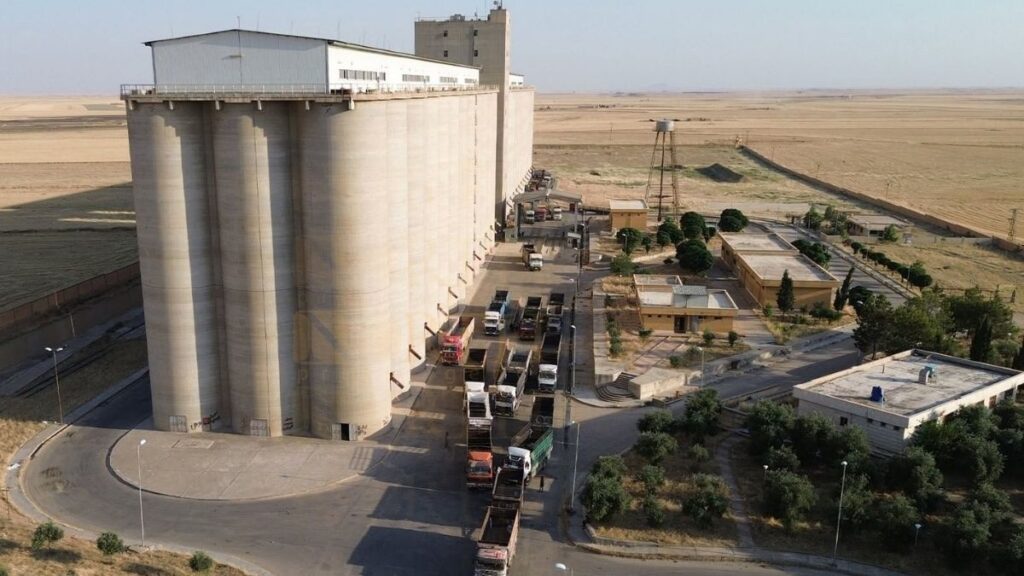

Al-Hasakah (northeastern Syria), Syria’s largest wheat-producing area, continues to record high rates in marketing the current season’s crop.
Wheat deliveries are taking place alongside government measures to expand the capacity of receiving centers, after several silos and storage facilities reached their maximum capacity, in an effort to ensure that marketing operations continue without interruption and to absorb expected production, which is likely to exceed one million tons this season.
Official figures show that al-Hasakah governorate accounts for more than 40% of all quantities marketed so far, reflecting its weight on Syria’s grain production map.
352,000 Tons at al-Hasakah Centers
Assistant Director of Agriculture in al-Hasakah governorate, Ezzeddin al-Hasso, told Enab Baladi that the quantity received at the governorate’s centers has reached 352,000 tons of wheat to date.
He explained that several receiving centers have already reached their storage capacity, but intake operations have not stopped, in implementation of instructions from the assistant minister of economy. Open yards were approved for receiving unpacked bulk wheat inside those centers, with the aim of easing pressure and ensuring continued crop intake.
Al-Hasso added that the relevant authorities opened new open yards at the Qamishli and Amuda centers, as part of efforts to increase the capacity of receiving centers and strengthen their readiness to take in the growing quantities supplied by farmers during the current season.
He said the step came in response to the sharp increase in daily deliveries and helps accelerate unloading operations, reduce truck waiting times, and improve workflow inside marketing centers.
Production Exceeds One Million Tons
For his part, Abdul Wahab al-Safar, head of the central committee monitoring the wheat marketing season, confirmed that total quantities received from various governorates had reached 860,000 tons as of the previous day, with marketing operations continuing at a high pace.
Al-Safar expected al-Hasakah governorate alone to produce more than one million tons during the current season, making it the most important governorate in Syria’s food security file.
He explained that the committee carried out field visits to receiving centers, which led to the opening of additional centers, coordination of grain transport between centers and silos, and monitoring and corrective measures that included suspending several officials and referring their violations to the competent authorities, to strengthen transparency and guarantee farmers’ rights.
Crowding Prompts Exceptional Solutions
The Syrian government had announced, during an expanded meeting in al-Hasakah governorate, a package of exceptional measures to address crowding at some receiving centers during the peak of the harvest season.
The meeting was attended by al-Hasakah Governor Nour al-Din Ahmad, his deputy Ahmed al-Hilali, Deputy Minister of Economy and Industry for Internal Trade and Consumer Protection Maher Khalil al-Hassan, along with the director general of the Syrian Grain Establishment and several officials from the agricultural and banking sectors.
Deputy Governor Ahmed al-Hilali said the meeting approved a series of facilities aimed at removing obstacles facing farmers and accelerating marketing operations.
The measures included allowing the receipt of unpacked bulk wheat in open yards, while preparing to open additional centers when needed, in addition to affirming the government’s commitment to buying the entire wheat production without exception.
The government also allowed the crop to be transported to receiving centers in other governorates, with the Syrian Grain Establishment fully covering transport costs, to ease pressure on full centers in al-Hasakah.
The measures also included adopting a direct transport mechanism after crop samples are analyzed at the center where the farmer is registered, granting the farmer documents that allow direct access to receiving centers in other governorates.
It was also decided to exempt trucks loaded with wheat from axle-load violations up to an increase of 25% above the legal limit, with the aim of speeding up transport between production and storage centers.
Government bodies announced the allocation of four new locations to pay wheat invoices in al-Hasakah, Qamishli, al-Malikiyah, and al-Darbasiyah starting in early July, to bring services closer to farmers and reduce the burden of travel.
30 Receiving Centers
For his part, Deputy Minister of Economy and Industry Maher Khalil al-Hassan explained that several silos and storage centers in al-Hasakah, including the Qamishli, al-Yarubiyah, al-Qahtaniyah, Tal Marouf, Ghuwayran, Tawarij, and Hittin silos, had reached their maximum capacity.
He said this required issuing instructions to continue receiving through the open-yard bulk system, in addition to opening new exposed receiving centers for both bulk and bagged wheat.
He added that the number of receiving centers rose to about 30 after ten new centers were opened, strengthening the governorate’s capacity and helping supply operations continue without interruption.
He noted that daily receiving rates reached about 70,000 tons across Syria, including about 30,000 tons per day in al-Hasakah governorate alone, reflecting the scale of production the governorate is witnessing this season.
He also considered that the decision to increase truck axle loads by 25% would help speed up transport and unloading operations, especially at centers that had reached maximum storage capacity.
Al-Hassan confirmed that the ministry also allowed farmers who wish to deliver their crops in the governorates of Damascus and Homs to do so, with the Syrian Grain Establishment covering transport fees, in a step aimed at easing pressure on storage centers in al-Hasakah.
He concluded by affirming that wheat crop intake would continue without interruption as long as supply operations continue, noting that all government bodies are working to ensure the success of the current season and provide the necessary services to farmers.
Farmers: Measures Eased Crowding
Several al-Hasakah farmers welcomed the recent government measures, considering that they helped speed up marketing operations compared with the first days of the season.
Farmer Mohammad al-Khalaf, from the northern countryside of al-Hasakah, who finished marketing his entire crop this week, told Enab Baladi that opening additional open yards to receive bulk wheat helped reduce crowding inside receiving centers.
He added that receiving procedures were smoother than he had expected, as the delivery of the crop took only a few hours after it arrived at the center, noting that organizing truck movement helped reduce waiting times.
For his part, farmer Ahmad al-Abd, from the countryside of Amuda, said he noticed a clear difference after additional centers were opened and capacity was raised, explaining that workers at the center completed weighing, testing, and receiving operations quickly.
He added that what reassures farmers most is the continued official announcement that the entire production will be received, along with providing alternatives to transport the crop to other governorates when needed, which eases fears that marketing operations could stop or silos could fill up.
Al-Hasakah at the Heart of Food Security
al-Hasakah governorate remains the main pillar of wheat production in Syria, as a large part of the country’s grain needs depends on it, making the success of its marketing season a decisive factor in stabilizing the strategic stockpile.
With harvest operations continuing across wide parts of the governorate and receiving centers expanding, government bodies appear to face a test of their ability to continue absorbing growing quantities in the coming weeks, especially amid expectations that production will exceed the one million ton mark.