


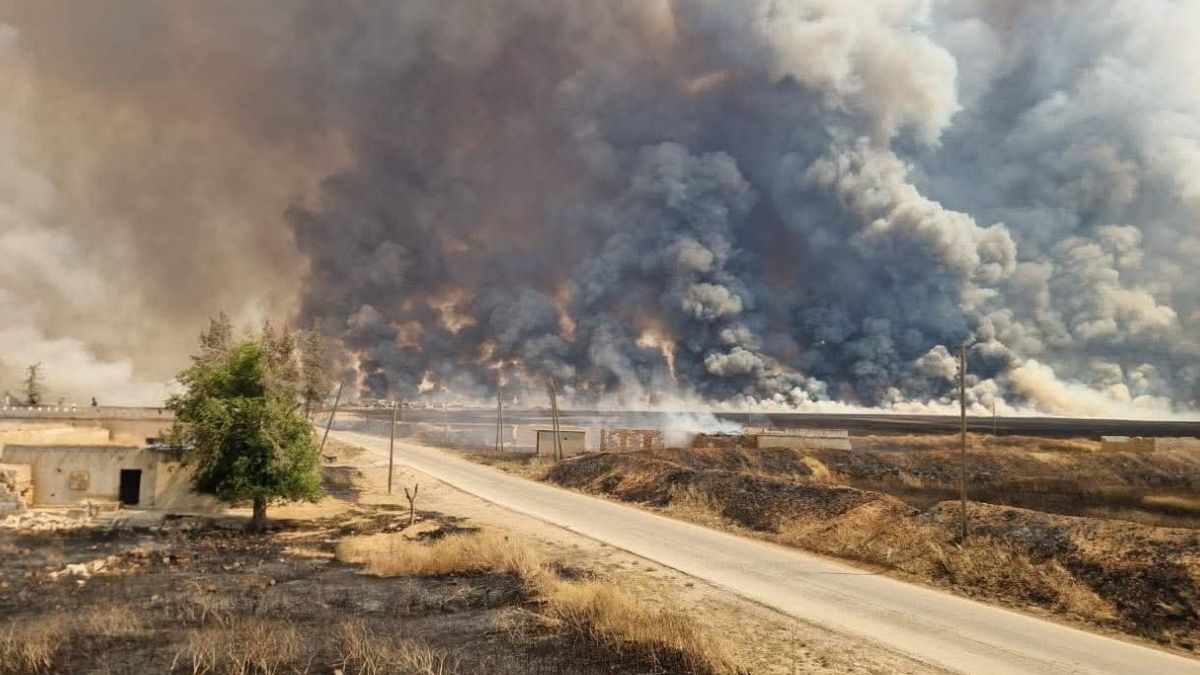
 Fires consume farmland in Zarkan, west of Hasakah, June 18, 2026 (Hasakah Observatory)
Fires consume farmland in Zarkan, west of Hasakah, June 18, 2026 (Hasakah Observatory)
Large fires continued across Hasakah governorate, northeastern Syria, from Thursday until dawn on Friday, June 19, causing major initial losses in farmland, as firefighting teams and residents struggled to contain flames that spread across several fronts, driven by strong winds and the abundance of dry grass across rural areas and the edges of residential zones.
The largest fires started in the Tal Ward and Rabiyat areas in the Zarkan, also known as Abu Rasin, countryside northwest of Hasakah, before expanding during the noon and afternoon hours on Thursday, coinciding with other fires in the countryside of Darbasiyah, Tell Brak, western Tell Tamr, northern Hasakah, and the vicinity of Qamishli airport.
Enab Baladi’s correspondent in Hasakah said the fire spread across an estimated area of about ten kilometers, burning thousands of dunams of crops, while the fires continued to expand into additional areas amid difficulty controlling them.
He added that strong winds accelerated the spread of the fires, bringing some fire points close to homes and residential gatherings, which pushed residents to take part in firefighting operations and try to create firebreaks to protect villages.
A source at the Hasakah Fire Department told Enab Baladi that the fires in the Zarkan countryside reached the highway linking the area’s towns, noting that controlling them was extremely difficult because of their widespread nature and the multiple ignition points.
The source added that the fires surrounded a fuel station located between the towns of Zarkan and Kisra, raising fears that flames could reach the fuel tanks and cause explosions that would increase the scale of the disaster.
He said emergency teams and residents made intensive efforts to prevent the flames from reaching the station, while fires were expanding in several other parts of the governorate.
The source estimated the initial losses at thousands of dunams of farmland, confirming that the first report of the Zarkan fires reached firefighting teams at 12:30 p.m., while response operations continued until the evening without interruption.
As the day advanced, the fires reached areas west of Tell Tamr and its northern countryside, where farmers expressed fears of losing an entire agricultural season after months of field work.
Farmer Khaled al-Hamad, from the northern countryside of Tell Tamr, told Enab Baladi that the fires advanced very quickly because of the winds and high temperatures.
He added, “We saw the flames move between fields in a very short time, and it was not easy to stop them with the available resources. Many farmers tried to open dirt lines using agricultural tractors to prevent the fire from spreading, but the wind speed was greater than our ability to control it.”
He said residents continued working for hours alongside firefighting teams, fearing the flames could reach villages and homes near the farmland.
By the evening, fires continued around Zarkan despite firefighting teams succeeding in extinguishing some ignition points, as flames reappeared in other areas because of stronger winds.
Enab Baladi’s correspondent reported that several villagers left their homes temporarily, especially in the village of al-Abboush, after the fire reached the edges of the residential area and burned parts near the houses.
Farmland also burned in the village of Khuwailid, northeast of Hasakah, while fires continued at several separate locations across the governorate.
Before evening, a new fire broke out in Doulab al-Owaisi neighborhood, west of Hasakah city, an area adjacent to the Khabur River and overlooking open land and farmland.
Mohammad al-Ali, a resident of the neighborhood, told Enab Baladi that the dry grass spread along the area’s edges poses a recurring danger during the summer.
He added, “There are large areas of dry grass adjacent to homes and residential neighborhoods, and when any spark occurs or temperatures rise, fires spread very quickly. We believe this grass is one of the main reasons fires keep recurring in the area.”
Al-Ali called on the concerned authorities to carry out regular campaigns to remove dry grass and clean the land bordering residential neighborhoods before the summer season, to reduce risks threatening residents and their property.
Humanitarian response expert Ahmed al-Salem told Enab Baladi that the current fires show the need for preventive plans and early response in exposed agricultural areas, especially in northern Hasakah.
He explained that the spread of dry grass, the extension of farmland across wide areas, and strong winds are all factors that accelerate the spread of flames and make them difficult to contain during the first hours.
Al-Salem added that the specific conditions in the Abu Rasin, Zarkan area make response operations more complicated than in other areas.
He said, “The Abu Rasin area has witnessed contact lines in past years between the Syrian Democratic Forces and the National Army, which is stationed on the outskirts of the area and in Ras al-Ain. This has led to the presence of areas believed to still be contaminated with mines and remnants of war.”
He added that these factors limit the ability of firefighting teams and residents to reach some burning sites, as responders avoid entering unknown areas or areas suspected of containing mines. This sometimes delays firefighting operations and increases the likelihood that fires will spread.
He said dealing with fires in such areas requires greater coordination between firefighting teams and the bodies responsible for mine clearance, as well as vehicles and equipment capable of reaching rough and remote areas.
Throughout Thursday evening, fires were still burning in several locations, while firefighting teams and residents continued response operations to limit the spread of flames toward villages and population centers. The source at the Hasakah Fire Department told Enab Baladi that the fire in the Zarkan area was brought under control at around 3 a.m. Friday.
No human injuries were recorded, according to information available at the time this report was prepared, but agricultural losses are likely to rise as fires continue to burn across several fronts in Hasakah governorate.
The fires come as wide areas of northeastern Syria are witnessing the grain harvest season, doubling the scale of economic damage for farmers who rely on wheat and barley production as a main source of income, amid fears that the heat wave and winds will continue in the coming days.
if you think the article contain wrong information or you have additional details Send Correction


 A
A
A
A
A
A





 More Society