
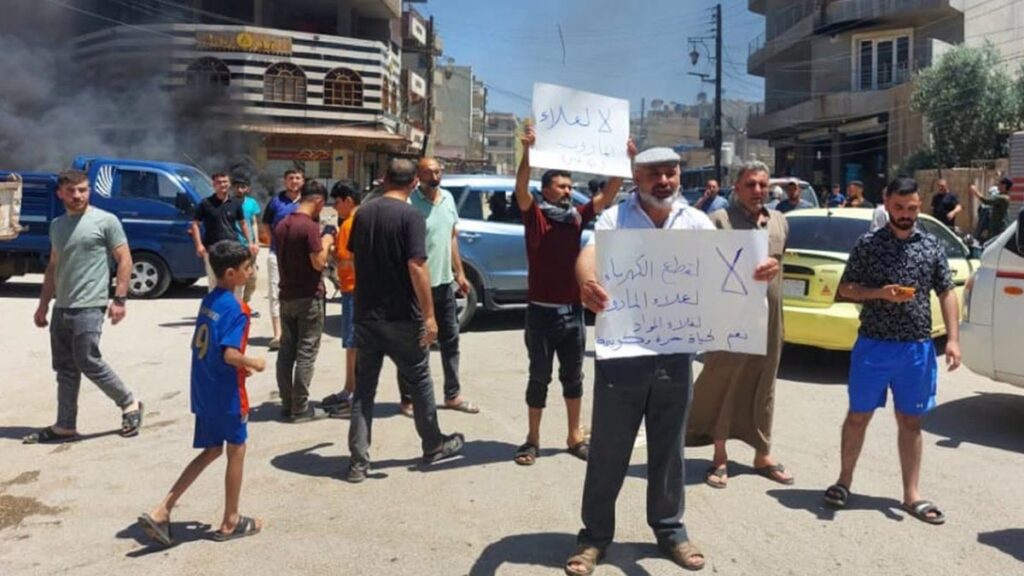

The fuel crisis in al-Hasakah (northeastern Syria) and Qamishli (al-Hasakah province) has worsened in recent days, disrupting vital services directly tied to residents’ daily lives, including electricity, water, transport, bread production, and public sanitation, amid public frustration and repeated demands for quick action by the authorities.
In the latest sign of mounting anger, dozens of residents protested in Qamishli on Sunday, 21 June, over diesel shortages and the shutdown of private generators in several neighborhoods.
Protesters demanded that electricity supplies continue, especially as temperatures rise and residents increasingly rely on private generators to meet basic household needs.
Protesters said the fuel crisis had directly affected the work of electric generators, leading to repeated power cuts and higher monthly subscription costs, at a time when most families are suffering from difficult economic conditions and declining purchasing power.
Participants in the protest also voiced opposition to rising fuel prices and the subsequent increase in generator subscription fees, saying the latest pricing decisions do not take residents’ living conditions into account.
The protesters said the cancellation of some previous support systems, especially those linked to operating generators for long daily periods, contributed to a decline in service levels and increased financial burdens on citizens, calling for a review of pricing mechanisms and regular diesel supplies.
Government Source Reveals Reasons
Alongside the growing protests, a government source in al-Hasakah province blamed the administration of the Syrian Company for the Storage and Distribution of Petroleum Products, SADCOP, for bearing primary responsibility in worsening the fuel crisis, saying it had not taken the necessary measures to secure sufficient quantities of service diesel despite receiving prior requests from the relevant authorities.
The government source told Enab Baladi that the Directorate of Agriculture in al-Hasakah had provided SADCOP with the needs related to irrigating agricultural crops and the harvest season more than a month ago, but the company did not take the necessary precautions to secure the material, contributing to the worsening current shortage.
The source added that al-Hasakah Governor Nour al-Din Ahmad also bears part of the responsibility, as he is able to secure part of the needs from oil burners that are still operating in areas where administrative integration has not yet been completed.
The source accused influential parties within the Syrian Democratic Forces (SDF) of benefiting from smuggling quantities of diesel stored at those burners to the black market instead of directing them to cover service needs in the province.
The source also blamed part of the responsibility on the government team working in the province’s “liberated” areas, citing what he described as a failure to secure the required fuel and take preemptive measures to prevent the service crisis from worsening.
The source believes government bodies have failed to contain public anger, amid weak communication with the local community and a lack of sufficient explanations regarding the causes of the crisis and the measures being taken to address it.
Public Transport Affected by Loss of Allocations
The effects of the crisis extended to the internal transport sector in Qamishli, where minibus drivers working on the National Hospital, al-Hizam route raised the fare for one passenger from 3,000 to 5,000 Syrian pounds.
Minibus driver Ahmad Hassan told Enab Baladi that drivers were forced to take this step after they stopped receiving subsidized diesel allocations about a week ago.
He added that drivers had previously received about 90 liters of service diesel per week for each vehicle, which reduced operating costs and helped keep fares within acceptable limits for citizens.
Ahmad Hassan explained that drivers are now forced to buy unsubsidized diesel at high prices, making it economically impossible to continue operating at the previous fare. He added that some drivers have often had to buy fuel from the market at prices higher than those available at stations because of limited supplies.
Water Crisis Looms
In al-Hasakah city, signs emerged that the water distribution sector is being affected by the same crisis after diesel supplies to water tankers stopped because they did not receive their allocated quantities.
Water tanker owner Mahmoud al-Ali told Enab Baladi that tanker owners were surprised when they did not receive their diesel allocations, despite continuing distribution operations until the end of last week.
He added that a continued cutoff in allocations could reduce tankers’ ability to cover the needs of neighborhoods that rely heavily on transported water, especially during summer, when demand for water rises markedly.
Mahmoud al-Ali said tanker owners are facing difficulty securing fuel from the open market because of high and fluctuating prices, threatening to increase the cost of transporting water for residents if the crisis continues.
Al-Hasakah city relies on tankers as a main source of water, making any disruption to their work directly affect residents’ daily lives.
Waste Piles Up in Streets
The impact of the fuel shortage has not been limited to electricity, transport, and water, but has also extended to public sanitation.
Several neighborhoods and streets in al-Hasakah city have seen a noticeable accumulation of waste in recent days after garbage collection and removal vehicles almost completely stopped operating because they did not receive their diesel allocations.
A source in al-Hasakah municipality told Enab Baladi that sanitation vehicles had not received their diesel allocations since the middle of last week, leading waste collection and removal operations to stop during that period.
The source added that the vehicles later received quantities of diesel that allowed work to gradually resume, but at a slower pace than usual, in an attempt to address the accumulations seen in some neighborhoods.
Non-Subsidized Bread Under Cost Pressure
The crisis also affected private bakeries producing non-subsidized bread in al-Hasakah, where sales briefly stopped before resuming at 6,000 Syrian pounds per bundle, less than 50 cents at the parallel market rate.
Bakery owner Khaled Ibrahim told Enab Baladi that the rise in diesel prices from 55 cents to between 75 and 88 cents per liter greatly increased production costs, prompting bakery owners to demand a review of the approved price.
He added that bakeries were forced to temporarily reduce the weight of a bread bundle from 600 grams to 500 grams until a new price that matches current costs is reached.
Khaled Ibrahim explained that the previous bundle price had achieved an acceptable balance when fuel prices were lower, but the latest increase made continuing production under the previous conditions extremely difficult.
He called for providing subsidized flour and adopting a semi-subsidized operating mechanism for private bakeries producing non-subsidized bread, ensuring stable production and maintaining acceptable prices for consumers.
Southern Protests Reflect Public Anger
These developments come as areas in southern rural al-Hasakah witness rising public anger over living conditions and the fuel crisis.
Residents of several villages in the southern countryside have recently closed main roads to oil tankers heading from the al-Jabsa field toward Syria’s interior, demanding fuel supplies for local residents, improved services, a review of the file of people dismissed from work at the field, and lower prices for basic materials, foremost among them diesel.
These protests reflect the scale of economic and service pressures facing the area, as accusations escalate between government and administrative bodies over the causes of the crisis and how it is being managed, while residents continue demanding urgent solutions that ensure the stability of electricity, water, transport, and bread services, and limit the effects of the severe diesel shortage on their daily lives.