


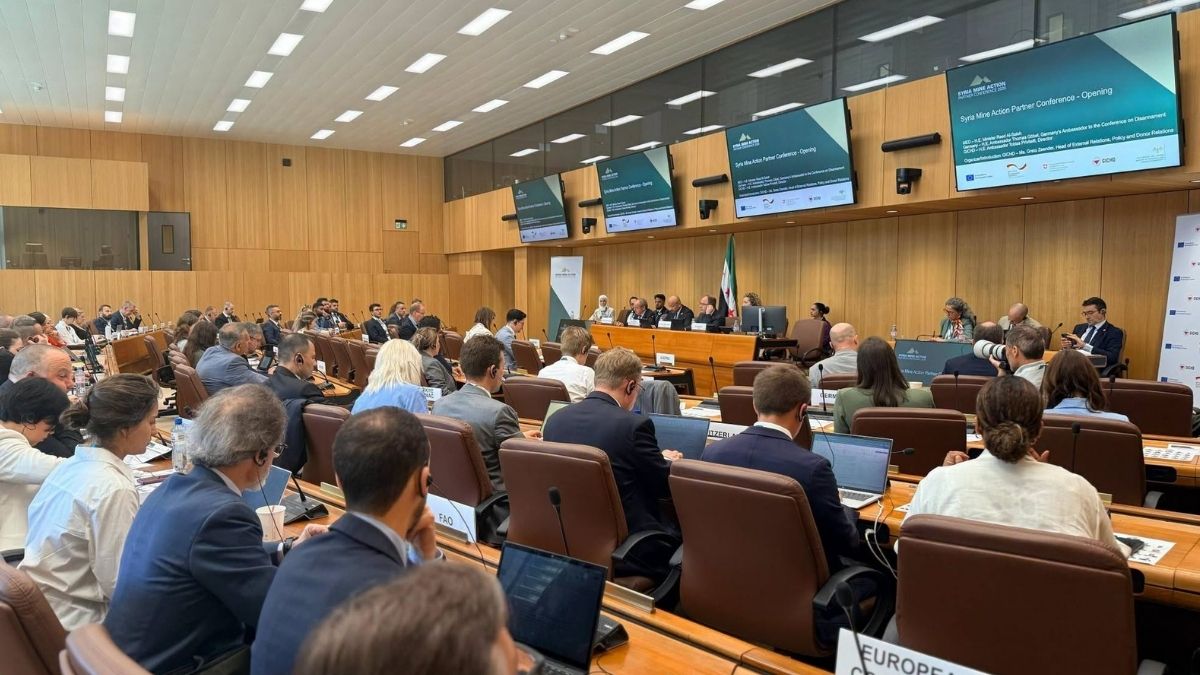
 Geneva hosts the conference for stakeholders involved in mine action in Syria, June 22, 2026. (Ministry of Emergency and Disaster Management)
Geneva hosts the conference for stakeholders involved in mine action in Syria, June 22, 2026. (Ministry of Emergency and Disaster Management)
A conference for stakeholders involved in mine clearance in Syria opened today, Monday, June 22, in Geneva, Switzerland, with the participation of a Syrian government delegation, international partners, and donor agencies, in a step aimed at coordinating efforts to address mines and unexploded ordnance, which remain among the most serious humanitarian and security challenges in the country.
The conference is chaired by Minister of Emergency and Disaster Management Raed al-Saleh, under the auspices of the Geneva International Centre for Humanitarian Demining (GICHD), and with support from the European Union, Germany, and Switzerland. It will continue until June 24.
The Syrian delegation includes representatives from the Ministries of Foreign Affairs and Expatriates and Agriculture, along with specialists, administrators, and technicians from the Syrian National Mine Action Center, which is affiliated with the Ministry of Emergency and Disaster Management.
According to the Ministry of Emergency and Disaster Management, the conference aims to provide a platform bringing together the Syrian government, donor agencies, and implementing partners, contributing to the development of a shared understanding of national needs and priorities related to addressing mines and unexploded ordnance.
The conference also seeks to strengthen coordination mechanisms among actors working in the sector, reduce duplication of efforts and similar programs, and identify practical pathways to accelerate field results for affected communities, especially in areas witnessing the return of displaced people and the resumption of agricultural and service activities.
The conference is being held amid the expansion of areas contaminated with mines and explosive remnants of war in Syria, which continue to cause human losses and affect recovery, reconstruction, and the use of agricultural land.
In his speech during the opening of the conference, the Minister of Emergency and Disaster Management described the issue of mines and unexploded ordnance as a “top national priority” for the Syrian government, stressing that dealing with this file is directly linked to protecting civilians and to the country’s future stability and recovery.
Al-Saleh said talk of the return of refugees and displaced people, reconstruction, restoring livelihoods, and achieving food security remains difficult while widespread contamination with mines and unexploded ordnance continues.
He added that the government’s vision for recovery and stability is based on the principle of “no safe return without safe land,” considering mine risk removal a basic condition for achieving sustainable stability.
The minister noted that the current authorities inherited a complex reality shaped over years of war, with no comprehensive national framework to manage the issue of mines and war remnants, despite the scale of contamination and the danger of its effects on civilians.
Al-Saleh addressed the efforts of UN organizations working in Syria over past years, saying they had not achieved the required effectiveness because of the absence of a unified national reference body to lead the sector and coordinate its operations.
He said previous work led to the absence of an integrated national database and comprehensive maps of contaminated areas, as well as the dispersal of efforts and resources among different actors.
He stressed that the government had decided to establish a unified national reference body, represented by the National Mine Action Center, to be responsible for planning, coordination, defining national priorities, and managing cooperation with local and international partners.
Al-Saleh explained that the National Mine Action Center is currently developing an integrated national system that includes preparing national databases, creating maps of contaminated areas, unifying technical standards and procedures, and strengthening information management systems for the sector.
He added that the center also coordinates operations among different actors working in mine clearance and unexploded ordnance removal, noting that building national institutions capable of managing the file is a long-term and more sustainable investment than temporary solutions.
He stressed that Syria is still at the beginning of the road in addressing this file, but developing the institutional structure is an essential step to accelerate survey and clearance operations in the future.
The Minister of Emergency and Disaster Management stressed that the scale of mine contamination in Syria exceeds the capacity of any single actor to deal with it, calling for expanded partnerships between the government, the United Nations, international and local organizations, and the private sector.
He explained that specialized companies can help accelerate mine clearance by introducing modern technologies and expanding field operational capacity.
He added that the success of these partnerships requires a unified national vision and clear leadership for the sector, ensuring that resources are directed toward the most urgent priorities.
Al-Saleh also reviewed the pillars of the government’s vision for developing the mine action sector, which include strengthening national capacities, expanding survey and clearance operations, developing information management systems, adopting modern technologies, strengthening explosive ordnance risk education programs, and providing support to victims and survivors.
The minister affirmed the Ministry of Emergency and Disaster Management’s commitment to transparency in managing the file, considering accurate data, reliable information, and open coordination among all parties as key pillars for success in this field.
He said the ministry is working to develop information-sharing mechanisms, strengthen participation in planning, set priorities, and evaluate results, in a way that ensures improved response efficiency and more effective allocation of available resources.
Al-Saleh considered mine action an investment in Syrians’ lives and stability, given its role in saving lives and restoring access to agricultural land and basic services.
He added that mine clearance helps enable refugees and displaced people to return to their areas, and forms a core part of the government’s vision based on ending reliance on camps and creating conditions for safe and voluntary return.
He expressed hope that the Geneva conference would mark a practical step toward ridding Syria of explosive remnants of war and opening the way to a safer and more stable phase.
Minister Raed al-Saleh had announced on May 14 preparations to hold an international conference in Geneva to discuss the mine file in Syria with supporting and donor parties.
At the time, he explained that the ministry had signed a memorandum of understanding with the National Mine Action Center in Ukraine to benefit from its technical expertise and develop mechanisms for detecting and removing mines in line with international standards.
He noted that addressing the effects of mines requires long-term efforts and will not end within one or two years, given the extent of contamination and the complexity of the file, calling on local communities to report suspected areas and avoid approaching dangerous sites.
The Ministries of Emergency and Disaster Management and Agriculture launched, on May 14, a project to remove mines and unexploded ordnance and rehabilitate agricultural infrastructure in affected areas.
The project is implemented in partnership with the United Nations Mine Action Service (UNMAS) and the Food and Agriculture Organization of the United Nations (FAO), with financial support from the Japanese government.
The project aims to enhance the safety of agricultural land and infrastructure linked to agricultural production, allowing their reuse and supporting livelihoods for local residents.
The Syrian Network for Human Rights documented, in a report issued on April 4 to mark the International Day for Mine Awareness, the deaths of 3,799 civilians in Syria as a result of landmines and cluster munition remnants since March 2011.
The report said the victims included 1,000 children and 377 women, while landmines caused the deaths of 3,398 civilians, compared with 401 civilians killed by cluster munition remnants.
The report noted that Aleppo, Raqqa, and Deir Ezzor governorates recorded the highest proportion of victims, followed by Hama, Daraa, and Idlib, as a result of the extensive use of mines and munitions during the years of conflict.
The network also recorded a notable increase in the number of victims after the fall of the former regime on December 8, 2024, coinciding with the return of displaced people to their areas and the resumption of agricultural activities in areas that had been theaters of military operations in past years.
if you think the article contain wrong information or you have additional details Send Correction


 A
A
A
A
A
A




 More Politics