
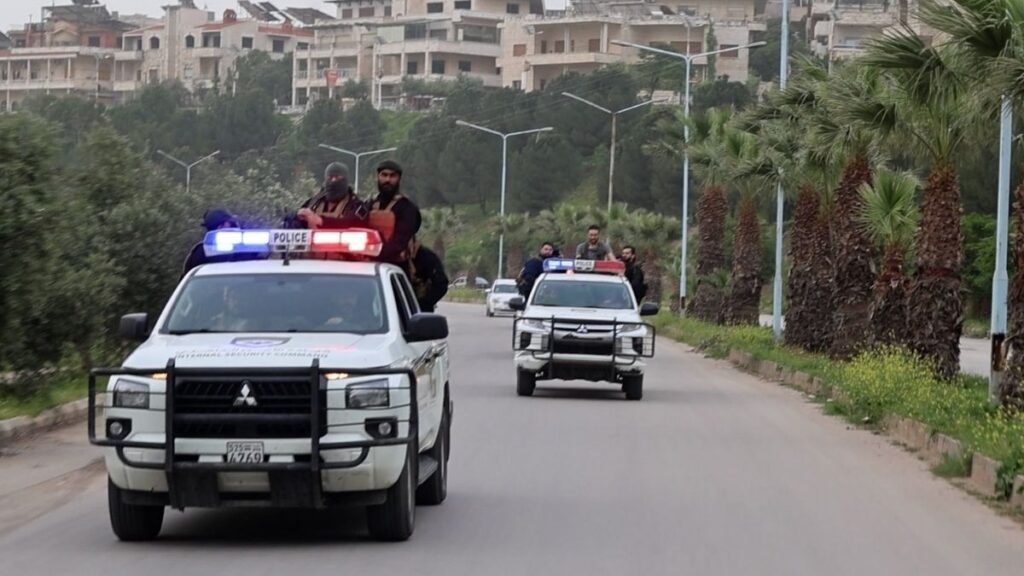

A woman was wounded after unknown assailants threw four grenades at passersby in Karm al-Zeitoun neighborhood in Homs (central Syria) on the evening of Tuesday, May 19.
Two community sources told Enab Baladi that unknown assailants threw four grenades in Karm al-Zeitoun neighborhood, wounding a woman in her 50s in the leg after one exploded among civilians on Street 26, while three other grenades did not explode.
Human rights activist Yamen Hussein said the incident followed tension in the neighborhood after a resident tried to stop young men riding bicycles from harassing a woman, leading to verbal altercations between the two sides.
He told Enab Baladi that a security patrol arrived at the scene to try to contain the dispute before a second patrol from Bab al-Seba’a police station arrived. The officers arrested the man who had intervened to stop the harassment of the woman.
One of the two community sources noted that security authorities had begun investigating the grenade attack, amid repeated similar incidents in Karm al-Zeitoun neighborhood during the past period.
He explained that the security situation in the neighborhood and nearby areas is deteriorating, with repeated abuses and security incidents by unknown assailants, and a weak role by security authorities in maintaining order and restricting weapons to the competent authorities. Residents called for a disciplined security reality similar to other governorates.
Enab Baladi contacted the Syrian Ministry of Interior to learn about the consequences of the incident in Karm al-Zeitoun neighborhood, but the media office responded that there were still no clear details.
Dozens of Civilian Victims
Homs city has witnessed separate security incidents since the beginning of the current year, claiming the lives of dozens of civilians.
In a previous report published by Enab Baladi, journalist activist Hanin Ahmed said she had documented the killing of 14 civilians in January and 16 victims in February, bringing the total toll, with the latest documentation, to 30 victims in only two months, through her supervision of a local documentation team.
Hanin Ahmed explained that recent months had seen “unprecedented boldness in killing,” with perpetrators following a similar pattern: “Gunmen on motorcycles penetrate neighborhoods surrounded by security checkpoints, carry out direct killings, and withdraw without a trace.”
She added that the targeting initially focused up to 90% on members of the Alawite community, before expanding to include Alawite civilians “in general,” who had no connection to any previous conflicts or illegal activities.
Hanin’s testimony overlaps with a recent human rights report issued by Syrians for Truth and Justice, which described these operations as a “mobile killing pattern.”
The report confirmed that the use of motorcycles allows perpetrators to arrive and withdraw quickly, warning that these crimes turn daily life in homes and workplaces into a “potential space for sudden death.”
Human Rights Recommendations
The Syrians for Truth and Justice report called on the authorities to assume responsibility in this context through several essential measures, namely:
Opening independent investigations: Authorities must open immediate and independent criminal investigations into all killing incidents, with concrete steps taken to identify the perpetrators and refer them to justice.
Strengthening protection: Preventive measures should be taken to protect civilians in areas that have seen an escalation in targeting, including Alawite-majority areas.
Cooperating with international organizations: Cooperation with the United Nations and relevant international mechanisms must be strengthened to ensure accountability for those responsible for these crimes and to verify that victims are not subjected to discrimination or impunity.
Civil society efforts: Syrian civil society organizations’ efforts should be strengthened to document these crimes systematically, analyze the geographical and temporal patterns of incidents, and provide psychological and legal support to victims’ families.
Improving Security Efficiency
The commander of Internal Security in Homs governorate, Brigadier General Murhaf al-Naasan, whom the Syrian president later appointed as governor of Homs, held an expanded meeting on February 26 with security directors and department heads to review ways to improve security efficiency and update field plans.
During the meeting, al-Naasan stressed the need to strengthen coordination to speed up the response to reports and ensure security stability. The directives coincided with killings and assassinations in the heart of the city.