
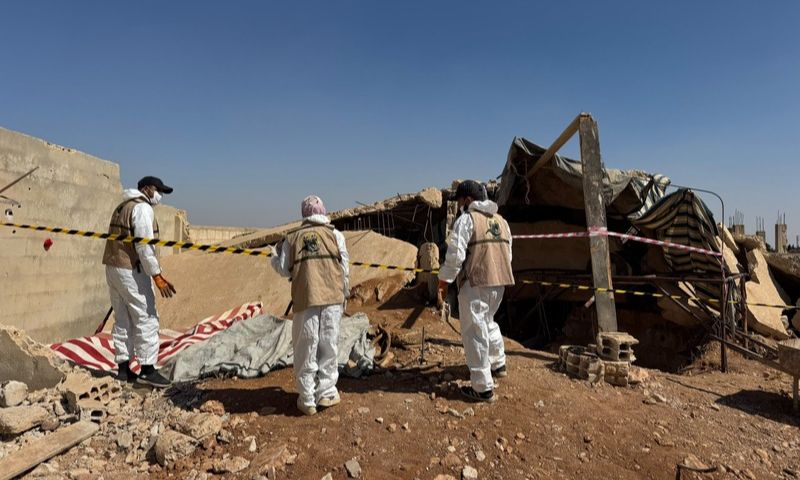

The National Commission for Transitional Justice has launched a pilot phase to collect data on victims and their families in preparation for establishing a national victims registry in Syria, initially focusing on residents most in need.
The commission invited direct victims of grave violations and their first-degree relatives to register through the following link:
The commission explained that registration represents a step toward recognizing victims and their rights and developing processes that better respond to their needs.
It described the registry as a record preserving the memory of violations and a reference for victims’ rights. It will serve as a central rights documentation unit within the Reparations Department and a secure national database documenting victims and grave violations, in coordination with the National Commission for Missing Persons.
According to the commission, the registry also represents a first step toward redress, official recognition of victims and the preservation of their human dignity. It will provide a unified source of data to help victims access their rights and support truth-seeking, accountability, remembrance and peacebuilding efforts, helping ensure that violations do not recur.
The commission added that the registry covers direct victims who suffered physical, psychological, economic, social or regional harm, as well as victims’ relatives and those who supported them. These include first-degree family members, dependents and people harmed while providing assistance.
However, the registry excludes incidents outside its specified time frame, natural deaths and civilian accidents. It also excludes ordinary criminal cases that do not constitute grave violations and cases lacking a minimum level of substantiation, such as fictitious names, incomplete data and undocumented claims.
Data Verification Procedures
Regarding verification procedures, the commission said it would use a methodology based on administrative and human rights verification through cross-checking different sources. Victims will be given the benefit of the doubt, and complete documentation will not be required to substantiate a case.
Cases will be classified according to graduated verification levels: strong, moderate, and preliminary pending verification. Assessments will draw on multiple sources, including testimonies, human rights documentation, digital and community-based evidence, and available documents.
The commission also stressed that protecting rights, privacy and dignity is a priority for the registry. It said it had adopted the “do no harm” principle, informed by more than 300 field visits across 11 governorates, to avoid retraumatizing victims.
It also highlighted policies to protect data, ensure impartiality and transparency, and prevent information from being politicized, alongside a system for prioritizing reparations according to the severity of violations and victims’ living conditions.
In handling sensitive cases, the commission explained that each experience has its own particular circumstances. In enforced disappearance cases, finding a body is not a requirement; family testimony, information about the person’s last known appearance and the subsequent absence of news about them may be used.
In cases involving violations of bodily integrity, social stigma will be taken into account, confidential statements will be accepted, and proof will not be limited to medical evidence. For chemical weapons violations and displacement, evidence may include medical records, international reports, displacement data and maps of military operations.