


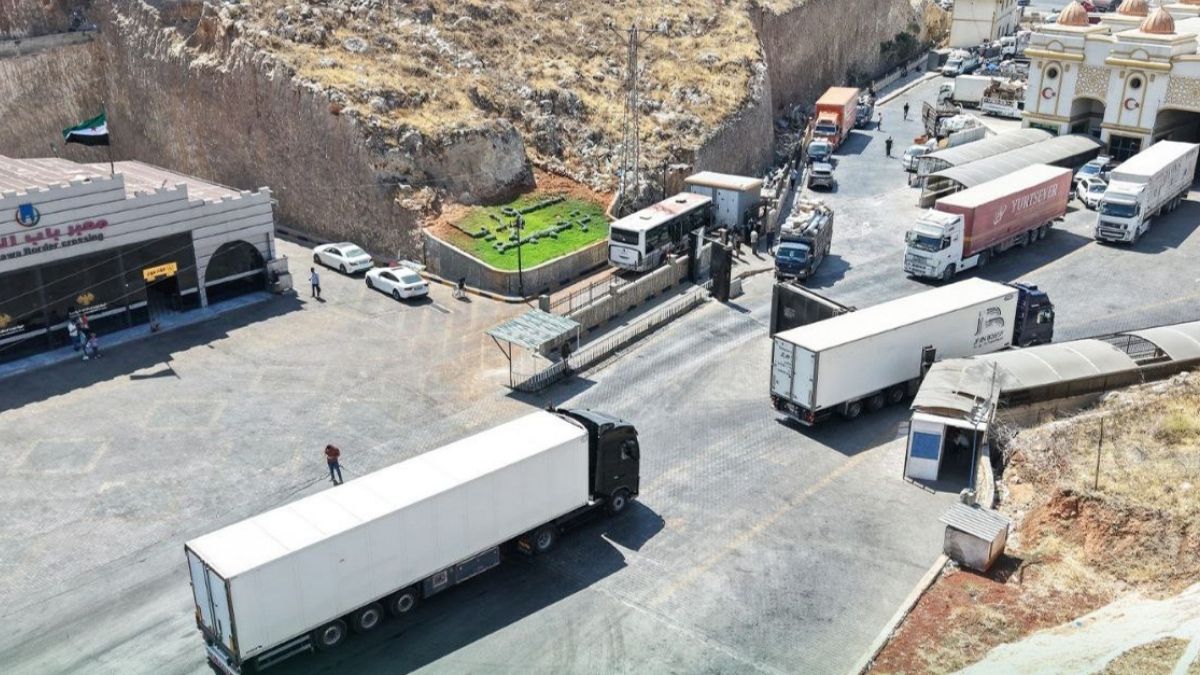
 Trucks loaded with Turkish products enter Syria through the Bab al-Hawa crossing, 28 August 2025 (Bab al-Hawa crossing)
Trucks loaded with Turkish products enter Syria through the Bab al-Hawa crossing, 28 August 2025 (Bab al-Hawa crossing)
Syrians streamed back to their country from Turkey in the first days after the fall of the former Syrian regime, carrying their furniture and years of displacement and asylum, hoping to settle in their homeland. But their belongings have become vulnerable to breakage by cargo handlers and inspectors at the Bab al-Hawa border crossing (Idlib governorate, northwestern Syria), on the Syrian-Turkish border.
When furniture belonging to Syrians voluntarily returning from Turkey arrives, a series of complications begins, according to truck drivers interviewed by Enab Baladi. These range from what they described as “excessive” inspections, including removing covers and tearing cardboard boxes, to moving items from large Turkish trucks to smaller Syrian trucks in a random manner, causing damage and ruining some of them.
Maher al-Omar, a truck driver with a Syrian-Turkish company that transports furniture for Syrians voluntarily returning from Turkey, said the complications begin as soon as the truck enters the Syrian side.
These complications affect truck drivers, shipping companies, and families as well, as they are made fully responsible for the shipment’s contents, with threats of fines reaching $30,000, in addition to delays in receiving their belongings.
When the belongings and furniture are unloaded, the crossing administration takes customs taxes on everything that is new, or appears to be new, or customs fees are imposed on the entire vehicle.
He also pointed to delays for families at the crossing lasting up to 24 hours.
According to testimonies Enab Baladi received from truck drivers, families face delays they described as deliberate, lasting long hours, without facilities or infrastructure that would help them remain there for such a long period.
“Mustafa,” a pseudonym for the owner of a shipping company in Istanbul who preferred not to be named to avoid conflict with workers at the crossing, told Enab Baladi that one truck remained at the crossing for more than six days because one shipment was registered under the name of a deceased person.
Mustafa explained that a Syrian man recently died and his family returned voluntarily to Syria, while their neighbors took responsibility for sending the furniture after their return.
When the shipment arrived at the crossing, one administrator asked for the families who owned the shipment to be present, including the deceased person. Although the company explained that even his wife could not attend because she was observing the Islamic waiting period after her husband’s death, the administrator continued to insist on his presence, according to Mustafa.
When the administrator was replaced, his substitute demanded that one of the deceased man’s relatives attend, provided that the relative had the same family name. But he delayed handing over the shipment and did not release it despite promises to do so, until the file returned to the first administrator, who insisted on the deceased man’s presence.
Mustafa said many shipments remain at the crossing for several days because families cannot be gathered together, or because of routine procedures he described as complicated.
Driver Maher al-Omar, who works for a company licensed in Turkey and seeking licensing in Syria, said most families that send their furniture from Turkey are unable to buy new furniture in Syria, so they resort to sending their old furniture.
Those who are financially better off sell their furniture in Turkey and buy new furniture in Syria.
Those who ship their furniture through large cargo vehicles are people unable to send it through private cargo vehicles because of the high cost.
While the cost of sending furniture in large shared trucks ranges between $400 and $500, depending on the amount of furniture, sending it in private vehicles costs about $1,200, according to al-Omar.
For that reason, three to four families share one vehicle to send their furniture to Syria. This is where the difficulty lies, according to al-Omar, because it is hard to gather them at the same time to receive their belongings and furniture.
According to what Enab Baladi observed, the cost of sending furniture from Istanbul in Turkey to Aleppo (northern Syria) in a large TIR truck sometimes exceeds $2,000.
Many families voluntarily returning to Syria send their furniture and then stay for a period to complete procedures to close electricity and water meters, or the opposite happens, with relatives or neighbors assigned to send the furniture after their return.
The suffering of those working in shipping is not limited to the procedures. Truck drivers interviewed by Enab Baladi complained of mistreatment by workers at the crossing and accused them of creating obstacles to push them to pay bribes.
According to Mustafa, the alleged bribe is $700 in return for avoiding strict inspection.
This inspection causes furniture damage because of how “scouts,” or inspectors, and cargo handlers move goods to Syrian trucks.
The workers at the crossing handle furniture roughly, tearing bags and cardboard boxes and mixing items, which also leaves them vulnerable to being lost, misplaced, or mixed with other owners’ belongings, according to driver Al-Omar.
“The workers who move furniture from Turkish vehicles to Syrian ones have no mercy or compassion. They throw the furniture into the vehicles without taking care of it, in addition to throwing goods that contain glass and placing them under other goods, which causes them to break.”
Maher al-Omar
Truck driver
Ahmed, a truck driver who also transports furniture for Syrians returning from Turkey, said workers and inspectors open the cardboard boxes and empty all their contents for inspection.
While they previously allowed the furniture to be repacked, they now do not allow drivers to approach the vehicles until they leave the crossing.
Ahmed said truck drivers in Syria face harassment at Bab al-Hawa crossing, calling on the relevant authorities to intervene and resolve this issue, which he said is escalating.
When drivers confront officials in the Bab al-Hawa yard, they are met with threats of ending their assignment and banning them from entering the crossing, according to Ahmed.
Video clips sent by the truck drivers interviewed by Enab Baladi show furniture thrown randomly inside vehicles after being opened for inspection and left open.
Another recording also showed furniture belonging to Syrians left on the ground because of delayed delivery, exposing it to breakage.

Furniture and luggage belonging to Syrians voluntarily returning from Turkey, some of it torn, 30 April 2026 (Enab Baladi/Mowaffak al-Khouja)
The Bab al-Hawa crossing administration employs workers to move goods and furniture from Turkish trucks to Syrian ones, as Turkish drivers are not allowed to enter Syria with their trucks.
As a result, shipping companies send goods and furniture with Turkish drivers to the border, then transfer them to Syrian vehicles to continue transporting them into Syria.
Previously, the Bab al-Hawa crossing administration allowed large “TIR” trucks to enter the crossing yard to receive furniture, but it recently banned them and allowed only smaller “Canter” trucks to enter, according to what Enab Baladi learned from the drivers it interviewed.
Ahmed, who supports two families, was banned from entering the crossing because of this decision.
This measure imposed higher costs on shipping company owners, as the cost of transporting one Canter vehicle to Aleppo governorate, for example, is about $100.
One TIR truck requires five Canter vehicles to unload it, according to al-Omar.
Enab Baladi contacted the Bab al-Hawa border crossing administration to present these complaints, which included six points, and to ask about their causes. The administration referred the response to the media office of the General Authority for Land and Sea Ports and Customs.
Enab Baladi then sent the questions to the authority’s media office and its relations official, Mazen Alloush, but had not received a response by the time this report was edited.
Owners of shipping companies operating in Istanbul and Bursa, according to a statement Enab Baladi received a copy of, called on the Bab al-Hawa crossing administration to treat this complaint seriously because of its direct impact on “citizens’ dignity and their trust in institutions,” as they put it.
The workers in the companies said in the statement that some Bab al-Hawa crossing employees dealt with people in a manner they described as “inappropriate,” marked by “harshness and arrogance” toward displaced people returning to Syria, along with clear double standards and selective treatment.
They said some people have their affairs facilitated easily, while others from the general public are treated as if they are under suspicion or at fault. They said this has become tangible and witnessed by a large number of returnees.
The complaints of the companies and truck drivers on the Syrian side were represented in several points:
The companies demanded:
The organizers of the statement pledged to provide photos, videos, and proof, or send a witness to accompany the shipment, while concealing his identity so he would not be recognized, to serve as a firsthand witness to what happens at the Bab al-Hawa crossing.
Syrians returned to their country in large numbers after the fall of the former Syrian regime from countries of displacement, because of the radical political change in the country, especially from Turkey, which has hosted the largest number of Syrian refugees since the beginning of the Syrian revolution.
According to statistics from the Turkish Interior Ministry issued on May 5, the number of voluntary returnees since 8 December 2024 reached about 667,565 people.
The number of Syrians under temporary protection in Turkey reached 2,280,542, according to statistics from Turkey’s Directorate of Migration Management, while their number had remained above 3 million even after mid-2024.
In the first days after the fall of the regime, Turkey announced a series of facilitations for voluntary returnees, most notably allowing Syrians to transport their furniture to Syrian crossings without imposing any fees on it.
Bab al-Hawa, administratively affiliated with Idlib governorate, is one of the most prominent land border crossings with Turkey. On the Turkish side, it faces the Cilvegözü crossing, which lies within the city of Reyhanli in Hatay province.
if you think the article contain wrong information or you have additional details Send Correction


 A
A
A
A
A
A





 More Society