


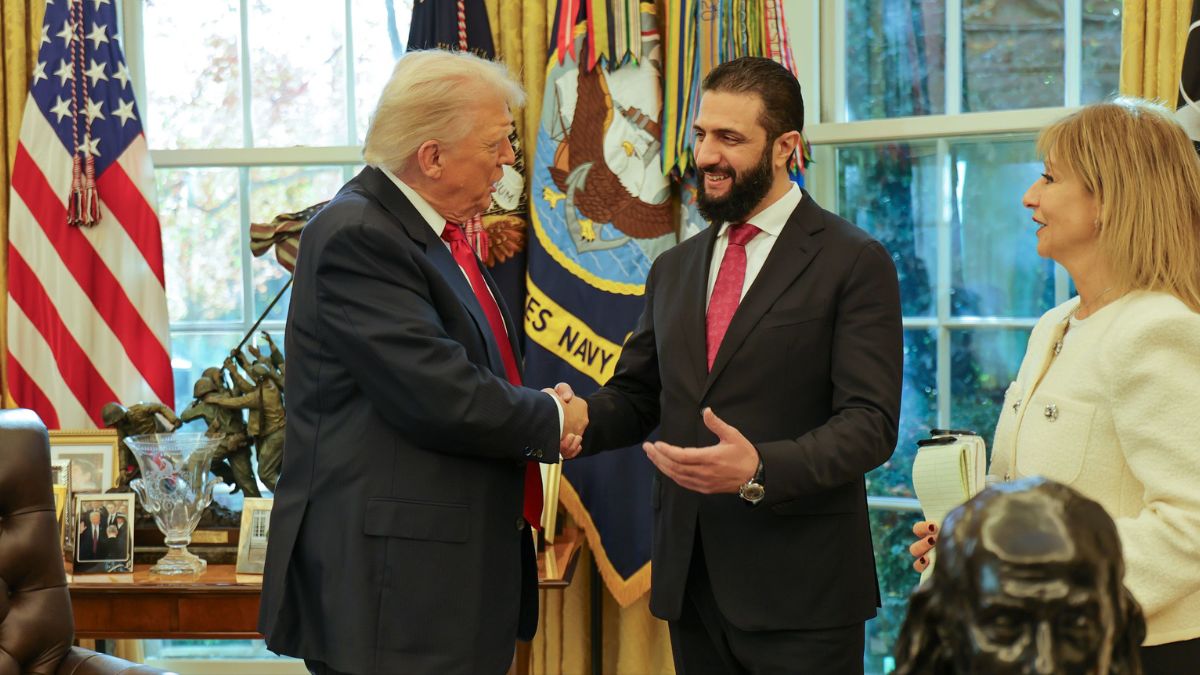
 Syria’s transitional president Ahmad al-Sharaa shakes hands with U.S. President Donald Trump during his visit to the White House, November 10, 2025 (Presidency of the Syrian Arab Republic)
Syria’s transitional president Ahmad al-Sharaa shakes hands with U.S. President Donald Trump during his visit to the White House, November 10, 2025 (Presidency of the Syrian Arab Republic)
The U.S. Departments of the Treasury and Commerce announced an extension of the partial suspension of sanctions under the Caesar Act for 180 days.
In a joint statement on Monday, November 10, the two departments said the decision replaces the waiver issued on May 23, adding that the new suspension halts most sanctions imposed under the law, except those involving financial or commercial transactions with Russia or Iran.
The statement followed the first-ever White House visit by a Syrian president, transitional president Ahmad al-Sharaa. It said the step aims to allow U.S. and international companies and institutions to engage in economic and development projects in Syria while maintaining restrictions related to entities and countries subject to separate U.S. sanctions.
“The United States remains committed to supporting a unified, stable, and peaceful Syria,” the statement read. Lifting sanctions would enable rebuilding the economy and achieving prosperity for all citizens, including ethnic and religious minorities, while strengthening counterterrorism efforts.
Sanctions remain in force on what it called “the worst of the worst,” including Bashar al-Assad and his close associates, human rights abusers, Captagon traffickers, and destabilizing regional actors. The U.S. government is also continuing to review Syria’s designation as a State Sponsor of Terrorism.
Sensitive U.S. exports on the Commerce Control List still require specific export licenses.
Zaki Lababidi, a board member of the Syrian American Council, told Enab Baladi that today’s suspension mirrors the one enacted in May. He added that President Donald Trump cannot suspend the Caesar Act for more than six months at a time and must renew the suspension every six months, which is what he has done now. Only Congress can repeal the law, he said.
Benjamin Fève, senior researcher and analyst at the Karam Shaar Center for Consulting, confirmed Lababidi’s point that today’s suspension decision does not differ from May’s.
Syrian American Council member Mohammed Alaa Ghanem likewise wrote on Facebook that the renewal adds nothing new to the May announcement.
The joint statement stressed that easing sanctions does not mean a lack of accountability, noting that Washington will continue to block resources from reaching entities that threaten regional stability or violate human rights.
The U.S. government will work with the public and private sectors to issue new guidance for companies and banks seeking to invest in Syria, while retaining the authority to reimpose restrictions if required by national security considerations.
The statement added that President Trump is delivering on his pledge to give Syria a chance to grow and that the United States is adopting a new policy that encourages investment and regional economic cooperation and supports the Syrian people in building a prosperous future away from wars and sanctions.
The Caesar Act is a bill passed by the U.S. House of Representatives on November 15, 2016, and signed by President Donald Trump on December 21, 2019 during his first term.
The law mandates sanctions on anyone who provides support to the former Syrian regime, and requires the U.S. president to impose sanctions on states allied with the deposed Assad.
It covers companies, individuals, and countries that provide military, financial, or technical support to the former regime, including Russia and Iran, and targets anyone providing aid for Syria’s reconstruction.
The law is named after the Syrian military defector Farid al-Madhhan, known as “Caesar,” who in 2014 smuggled 55,000 photographs of 11,000 detainees who were killed under torture. The FBI verified the images, which sparked global outrage at the time and were displayed in the U.S. Senate.
if you think the article contain wrong information or you have additional details Send Correction


 A
A
A
A
A
A




 More Politics