


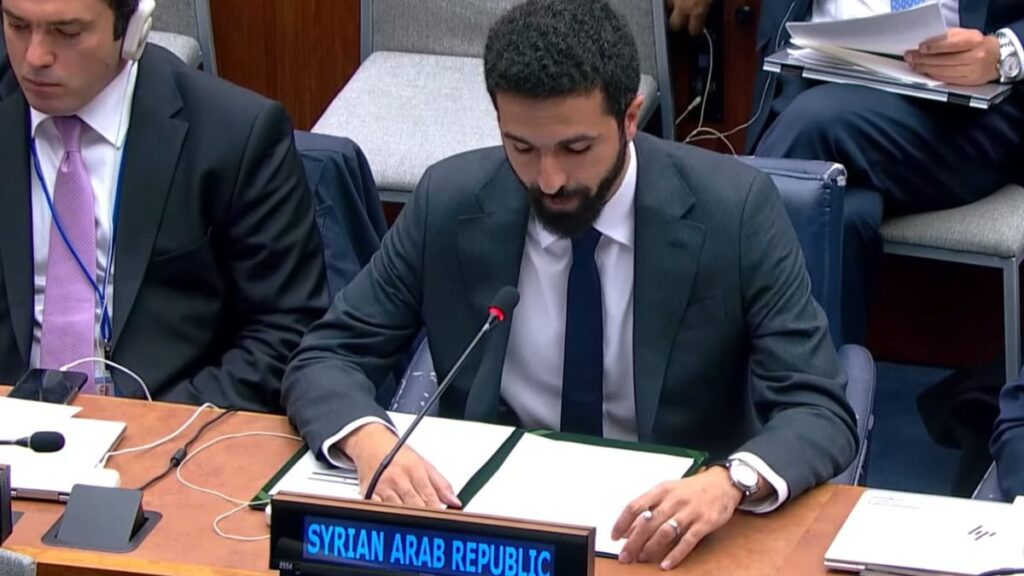
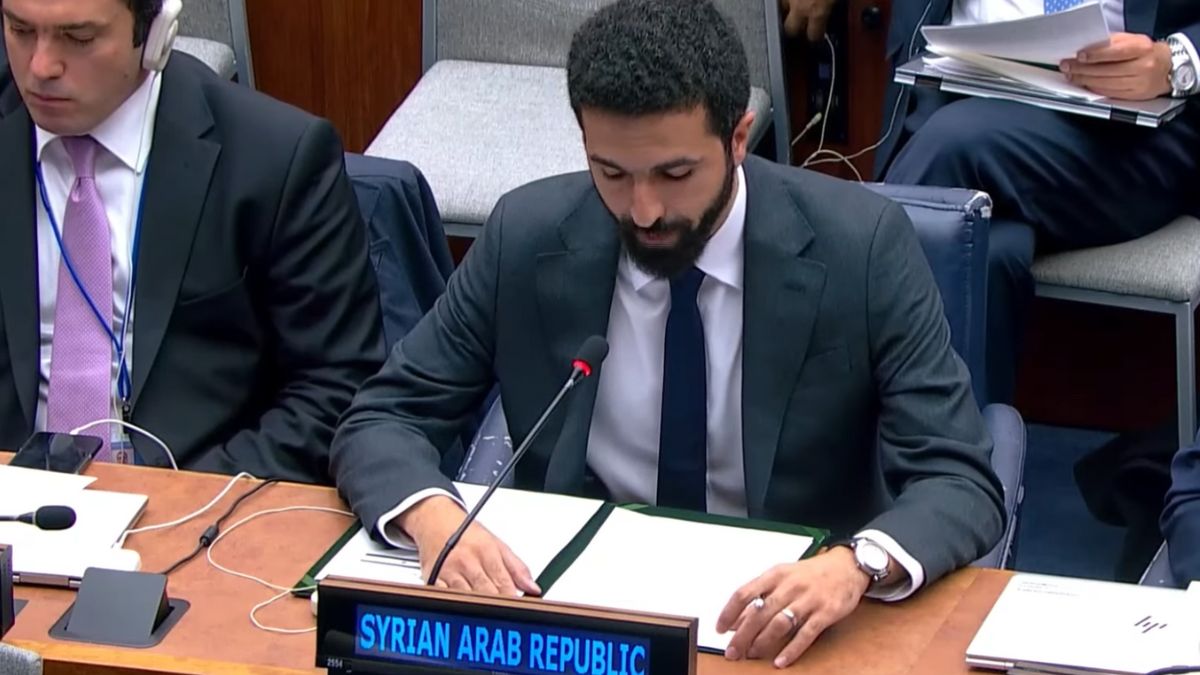
 Syria’s Permanent Representative to the United Nations Ibrahim Olabi delivers Syria’s statement to the First Committee on Disarmament and International Security in New York, November 3, 2025 (Syrian News Channel/YouTube)
Syria’s Permanent Representative to the United Nations Ibrahim Olabi delivers Syria’s statement to the First Committee on Disarmament and International Security in New York, November 3, 2025 (Syrian News Channel/YouTube)
Syria’s Permanent Representative to the United Nations, Ibrahim Olabi, said the Syrian delegation voted in favor of draft resolution L62 titled Implementation of the Convention on the Prohibition of the Development, Production, Stockpiling and Use of Chemical Weapons and on Their Destruction, including clauses specific to Syria.
Speaking before the UN General Assembly’s First Committee on Disarmament and International Security in New York on Monday, November 3, Olabi said adoption of the draft marks a qualitative step toward establishing the truth and doing justice to the Syrian people after years of misinformation and obfuscation.
Syria’s Ministry of Foreign Affairs and Expatriates said the First Committee’s decision, adopted with the support of 151 states, is an important step in correcting the narrative about events in Syria and reflects the international community’s commitment to acknowledging facts after years of distortion and disregard for the suffering of victims of chemical attacks.
In a statement posted Monday, November 3, on its X account, the ministry said the decision highlights positive and advanced cooperation between Syria and the Organisation for the Prohibition of Chemical Weapons and commends the Syrian government’s full and transparent engagement with the organization. It called on the international community to provide the necessary support to sustain these efforts.
The statement added that the decision praises practical steps Syria has recently taken to build a genuine partnership with the OPCW and reflects a firm political will to end doubts associated with the former regime and to establish a professional framework based on mutual respect.

Statement by Syria’s Ministry of Foreign Affairs and Expatriates on implementing the Convention on the Prohibition of the Development, Production, Stockpiling and Use of Chemical Weapons and on Their Destruction, November 3, 2025 (Syrian Ministry of Foreign Affairs and Expatriates/X)

Statement by Syria’s Ministry of Foreign Affairs and Expatriates on implementing the Convention on the Prohibition of the Development, Production, Stockpiling and Use of Chemical Weapons and on Their Destruction, November 3, 2025 (Syrian Ministry of Foreign Affairs and Expatriates/X)
Olabi said adoption of the resolution is a foundational step toward justice for Syrians after many years of misinformation and attempts to smother the truth, particularly regarding chemical weapons use in the country.
He said the decision enables Syria to breathe again on the international stage and reflects broad support for its position, expressing gratitude to states that helped advance the measure, led by Poland, which assumed responsibility for sponsoring and repeatedly tabling the text in recent years while drawing attention to the challenges Syria faces.
Olabi added that the resolution documents the Syrian people’s suffering under chemical weapons and fixes it in the historical record. He urged the international community to support Syria’s efforts to address the chemical legacy of the former regime, protect Syrians, ensure their collective security, and bolster international peace and security.
Syria’s delegation welcomed the decision’s operational paragraphs that reflect the country’s reality after 14 years of war, including language that welcomes Syria’s recent positive cooperation with the OPCW, calls for international support, endorses Executive Council decisions on accelerated destruction, and recognizes the historical and institutional context in which the former regime’s chemical weapons program developed.
After the fall of the former regime, OPCW Director-General Fernando Arias met in Damascus (southern Syria) on February 8 with a high-level technical delegation, Syrian Foreign Minister Asaad al-Shaibani, and Syria’s transitional president, Ahmad al-Sharaa.
The organization said at the time the meetings were long, productive, and very open, featuring in-depth exchanges that would form a basis for concrete outcomes and help break an impasse that had lasted more than 11 years.
On October 9, Syria’s Foreign Ministry welcomed a decision on the accelerated destruction of any remaining chemical weapons in the Syrian Arab Republic. The decision also amended the item title in the Executive Council’s agenda to Removal of any remnants of the chemical weapons program of the Assad era.
The measure instructs OPCW inspection teams to continue investigating and collecting evidence on chemical weapons use, to support national accountability processes. This goes beyond past practice in which investigation results were shared only with UN bodies.
In June, the OPCW deployed the first team from the Office of Special Missions in Syria with tasks that include visiting declared or suspected sites related to chemical weapons activities, collecting evidence and documentation, and taking samples for analysis in designated laboratories.
An Israeli strike on the Syrian General Staff building in Damascus (southern Syria) on July 16 prevented the deployment of a second team from the OPCW Technical Secretariat.
The Secretariat is currently planning upcoming inspections at the Barzeh and Jamraya facilities of the Agency for Scientific and Technological Research near Damascus.
if you think the article contain wrong information or you have additional details Send Correction


 A
A
A
A
A
A



 More Politics