


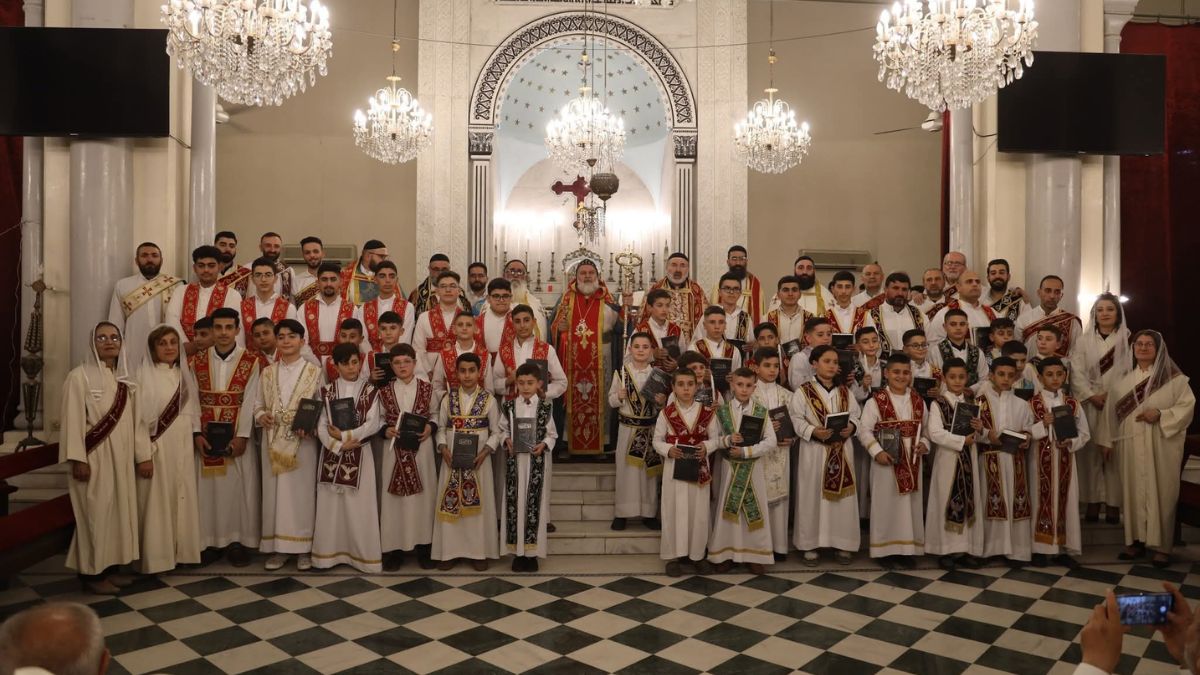
 Divine Liturgy at the altar of the Church of the Virgin Mary in Qamishli (al-Hasakah province, northeastern Syria), October 31, 2025 (Archdiocese of al-Jazira and al-Furat for the Syriac Orthodox/ Facebook)
Divine Liturgy at the altar of the Church of the Virgin Mary in Qamishli (al-Hasakah province, northeastern Syria), October 31, 2025 (Archdiocese of al-Jazira and al-Furat for the Syriac Orthodox/ Facebook)
Heads of Christian denominations in al-Jazira and al-Furat (northeastern Syria) announced an agreement with the Education Authority of the Autonomous Administration of North and East Syria under which church-run schools will continue teaching the Syrian Ministry of Education’s curriculum during the 2025–2026 school year.
According to a statement by the Council of Churches in al-Jazira and al-Furat issued on Sunday, November 2, this follows consultations between the two sides in recent weeks. It added that the official school year at those institutions will begin on Monday, November 3.

Statement issued by the Council of Churches in al-Jazira and al-Furat (northeastern Syria) on teaching the Syrian Ministry of Education curriculum in areas of the “Self-Administration,” November 2, 2025 (Archdiocese of al-Jazira and al-Furat for the Syriac Orthodox/ Facebook)
The statement expressed thanks to those who helped reach the agreement, foremost the Commander of the Syrian Democratic Forces (SDF), Mazloum Abdi, for his efforts to understand “the specific circumstances of the churches and their educational and social institutions.”
The Christian leaders affirmed their commitment to ensuring “love, justice, and equality among all Syrians,” and called for implementing the March 10 agreement between the Syrian state and the Autonomous Administration to achieve security and peace across all Syrian territory.
On September 30, the Autonomous Administration closed Christian community schools serving Syriacs and Armenians in areas under its control, as Internal Security Forces (Asayish) raided five private Christian schools in Qamishli (al-Hasakah province, northeastern Syria) and shut them down by force after abruptly expelling administrators and students.
The closures came after Christian church leaders rejected the Administration’s attempt to impose its own curriculum on their private schools and insisted on continuing to teach the state curriculum issued by the Syrian Ministry of Education.
At the time, Christian residents interviewed by Enab Baladi urged the Autonomous Administration to reverse the decisions, stressing that their demands are grounded in fundamental constitutional and human rights, not sectarian privileges.
The shutdown orders targeted several private schools and colleges, including Mar Quriakus School (Syriac Orthodox), al-Salam School (Armenian Catholic), Maysaloun School (Protestant), Faris al-Khoury School (Assyrian), al-Ittihad School (Armenian Apostolic), and al-Amal School in al-Hasakah affiliated with the Syriac Orthodox Church.
The Syriac Orthodox Church accused the SDF of closing Christian denominational schools in the al-Jazira region after they refused to adopt the Autonomous Administration’s curriculum.
On October 7, Bishop Mor Maurice Amsih, Syriac Orthodox Metropolitan of the Archdiocese of al-Jazira and al-Furat, told the state-run Syrian Arab News Agency (SANA) that the archdiocese “categorically rejects the imposition of the SDF curriculum or any curriculum not officially recognized,” noting that the roughly 35 denominational schools “will adopt only the curriculum issued by the Syrian Ministry of Education and recognized internationally.”
He explained that dialogue between the archdiocese and the SDF had continued for more than a month, during which the latter presented schools with only two options: either the Autonomous Administration’s curriculum or a UNICEF curriculum, without licensing from the Ministry of Education in Damascus. “This is entirely unacceptable because it threatens students’ futures and exposes schools to the loss of their licenses,” he said.
Amsih added that some archdiocesan schools date back more than a century, use official Syrian certificates at the preparatory and secondary levels, and enroll students from a range of Syrian communities, including Arabs, Kurds, Assyrians, and Yazidis.
if you think the article contain wrong information or you have additional details Send Correction


 A
A
A
A
A
A


 More Politics