


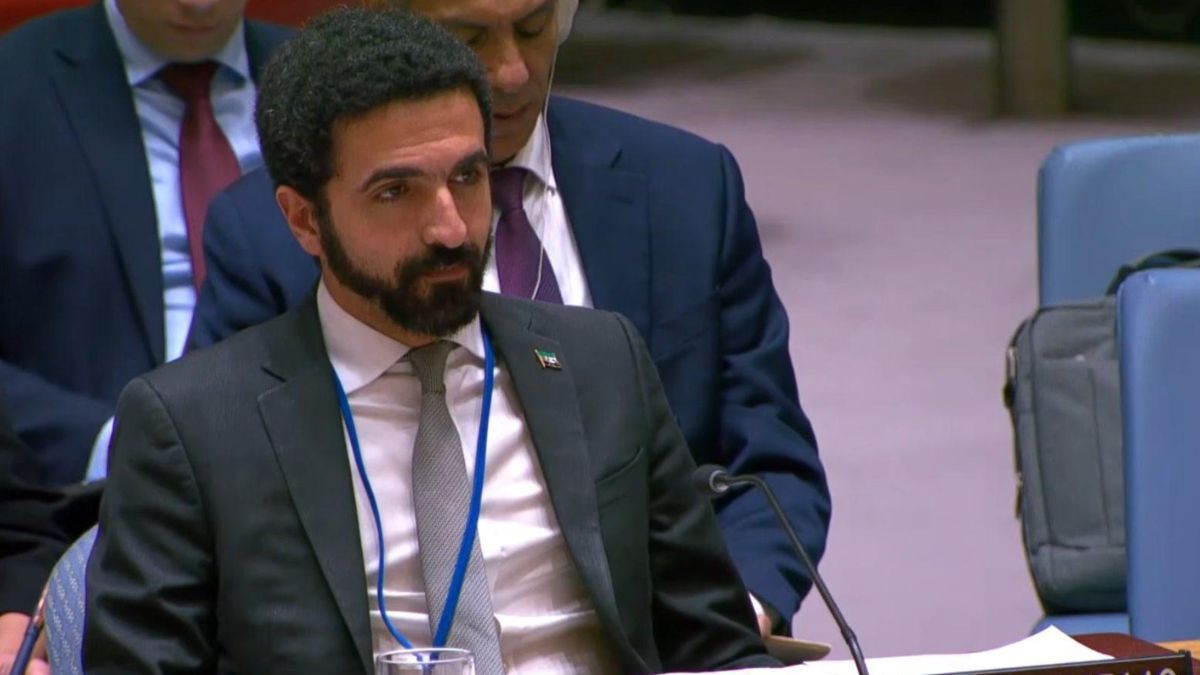
 Syria’s Permanent Representative to the United Nations, Ibrahim Olabi, during a UN Security Council session, September 12, 2025 (Syrian Alikhbariya)
Syria’s Permanent Representative to the United Nations, Ibrahim Olabi, during a UN Security Council session, September 12, 2025 (Syrian Alikhbariya)
Syria’s Permanent Representative to the United Nations, Ibrahim Olabi, stated that the country’s current priority is the economy, which will be the focus of the transitional president, Ahmad al-Sharaa’s, visit to Washington. He pointed to U.S. sanctions and the importance of lifting them.
In comments to Saudi TV channel Al Arabiya on Sunday, November 9, regarding al-Sharaa’s visit to the United States, Olabi said it is the first of its kind for a Syrian president. The mere presence of a Syrian president at the White House to meet President Trump and discuss many issues is, he said, a historic event.
According to Olabi, the United States drafted the UN decision supporting Syria and removing sanctions on the president and Interior Minister Anas Khattab. “This decision passed without any objection or veto from any country, receiving 14 votes in favor, and it was an American decision par excellence,” he said.
Al-Sharaa arrived in Washington on Saturday, November 8, on an official visit to meet his American counterpart, Donald Trump, on Monday, November 10.
Olabi said Syria’s priorities at this stage are not demands to be made of the United States or others. Syria’s priorities now center on the economy, specifically the need to support Syrians who have endured years of war, displacement, and dispossession.
The United States is a major economic power and imposed sanctions on the former regime, which is a very important issue that must be addressed.
President Trump has been a strong supporter of this policy, Olabi added, noting that he canceled sanctions issued by executive orders and suspended some sanctions linked to Congress. However, some congressionally mandated sanctions remain in place, and President Trump is applying pressure on the economy in this regard.
He noted that the first gateway to restoring a dignified life for Syrians is the economic one. UN reports indicate there are more than one million refugees, most of them in neighboring countries and elsewhere.
Olabi said the path toward lifting sanctions on Syria is clear and that the United States fully understands that Syria’s stability bolsters regional stability, which is in Washington’s interest.
Stability is not only a security matter, he argued. There must also be economic stability, and the government is working in that direction.
Olabi said discussions between Syria and Israel are ongoing. Security arrangements along border points, including delineations, troop numbers, and each side’s security concerns, are at the core of these talks.
He added that the United States supports these discussions, and at the United Nations, there is talk of Israel returning to the 1974 Disengagement Agreement, a central topic at the Security Council. “This is our starting point,” he said.
“We are not speaking here solely about Israeli issues, but about achieving stability, peace, and security for Syrians so we can continue the reconstruction process we began after liberation,” Olabi said, adding that if an agreement is reached, it will be announced directly to the Syrian people.
Al-Sharaa from Washington: Sanctions on Syria are in their final stages
The Syrian government’s efforts against the Islamic State group are not new, Olabi said. The battle began long ago and included opposition factions such as the former al-Nusra Front. What is happening now is increased security coordination with the International Coalition, which reflects realities on the ground.
Initially, the Syrian government was fighting the group alone. Now the efforts fall within the framework of the International Coalition, which has provided greater legitimacy to these efforts.
Olabi said communication with the American side is ongoing, and security coordination is underway. If there is a need to arrange matters in specific ways, it will be done in the interest of the Syrian people.
Although the challenges are great and the situation in Syria is highly complex due to the presence of many international powers, the basis for these negotiations is what such arrangements can provide to the Syrian people. “This is not about a single military base or more, but about serving local interests,” he said.
He believes balancing relations among major powers is critical. At the United Nations, the government is working for Syria’s unity and national rights and has succeeded in convincing many states to adopt supportive positions, as seen recently with the decision to remove the Syrian president’s name at the Security Council.
Olabi previously said that Syria and “Qatar Syria” introduced a resolution titled “Implementation of the Convention on the Prohibition of the Development, Production, Stockpiling and Use of Chemical Weapons and on Their Destruction,” which was adopted by more than 150 votes.
In his November 3 remarks to the UN General Assembly’s First Committee on Disarmament and International Security in New York, he said adoption of the draft marked a qualitative step toward establishing the truth and doing justice to the Syrian people after years of deception and obfuscation.
“Syria is no longer a state that has decisions dictated to it. It now sponsors and drafts the decisions that concern it, with international support,” Olabi said in a November 4 interview with Syrian al-Ikhbariya. He added that Syria has returned strongly to the international community at the United Nations and that many countries support it. Syria is building its foreign policy based on its developmental and economic interests.
Syrian Foreign Minister Asaad al-Shibani said Israeli strikes on Syria after the fall of Bashar al-Assad’s regime stunned Syria and made normalization talks “difficult.”
In a September 28 interview with CNN, al-Shibani criticized Israel for “impeding” the Syrian government as it faced what he described as rising “sectarian violence” in southern Syria.
He pledged that “a strong and unified Syria will benefit regional security, and this will benefit Israel.”
Transitional president Ahmad al-Sharaa warned that the Middle East is heading toward a new round of turmoil unless a security agreement with Israel is reached that preserves Syria’s sovereignty. He called on Tel Aviv to commit to a serious negotiating track and to stop exploiting a “moment of weakness” Syria is experiencing to carry out large-scale attacks.
In a lecture hosted by the Middle East Institute in New York on September 23, attended by hundreds of diplomats, journalists, and businesspeople, al-Sharaa said, “We have stepped up our diplomatic efforts for dialogue with Israel. We are not the ones causing problems. We fear Israel, not the other way around,” warning that continued air violations and ground incursions obstruct negotiations and threaten stability, according to Agence France-Presse.
Al-Sharaa said Damascus is open to a security agreement, but tied this to Israel’s acceptance of deploying UN forces under the 1974 agreement and to halting Israeli air and ground attacks.
U.S. Special Envoy for Syria Tom Barrack said Syria and Israel are moving closer to an agreement to “reduce escalation,” under which Israel would halt its attacks while Syria would agree not to move any vehicles or heavy equipment near the Israeli border.
if you think the article contain wrong information or you have additional details Send Correction


 A
A
A
A
A
A




 More Politics