

Mowaffak al-Khouja | Wasim al-Adawi | Amir Huquq |Omar Alaa Eldin
While Syrians hope the United States will lift the “Caesar” economic sanctions on Syria after the fall of the Assad regime, the road to repeal remains bumpy, even after the bill cleared the U.S. Senate on 10 October.
The measure now needs a vote in the House of Representatives, followed by a conference process to reconcile versions and send a final bill to U.S. President Donald Trump for signature. Inside the White House, however, competing forces are still at play.
As the White House presses Congress hard to repeal “Caesar,” several Washington groups and figures supportive of Israel, and opposed to the authorities in Damascus, are calling to keep sanctions on a state they view as a potential threat to them and to minorities such as Alawites and Druze.
Countering that push, a number of Syrian-American organizations are lobbying for full and immediate repeal, which would open the door for international companies to re-enter Syria’s post-war economy.
Enab Baladi reviews the efforts to keep the “Caesar” Act, first imposed on the former regime and its deposed president, Bashar al-Assad, in 2020, and examines the odds of its survival or repeal, the accompanying conditions, and the economic and political implications, through conversations with researchers and experts.
Pressure Triangle Confronts Trump’s Will
Repeal advanced significantly when the Senate voted to remove the law by passing the annual defense budget on 10 October. Yet key pushback remains, most prominently from pro-Israel organizations, before the issue lands in the House.
A senior congressional aide told Al-Monitor, on condition of anonymity, that officials at the White House and the Departments of State and Treasury “were very clear with Congress that the administration’s official position is full and final repeal of the Caesar Act.”
By contrast, some pro-Israel organizations in Washington are advocating to keep sanctions on a country they deem a potential threat to Israel and to minorities such as Alawites and Druze, according to the outlet.
Sources familiar with the lobbying told Al-Monitor that senior Israeli officials, including Ron Dermer, a close aide to Prime Minister Benjamin Netanyahu, have also been in touch with lawmakers.
Following those reports, Syrian American Council member Mohammad Alaa Ghanem posted a video on Facebook saying negotiations with the House are ongoing despite the government shutdown, cautioning that success is not guaranteed while expressing hope for a House compromise.
U.S. envoy to Syria Thomas Barrack has also pushed toward lifting sanctions, facilitating several meetings between Syrian Foreign Minister Asaad al-Shibani and the U.S. Treasury Department and members of both chambers on 19–20 September, including Lindsey Graham and Chris Van Hollen.
Another congressional source told Al-Monitor that Barrack called senior Republican lawmakers in recent weeks to urge them to support repeal.

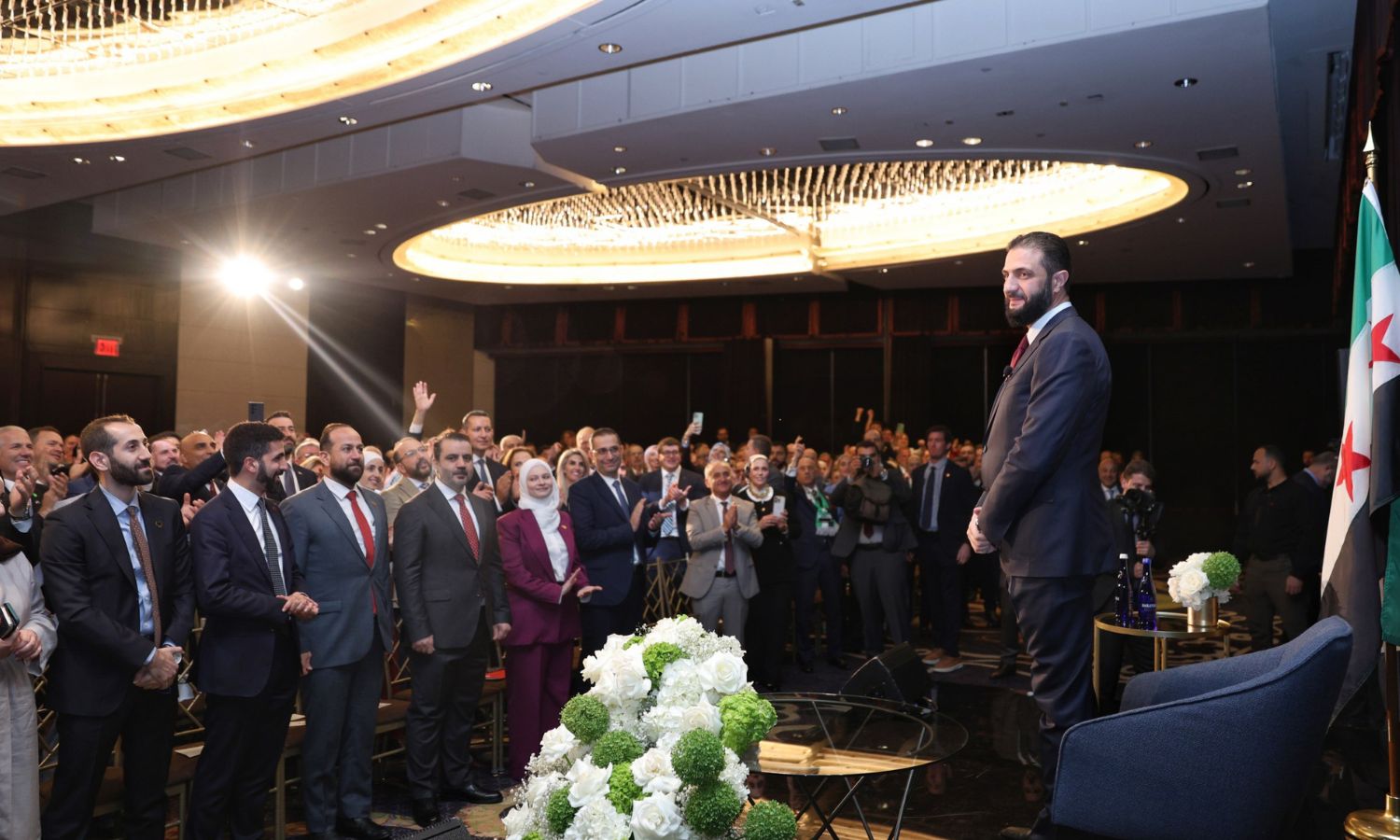
Syria’s transitional president Ahmed al-Sharaa meets a delegation from the Syrian diaspora in the United States, 22 September 2025 (Syrian Presidency).
Conditions tabled for lifting the law
On 15 September, before al-Shibani’s Washington visit, Sen. Lindsey Graham, a staunch supporter of Israel, introduced on his and Sen. Chris Van Hollen’s behalf an amendment to suspend the “Caesar” sanctions on Syria.
According to Congress.gov, Graham’s amendment stated that the “suspension shall not be absolute” and would be conditioned on strict, periodically reviewed commitments required of the transitional government:
-
Officially join the Global Coalition to Defeat ISIS.
-
Commit to fighting “terrorism.”
-
Protect the rights of religious and ethnic components and ensure their political participation.
-
Maintain peaceful relations with regional states, including Israel.
-
End support for, or sheltering of, designated “terrorist” organizations.
-
Remove foreign fighters from state and security institutions.
-
Hold perpetrators of crimes and violations accountable since December 2024.
Hours before the foreign minister’s meetings, Graham told Axios that al-Shibani would meet several House members to discuss permanently lifting “Caesar,” adding that his own support was conditional on Syria’s formal accession to the anti-ISIS coalition and a new security arrangement with Israel.
After the Senate’s passage of the repeal language, however, these provisions became non-binding.
According to Syrian American Council member Mohammad Alaa Ghanem, the non-binding provisions would automatically re-activate “Caesar” if benchmarks are missed. He added another non-binding clause under which Congress would consider reinstating the law if the Syrian government fails, for 12 consecutive months, to make progress on required items.
Researcher Mohammad Suleiman at the Jusoor for Studies Center said most of these items can be seen as a “political compass” more than “coercive conditions,” arguing that the Syrian government can, to varying degrees, implement several of the commitments and is “genuinely willing” to do so.
Former U.S. State Department advisor Hazem al-Ghabra told Enab Baladi that lifting sanctions is tied to “very clear and practically simple requests,” shared by Washington and Damascus, including “protecting minorities and their security, and combating terrorism.”
Who backs repeal, and who opposes it?
Coalitions over the “Caesar” Act in Congress and across the United States have fractured within both parties, and even within the Syrian-American community itself.
Supporters of repeal include:
-
The Trump administration, the U.S. Treasury Department, and the U.S. Chamber of Commerce.
-
Members of Congress:
-
Democrats: Jeanne Shaheen, Maxine Waters, Rashida Tlaib, Ilhan Omar, Jimmy Panetta, Pramila Jayapal.
-
Republicans: Joe Wilson, Rand Paul, Anna Paulina Luna, Marlin Stutzman, Lou Correa, Jack Bergman.
-
-
Families of Americans missing in Syria.
-
-
A number of Israel-aligned Republicans and Democrats: Lindsey Graham, Mike Lawler, Chris Van Hollen, Brad Sherman.
-
Pro-Israel organizations: AIPAC, Foundation for Defense of Democracies (FDD), Jewish Institute for National Security of America (JINSA), American Security Forum (ASF).
-
From Syrian groups: the Alawite Association of the United States (AAUS) and other organizations formed after the fall of the former regime.
Zaki Lababidi, a board member of the Syrian American Council, told Enab Baladi the Alawite Association is recently established with no real clout in Washington and lacks allies in either chamber. Despite obstacles from the powerful pro-Israel lobby, he said, “the Senate landscape is excellent,” while “the problem lies in the House,” where the Syrian-American community is working to secure a solution.
Lababidi added that the favorable counterweight is the clear desire of President Trump and the White House to lift sanctions, and their active pressure to that end, suggesting U.S. political balances will ultimately determine whether sanctions end.
Separately, the spiritual leader of Israel’s Druze community, Mowafaq Tarif, said he held meetings with members of Congress to set conditions for lifting Syria sanctions. In remarks to Alawite activists, shared by Israeli journalist Edy Cohen, he pointed to additional congressional outreach to push for re-imposing “Caesar” if the Syrian government violates minority rights.
What is the “Caesar” Act?
The “Caesar Syria Civilian Protection Act” was passed by the U.S. House on 15 November 2016 and signed by President Donald Trump on 21 December 2019, during his first term.
It sanctions anyone who provides support to the former Syrian regime and requires the U.S. President to sanction states allied with the deposed Assad. The law targets military, financial, and technical support from individuals, companies, and states, including Russia and Iran, and extends to those financing Syria’s reconstruction.
The act is named after a defected Syrian military photographer, Farid al-Mudhan, who leaked 55,000 images of 11,000 detainees in 2014 who died under torture. The FBI authenticated the photos, which sparked global outrage and were presented to the U.S. Senate.
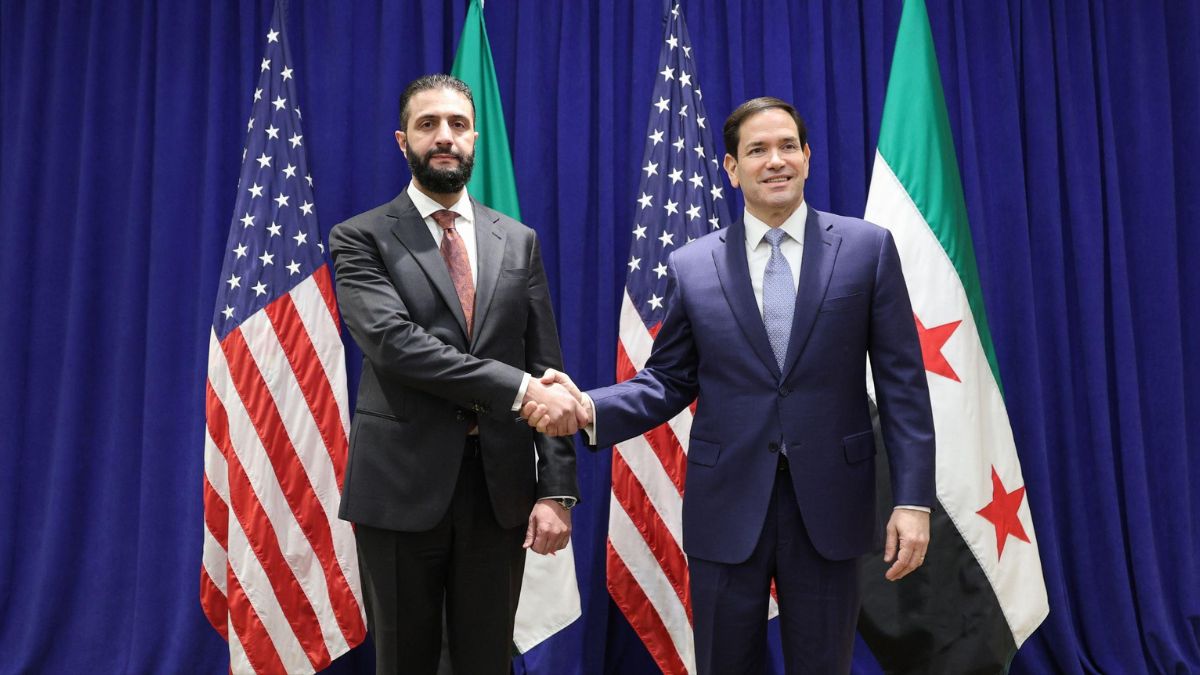
Syrian President Ahmed al-Sharaa meets U.S. Secretary of State Marco Rubio in Washington, 22 September 2025 (Syrian Presidency).

Congress weighs “supervised liberalization” of sanctions
U.S. Syria sanctions have re-entered Washington’s spotlight amid a deep debate over how to engage with Syria’s new authorities after Assad’s fall and the country’s shifting regional role.
Syrian political analyst Abdullah al-Ali told Enab Baladi that Washington is unlikely to enact a full, final repeal. Rather, he expects a dismantling process under strong oversight, balancing economic opening with retained U.S. leverage. Israel’s interests, counterterrorism, Captagon trafficking, and refugee policy all shape the U.S. decision.
Any opening, he stressed, would be conditioned by strict monitoring, not a free-for-all.
The opportunity and the constraints
According to al-Ali, the post-Assad moment has raised the chances of lifting U.S. sanctions more than ever, but that does not mean a swift outcome. He argues the opportunity is linked to “precise preconditions and arrangements” set by backers to ensure the political transition aligns with their interests. Sanctions may be eased, but replaced by “new mechanisms,” targeted sanctions or snap-back threats, to preserve oversight.
Complicating matters, he said, are armed formations that replaced the former regime and remain under UN sanctions. Lifting those would require a UN Security Council decision. He pointed to the Council’s recent failure to delist just two individuals despite a major U.S. push.
U.S. divisions and Hill legislation
Per al-Ali, the sanctions debate is no longer a classic partisan split. In the Senate, cross-party blocs backed repealing “Caesar” via the defense bill, while others in both parties favored a two-year extension.
This reflects two dominant approaches:
-
Monitored opening: end broad sanctions while retaining oversight and a rapid “snap-back” mechanism.
-
Conditional gradualism: set prerequisites or time-limited extensions before broad liberalization.
He added the parties still share a baseline: protecting U.S. and allied interests while reducing burdens on Syrians.
Oversight mechanics and conditions
The Senate text reportedly includes an important oversight clause: periodic reports every 120 days across six criteria, with a snap-back trigger if indicators slip twice, turning any lifting into continuous monitoring, not an irreversible end.
Al-Ali said coordination with Moscow does not preclude lifting sanctions but would necessitate more conditionality to keep deconfliction rules steady and the front linked to Israel calm.
According to al-Ali, the web of issues shaping U.S. policy on whether to lift sanctions on Syria includes:
Still, he noted practical questions: how to ensure stability and civil peace across all Syrian constituencies. Lifting without real guarantees from Damascus may not be feasible, he said.
The goal, per Barabandi, is to give Syria breathing room, conditioned on formal commitments, with a mechanism to restore sanctions if commitments are broken. Those arguing for strict conditions insist Damascus must not get a “green light” to ignore obligations.
Field challenges
Both al-Ali and Barabandi agree the situation on the Syrian coast (western Syria) and events in As-Suwayda (southern Syria) pose challenges to minority rights and human-rights policy, and that foreign lobbying interests in continued instability complicate sanctions talks.
Still, Barabandi stressed that timing and implementation of lifting depend on U.S. internal consensus. Once that is set, the decision’s time and place will follow.
Together, their views suggest the question is less whether U.S. sanctions will be lifted than how, and what conditions Damascus must credibly meet.
A conditional historic convergence between Republicans and Democrats
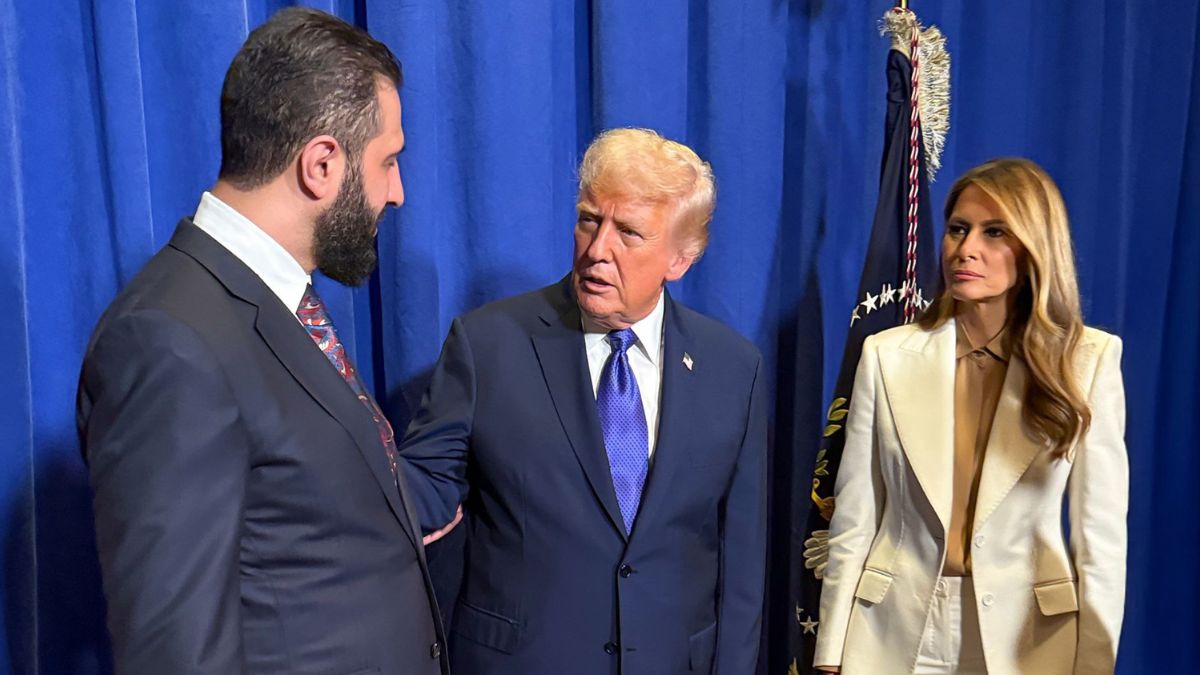
Syrian President Ahmed al-Sharaa meets U.S. President Donald Trump and First Lady Melania Trump, 25 September 2025 (Syrian Presidency).
The legislative path for “Caesar”
Samir Sabounji
Syrian-American attorney and member of the U.S.–Syria Business Council
Repeal passed in the Senate’s version of the NDAA. Both House and Senate pass their own versions annually. The House passed its bill without the “Caesar” repeal, while the Senate included explicit repeal language.
Next, the two chambers meet in a conference committee to resolve differences and produce a unified bill. At that stage, provisions absent from either original version can still be added if both sides agree.
Through this process, the “Caesar” repeal could make the final text, or be dropped. Politically, momentum now favors inclusion, given growing bipartisan appetite to reassess U.S. Syria sanctions.
For now, the federal government shutdown has paused legislative business and delayed the conference and final vote. Even so, there is public pressure to pass the defense budget.
Possible outcomes
If Congress reaches an agreement to repeal or amend the “Caesar” Act, there are three main possible formats:
-
Full, unconditional repeal: the “Caesar” Act is rescinded in its entirety, immediately ending the legal basis for the sanctions imposed under it.
-
Repeal with periodic reporting requirements: the law is repealed, but a reporting mandate is added. In this case, the U.S. President or the Department of State must submit regular reports to Congress on the Syrian government’s performance, such as progress on human rights, political reform, and humanitarian access. Congress retains the right to reimpose sanctions through new legislation if it finds that Syria has failed to meet the set benchmarks.
. In this model, the law is effectively repealed, but congressional oversight continues via the reporting mechanism.
.If Congress decides in the future to restore sanctions, it would need to pass a new law, by nature a lengthy and complex process. -
Temporary suspension with conditional review: enforcement of the “Caesar” Act is suspended indefinitely, with a clear timeline for reporting (e.g., one or two years). If the Syrian government meets the specified benchmarks within that period, the law would then be permanently repealed.
This scenario maintains the current suspension of “Caesar,” but with defined criteria and a clear timetable paving the way for its final repeal.
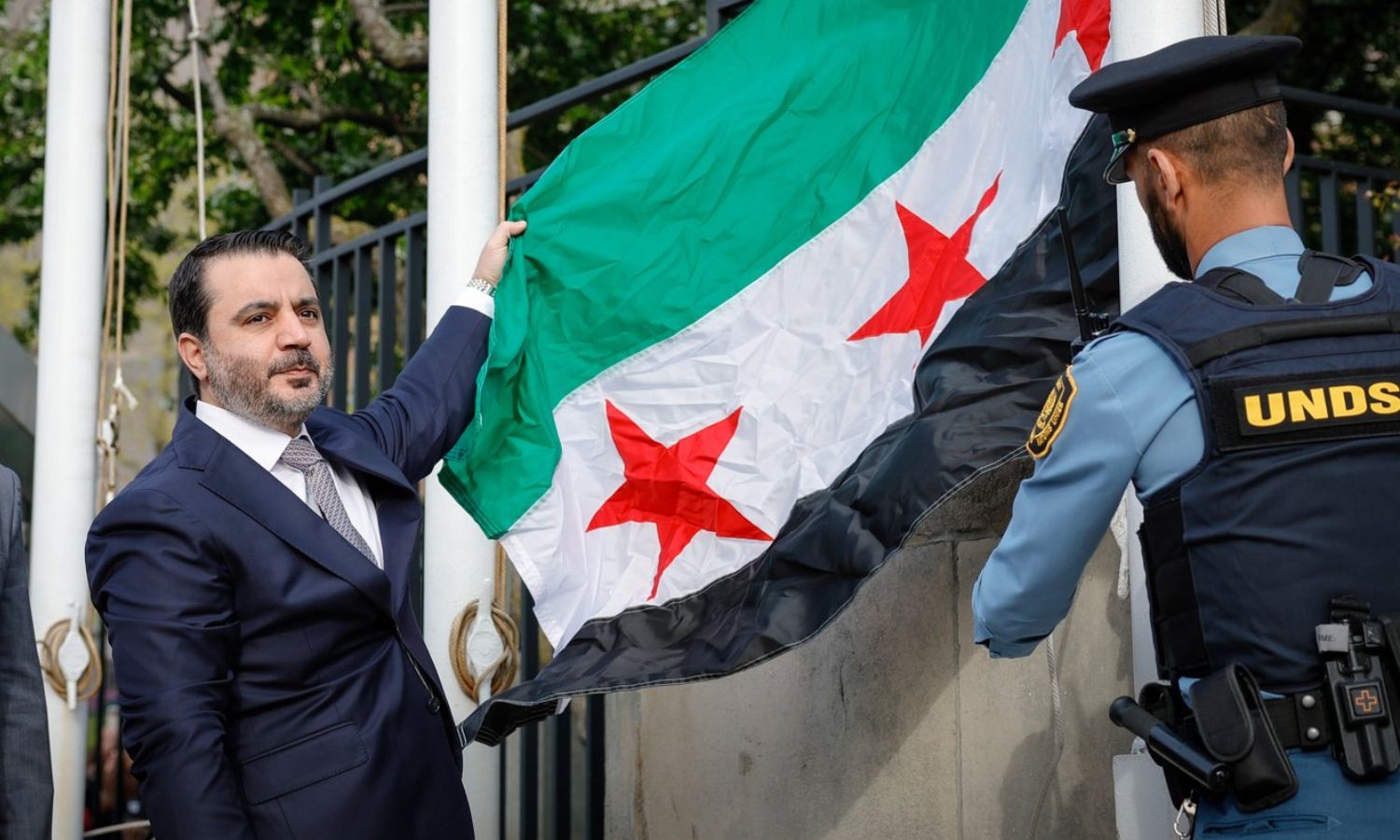
Syrian FM Asaad al-Shibani raises Syria’s new flag at the UN, 25 April 2025 (X).
Economic and political impact:
scenarios if “Caesar” stays or goes
Since the United States and Western countries imposed sanctions on Damascus, multiple sectors of the Syrian economy have been severely affected, making the question of lifting or modifying these sanctions critically important for the country’s economic future.
Changes so far haven’t translated into visible gains
Vittorio Maresca di Serracapriola, lead sanctions analyst at Karam Shaar Consulting, told Enab Baladi that many U.S. economic sanctions on Syria have already been eased. Most banks were delisted, Hayat Tahrir al-Sham’s foreign-terrorist designation was adjusted regarding governance structures, and several entities and individuals were removed from lists. “Caesar” is temporarily waived in practice, and some provisions of the Syria Accountability Act have been softened.
In theory, this re-opens major sectors to trade and investment. Yet banks and reconstruction projects have seen little tangible improvement, mainly for two reasons:
-
Other sanctions still apply. “Caesar” remains on the books even if waived, so secondary exposure could snap back at any time.
-
Persistent ambiguity deters even non-U.S. firms and banks from re-engaging.
Investment appetite
Economist Dr. Ali Mohammad told Enab Baladi that while outcomes hinge on many variables, current dynamics point to a strong likelihood of full repeal. Some companies are already waiting to execute memorandums of understanding with Damascus, worth about 24 billion dollars, once sanctions are cleared, which could jump-start production and industry.
Lifting sanctions would help attract new investments, especially in power projects, and encourage foreign banks to re-enter the market.
Capital inflows and the lingering “sanctions overhang”
If all sanctions are fully lifted, renewed business interest and a tangible inflow of capital into Syria can be expected, according to Vittorio Maresca di Serracapriola, lead sanctions analyst at Karam Shaar Consulting.
However, he emphasized that a “sanctions overhang” would likely persist: ongoing uncertainty, reputational risk, and compliance concerns even after formal restrictions are removed.
Addressing this requires steps on both sides, including:
Syrian banks strengthening their anti–money laundering and counter–terrorist financing frameworks.
Creating risk-sharing mechanisms or incentives, since markets are unlikely to take the plunge again without external support.
Investment Opportunities Syria Needs
Financial sector: a highly significant opportunity through opening branches of international banks and major financial firms.
Tourism sector: capable of bringing in substantial foreign currency and activating multiple facilities such as hotels, resorts, and planned tourism cities.
Technology, telecommunications, and artificial intelligence: a critical opportunity today; the groundwork exists but lacks tools. Success here can lift the wider economy by boosting industry, agriculture, and tourism.
Dr. Majdi al-Jamous
University professor and economic expert
If some sanctions remain
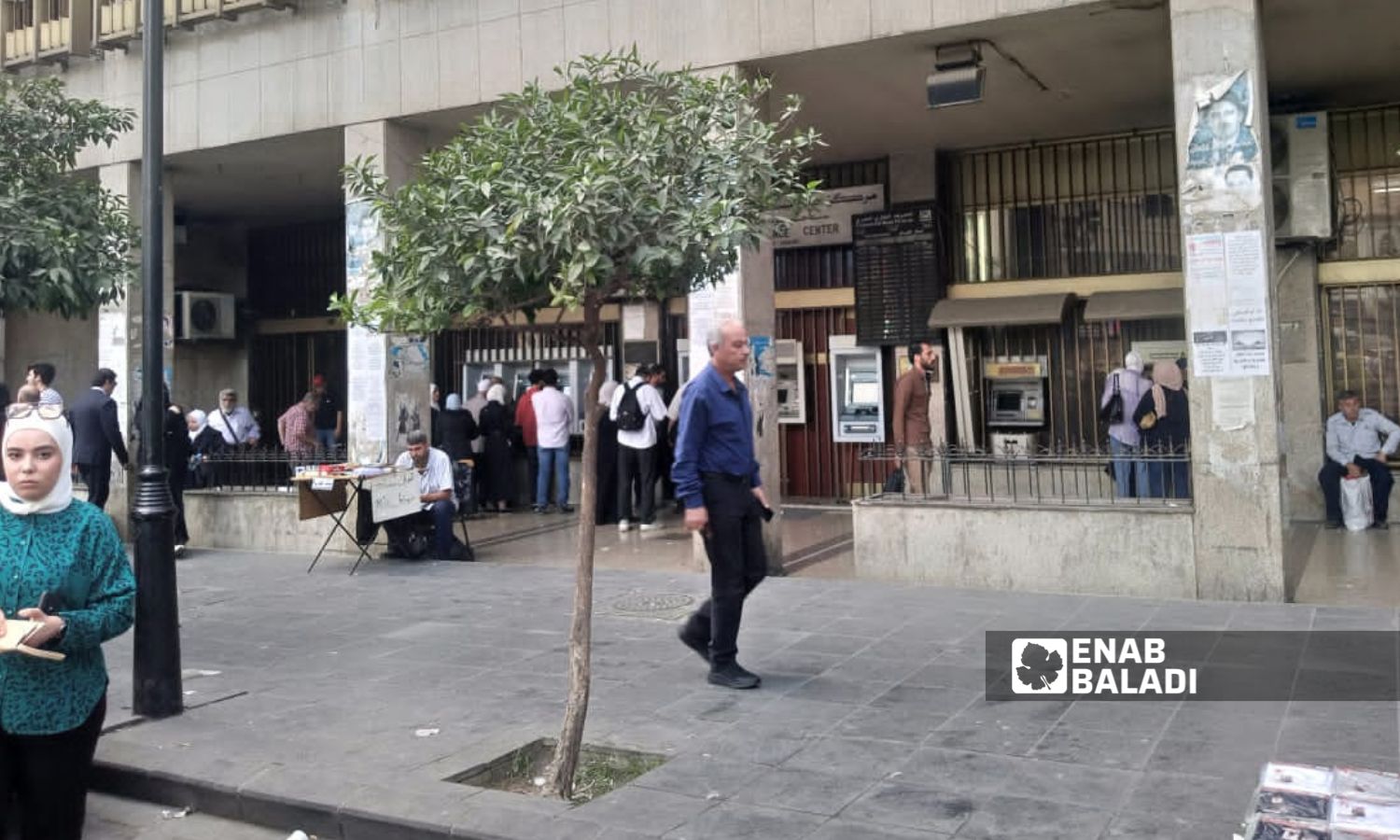
Customers at state bank ATMs in central Damascus, 12 October 2025 (Enab Baladi/Marina Marhej).