
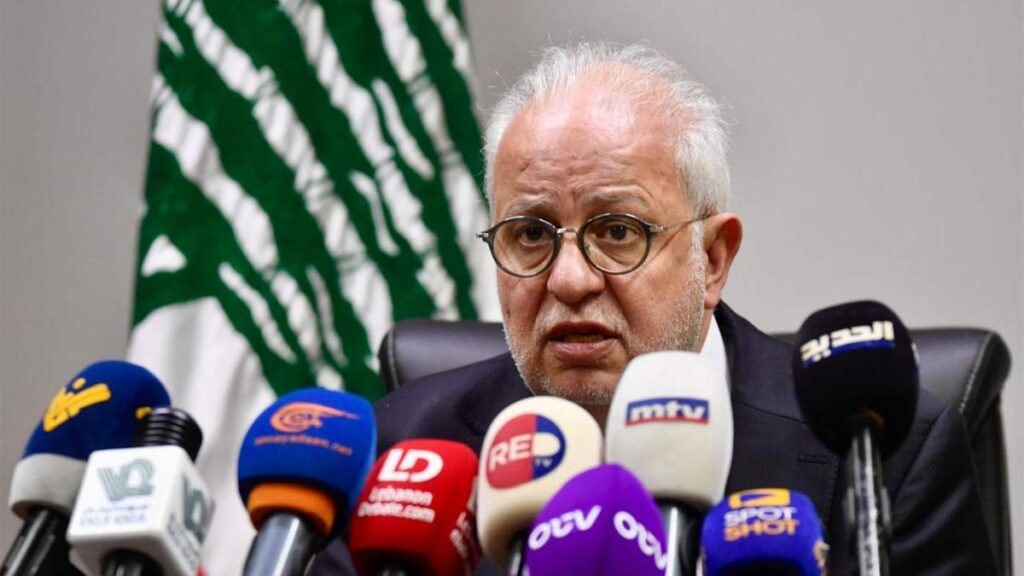

Lebanese Justice Minister Adel Nassar said that Syria is showing a positive attitude toward providing his country with information on assassinations and enforced disappearances that took place under the former Assad regime.
In a press conference on the evening of Friday, 21 November, Nassar stated that the Lebanese Ministry of Justice had sent an official request to Damascus for data concerning a series of assassinations that targeted prominent Lebanese figures inside Syria, in addition to files of Lebanese who were forcibly disappeared and fugitives from justice.
Among the most prominent figures assassinated in Syria were former presidents Bachir Gemayel and René Moawad, former prime ministers including Rafic Hariri, and religious figures, most notably former Grand Mufti of Lebanon Sheikh Hassan Khaled, among others.
Nassar pointed to positive signals from the Syrian side in this regard, expressing his hope that this positivity would translate into concrete, practical steps.
Regarding the prisoners’ file, the Lebanese minister explained that the cases of Syrian prisoners in Lebanon are handled in accordance with the applicable laws and regulations and through the competent institutions, stressing that Lebanon is committed to the law and the sovereignty of its institutions.
There are no official estimates of the number of Lebanese missing in Syria, but the Association of Lebanese Detainees in Syrian Prisons estimates the figure at 622 missing persons.
Meanwhile, former Lebanese Justice Minister Henri Khoury submitted in December 2024 a list containing more than 6,500 names of Lebanese missing in Syria.
During and after the Lebanese civil war, a wave of assassinations targeted militia leaders, intellectual and political figures, and security officials, in the context of the struggle for influence between Syria, other Lebanese actors, and Israel.
Many of these operations have never been conclusively resolved in court as to who was behind them, but fingers of blame have repeatedly pointed at the Syrian regime or its allies in Lebanon.
Mitri in Damascus
Deputy Prime Minister Tarek Mitri visited Syria on 20 October this year, where he met President Ahmad al-Sharaa, and the two held in-depth discussions on ways to improve and develop bilateral relations between Lebanon and Syria in the service of their common interests and in a manner that contributes to strengthening stability and cooperation at various levels.
According to the Lebanese National News Agency, Mitri also held a series of meetings with several senior Syrian officials, including Foreign Minister Asaad al-Shaibani and Justice Minister Mazhar al-Wais.
During the two meetings, they discussed various shared files, including the issues of detainees, the missing, and the border question, and stressed serious work to find fair and workable solutions to these issues in a way that safeguards rights and strengthens judicial cooperation between the two countries.
The two sides underlined during the meetings “the importance of continuing coordination and developing relations in the political, security, judicial, and economic fields, in a way that helps open new horizons for constructive cooperation between Lebanon and Syria.”
No final vision yet
In a joint press conference between Syrian Justice Minister Mazhar al-Wais and Lebanese Justice Minister Adel Nassar on 14 October this year, Nassar stressed that “there is no need to prolong things, and the legal frameworks and sovereignty of both states must be respected,” noting that “there is a desire for cooperation.”
For his part, al-Wais said, “We have not yet reached a final vision, and what happened in Syria is substantial at the legal and constitutional levels, but the points of view are close and the will and desire are shared, and we are forming teams and trying to cooperate within the framework of truth and justice.”
Nassar had stated one day before the press conference that the Lebanese Ministry of Justice had prepared an initial working draft consistent with the constitutional principles and legal procedures in force in both countries.
He explained that the meeting aims to lay the “foundations for a radical solution” to this file, away from any “selectivity,” within a transparent and responsible judicial process, stressing that any release of detainees will only take place after a careful study of each case in accordance with legal and international standards.