


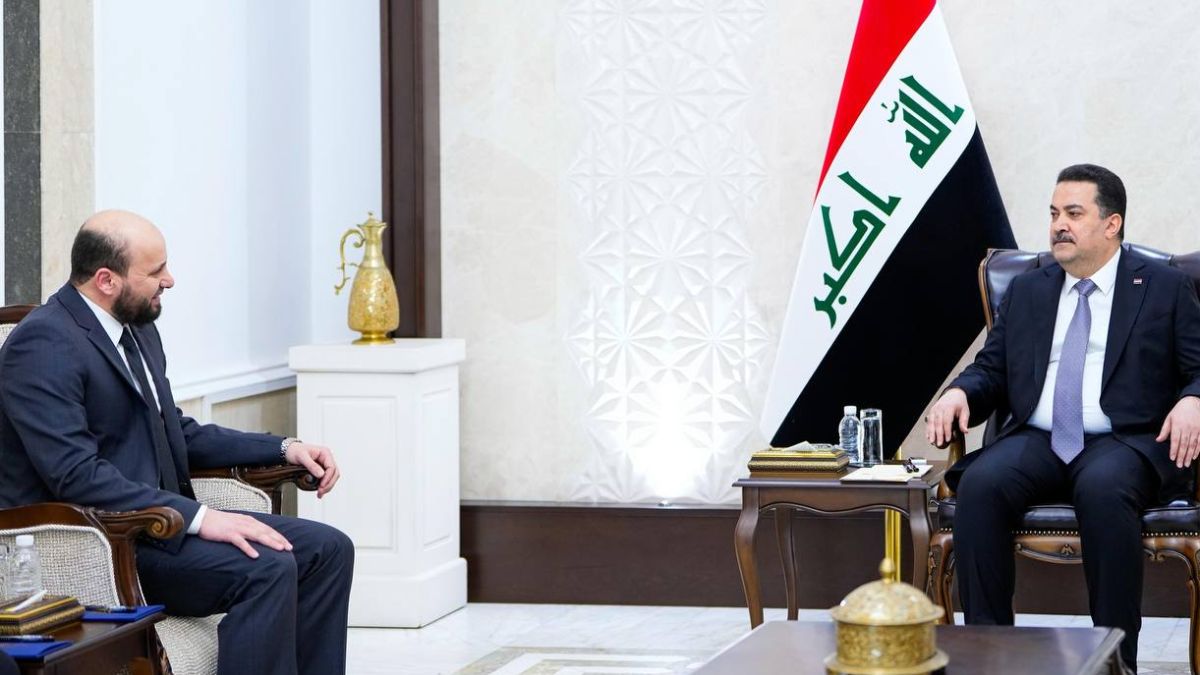
 Iraqi prime minister meets Syrian Energy Minister Mohammed al-Bashir to discuss reviving the Kirkuk-Baniyas line, 12 August 2025 (Iraqi Prime Minister’s Media Office)
Iraqi prime minister meets Syrian Energy Minister Mohammed al-Bashir to discuss reviving the Kirkuk-Baniyas line, 12 August 2025 (Iraqi Prime Minister’s Media Office)
Syria and Iraq have agreed to appoint a consultant to evaluate the condition of Iraq’s oil pipeline to Syria, which has been out of operation since 2003 due to war and political turmoil.
Iraqi Prime Minister Mohammed Shia’ al-Sudani told Reuters on Tuesday, 4 November, that Baghdad and Damascus agreed to commission an assessment of the Kirkuk-Baniyas pipeline with a view to bringing it back online.
In August, the Iraqi premier met Syria’s Energy Minister, Mohammed al-Bashir, to discuss reviving the line.
While al-Sudani offered only a brief statement, Syria’s Energy Ministry had not commented on his remarks at the time of publication.
On 13 October, Abdul-Baqi Khalaf, adviser to Iraq’s oil minister, said multiple attempts had been made to restart the line linking Iraq to Syria, but the age of the pipes has prevented that. In an interview with the Saudi outlet Asharq, he said both countries are keen to restart the pipeline but that a fresh technical evaluation is needed.
In August, al-Bashir and al-Sudani discussed reactivating the Kirkuk-Baniyas route. According to a 12 August statement by Syria’s Energy Ministry, the meeting addressed forming a joint technical committee to study the pipeline’s condition and define rehabilitation options that would benefit both economies.
Analysts say rehabilitating and restarting the Kirkuk-Baniyas pipeline carries deep strategic implications that could redraw regional oil flows and affect economic alignments over the medium and long term. That outcome, however, depends on difficult security, political, and technical conditions, according to Nawar Al-Saadi, director of the Research Center at Cihan University in Iraq and a doctor of international economics, who spoke to Enab Baladi earlier.
The line was built in 1952, spans roughly 800 kilometers, and originally had a throughput of up to 300,000 barrels per day. It is one of the region’s oldest export routes.
Estimates suggest rehabilitating the route could cost around eight billion U.S. dollars to accommodate export capacity of about 700,000 barrels per day, though lower figures are possible if only partial rehabilitation is undertaken.
The project could be viable, Professor Hassan Hazouri of the Faculty of Economics at the University of Aleppo said in an earlier comment to Enab Baladi, if several conditions are met:
If the gap between costs and risks on one side and potential returns on the other remains large, however, the project’s feasibility would be in doubt.
if you think the article contain wrong information or you have additional details Send Correction


 A
A
A
A
A
A


 More Economic Reports