


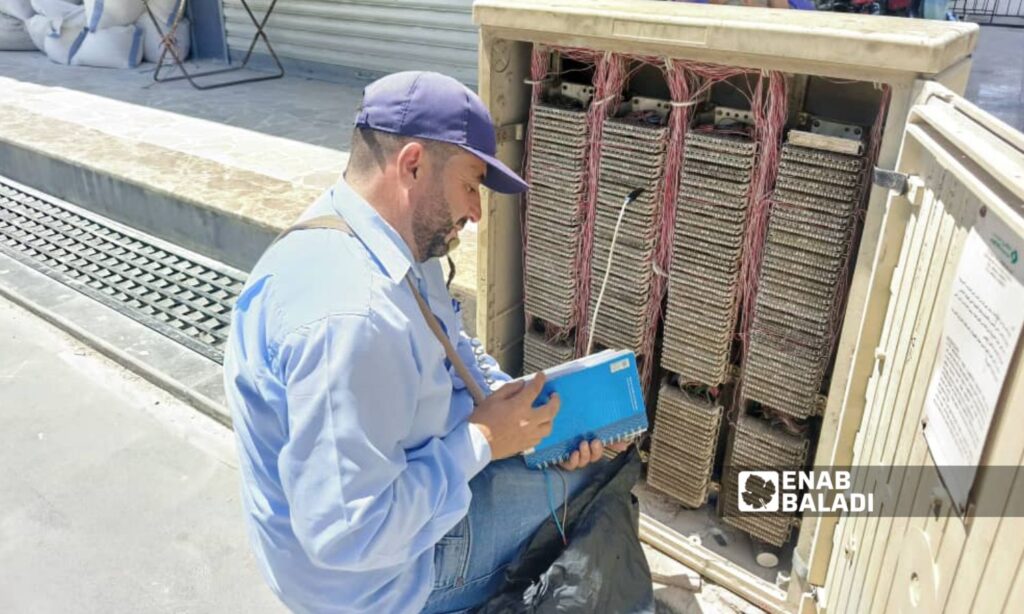
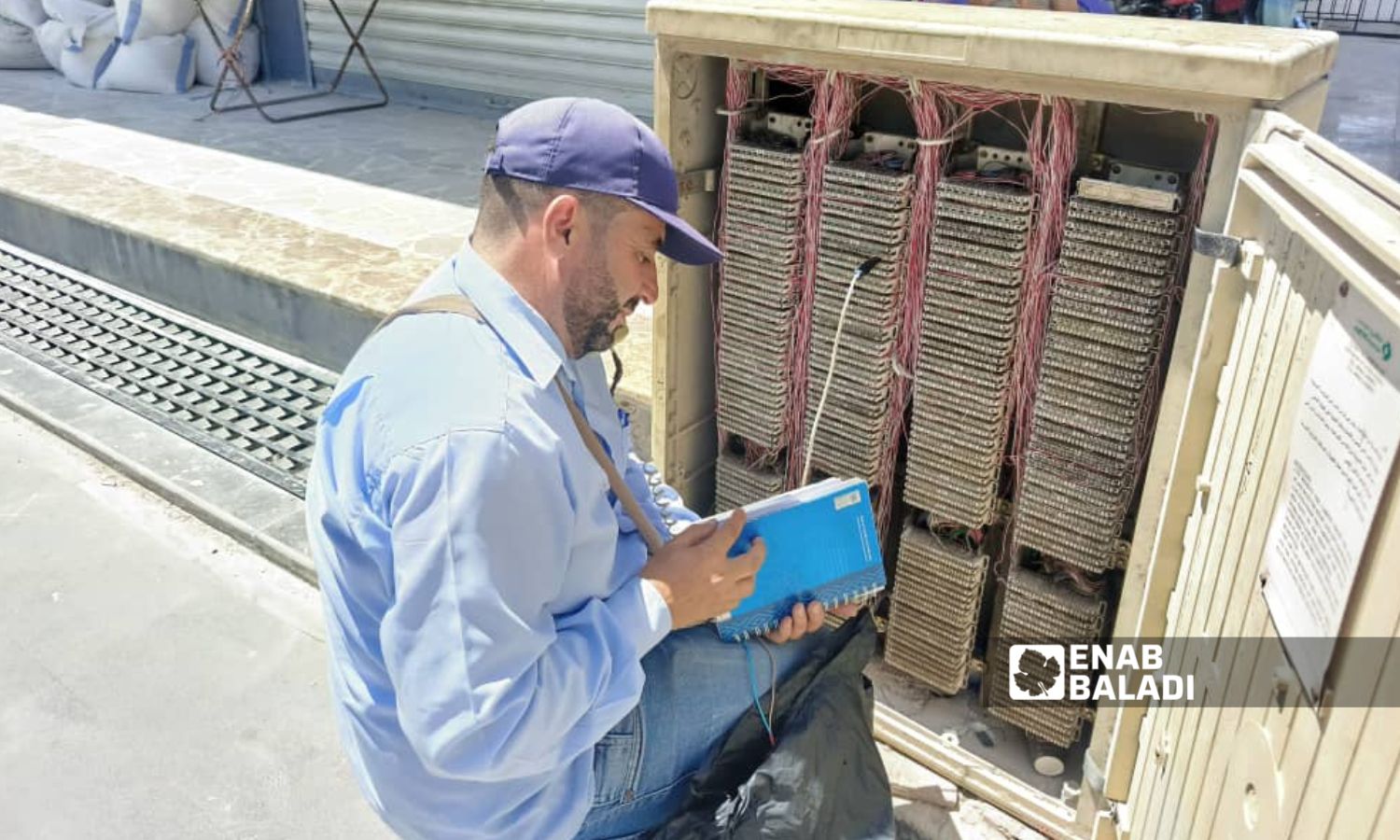
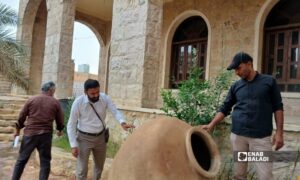
 An employee at the Daraa Telecommunications Directorate repairs landline cables, 30 June 2025 (Enab Baladi / Enab Baladi/Mahjoub al-Hashish)
An employee at the Daraa Telecommunications Directorate repairs landline cables, 30 June 2025 (Enab Baladi / Enab Baladi/Mahjoub al-Hashish)
Daraa – Mahjoub al-Hashish
The internet sector in Daraa province (southern Syria) has been experiencing repeated outages after vandalism of the fiber-optic cable between the provinces of Daraa and Damascus, which has intermittently paralyzed the service.
Residents suffer from weak coverage, which has pushed them to seek alternatives such as Starlink satellite internet or satellite internet coming from Jordan.
Several residents told Enab Baladi that the province has seen repeated internet outages in recent weeks, while the Director of the Syrian Telecom Company in Daraa, Ahmad al-Hariri, blamed this on thieves attacking and sabotaging the fiber-optic cable.
Al-Hariri said the most recent act of vandalism took place in early October, noting that such incidents have declined since one of the saboteurs was arrested.
Attacks on the cable cause paralysis in data exchange, especially in banks, civil registry offices, citizen service centers, passport offices, as well as all government departments and economic and commercial activities linked to the capital, Damascus.
Hayyan al-Shaaban, a university student in Daraa, told Enab Baladi he waited for hours to obtain an official document from the university administration because of the internet outage.
He added that he struggles to communicate with his friends and family while at university, and also finds it difficult to coordinate with the driver of the only minibus that goes to his village when he wants to return home.
Hayyan relies on Jordanian satellite internet at his house, but is forced to activate a mobile data plan from Syriatel to secure internet access while he is at university.
For his part, Yasin al-Akrad, a resident of the Tariq al -Sadd neighborhood in Daraa city, said he waited for hours to obtain a criminal record certificate at the Criminal Security Department. The same thing happened to him at the court, where the employee told him that “the internet is down from Damascus.”
Mohammad al-Hussein, a media worker in Daraa, resorted to sharing a Starlink subscription with his friends due to the poor quality of internet, in addition to the fact that internet services in Syria do not meet his professional needs.
Mohammad pays 25 US dollars per month for the satellite internet subscription. He says he wants a strong connection at home so that he can keep up with events and upload the photos and videos he films as quickly as possible.
He added that some official departments have also installed Starlink to secure an internet service that meets their needs.
Starlink subscribers pay 100 US dollars per month as a subscription fee.
The Telecommunications Ministry has previously warned against possessing Starlink devices or distributing satellite internet without a license, considering this a violation of the regulations and laws in force.
The head of the Syrian Telecommunications and Post Regulatory Authority, Atef al-Deiri, said on 25 January that the use of unlicensed satellite internet stations is a clear violation of applicable regulations, calling on companies and users to comply with the rules.
He added that the “WiFi Outdoor” service, a wireless network independent of landlines, is a pioneering experiment to provide internet in underserved areas, noting that it is already available in areas of northern Syria.
Al-Deiri explained that the service relies exclusively on internet provided through the Syrian Telecom Company, and that it will not be allowed for now in areas served by ADSL, with priority given to regions suffering from a lack of internet services.
The Director of Telecoms in Daraa, Ahmad al-Hariri, said that the Daraa branch of the state-owned Syrian Telecom Company is in the process of increasing the international internet bandwidth and extending fiber-optic cables to all provinces.
He promised to replace copper networks with fiber and to serve areas that currently lack telephone service with fiber networks, in line with the company’s upcoming plan.
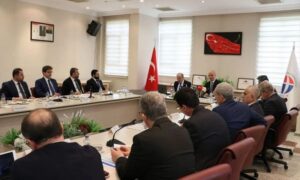
In a step expected to improve the reality of internet services in Syria, the Syrian Telecom Company signed, on 25 October, an agreement with the Spanish company Medusa, headquartered in Barcelona, to land the first international submarine cable connecting Syria to the global communications network.
The project will be implemented in phases until its full completion in 2027, with its services expected to cover all Syrian provinces.
During the signing ceremony, Minister of Communications Abdulsalam Haykal said this project goes beyond being a piece of digital infrastructure, describing it as a message to the world that Syria has returned to be a bridge between continents, between Europe and Asia, and a symbol of cooperation and openness that reflects the character of the “new Syria.”
if you think the article contain wrong information or you have additional details Send Correction


 A
A
A
A
A
A



 More Society