


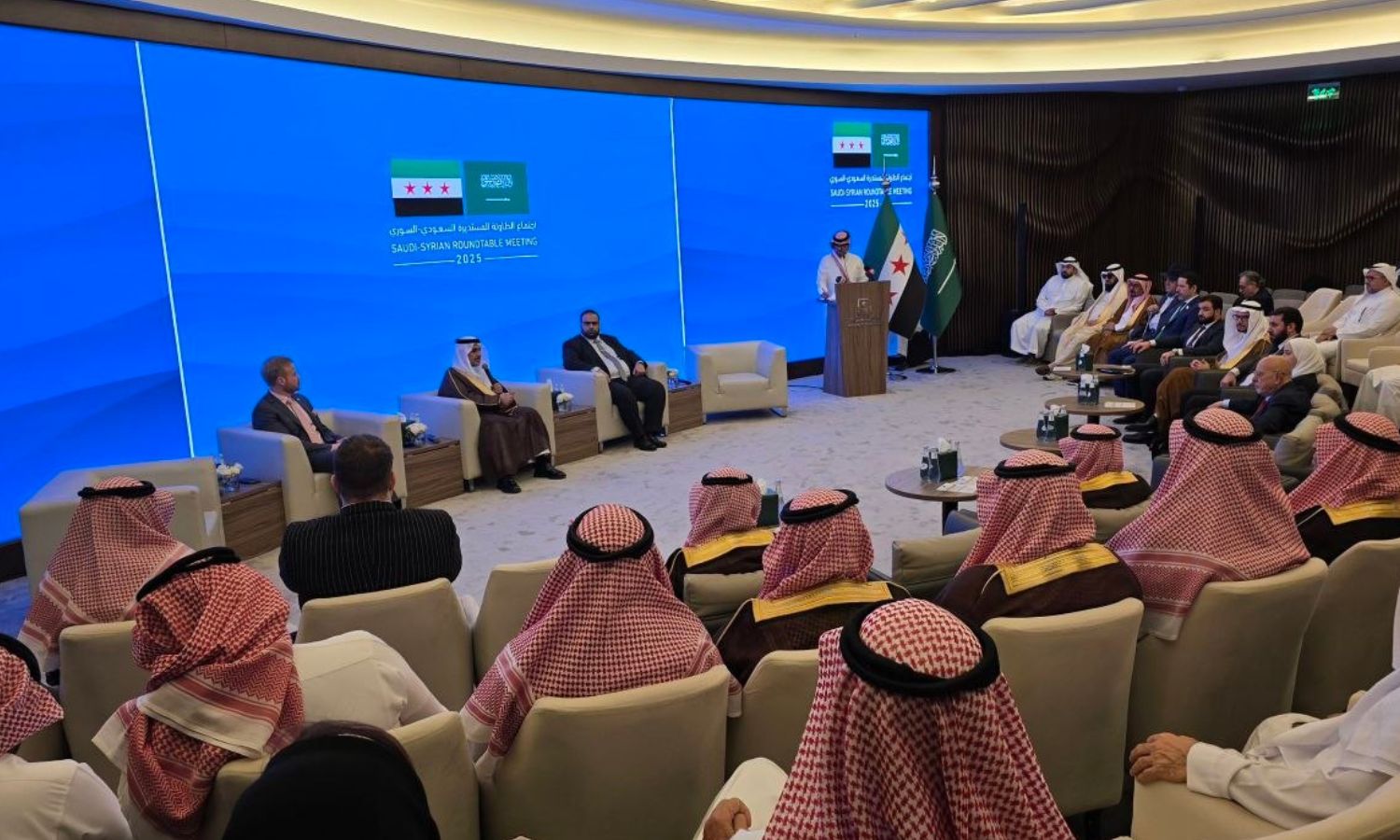
 Saudi–Syrian economic roundtable, October 27, 2025, Ministry of Economy and Industry/X.
Saudi–Syrian economic roundtable, October 27, 2025, Ministry of Economy and Industry/X.
André Lahoud, CEO of Bemo Saudi Fransi in Syria, said the bank hopes cooperation will include vocational training for Syrian youth and upgrading the banking sector’s technology infrastructure, to enable investors to conduct direct financial dealings between the two countries.
Lahoud said activating direct transfers between the two banks builds confidence and opens new horizons for investment that benefit both institutions and the Saudi and Syrian economies. The step is also meant to accommodate the large number of investors seeking to enter the Syrian market by providing a banking channel through which operations between the two countries can be carried out.
Bemo Saudi Fransi told Enab Baladi that outward and inward international transfers are available via the SWIFT system in euros, subject to the correspondent bank’s approval, or in Saudi riyals, and that there is no specific cap on transfer amounts.
Benjamin Fève, lead researcher and analyst at the Karam Shaar Center for Consultancy, said the immediate effect of reactivating transfers between the two banks is the creation of direct financial channels between Saudi Arabia and Syria. This is crucial, he argued, because it means that all the agreements, memorandums of understanding, and contracts recently signed by Saudi entities for projects in Syria can actually be financed.
He explained that, for example, if an investor wants to build a large factory in Syria costing several million dollars, but cannot transfer funds from Saudi Arabia or from Qatar or France to Syria, the project cannot proceed. Launching direct financial channels between Saudi Arabia and Syria addresses this problem, at least partially.
This step will also allow banks that maintain correspondent relationships with Saudi Fransi in the Kingdom to offer their clients the option to send money to Syria as well. If another bank in Saudi Arabia or a bank in Qatar has ties with Saudi Fransi, then an investor in Qatar could route funds to Syria via Saudi Arabia. This is the essence of how banks transact with one another, Fève said.
Dr. Abdul Hakim al-Masri, economist and former finance minister in the Syrian Interim Government, told Enab Baladi that this cooperation will facilitate transfers between the two countries without complications and help invigorate bilateral trade. Its importance lies in reassuring Saudi investors about dealing with the Syrian side.
Fève cautioned that it remains to be seen whether the plan will be fully implemented. Recently, for instance, a SWIFT transfer was executed between an Italian bank and a Syrian bank, but it did not go beyond a single pilot transaction, and the amount was very limited.
Experts note that sanctions on Syria continue to hinder the banking sector’s recovery and relaunch. The Caesar Act still restricts the movement of actors in banking and investment, and compliance concerns continue to delay the start of transfers between international and Syrian banks.
Fève said several obstacles could impede expanding these new channels between Syria and Saudi Arabia, even as normalization efforts continue. Chief among them are regulatory and compliance risks. Despite recent political outreach, Syria is still classified as a high-risk jurisdiction under international banking standards, and most global correspondent banks avoid Syrian institutions due to U.S. sanctions and concerns over anti-money-laundering and counter-terrorist-financing compliance, as well as misalignment with Financial Action Task Force recommendations.
He added that Syria is on the FATF grey list, which means that even if Saudi banks obtain the licenses needed to operate with Syria, their ability to settle transactions through major global financial systems will be limited or constrained. Even without formal restrictions, some transactions may be deemed high-risk.
Abdulkader Husrieh, governor of the Central Bank of Syria, said on September 21 that the Syrian banking sector needs infrastructure and governance upgrades. To bolster the sector, authorities are working to raise governance and transparency requirements and to support the digitalization of banking services to expand financial inclusion.
Speaking to the Saudi daily Asharq Al-Awsat about plans to update banking regulations and strengthen fintech, Husrieh said there is a plan to modernize supervisory and legislative frameworks in line with international practices and to introduce new technical requirements. Priorities include developing the infrastructure for electronic payments and encouraging mobile-payment solutions.
Fève said Syria’s technical and institutional readiness could pose practical challenges. Although the Central Bank is working to develop financial infrastructure and digital payment systems, integrating these with modern international standards, including SWIFT connectivity, compliance screening, and cybersecurity, will take time, and any delay in these reforms could slow or limit direct banking cooperation.
Before we see transfers worth tens or hundreds of millions of dollars to Syria, Fève believes Syrian banks will need a full systems overhaul because, in their current state, they are not ready to handle such large volumes.
Dr. Abdul Hakim al-Masri told Enab Baladi that Syria faces complex regulatory and technical obstacles that could be solved if Caesar Act sanctions are lifted, but some issues require direct state intervention. There are sanctioned entities and individuals who hold varying share stakes, sometimes 5 or 10 percent, giving them influence over investor decisions and management. The state must take clear steps to ensure these individuals’ influence does not persist, whether by freezing their shares and funds, selling them to other investors, removing them from boards, or stripping voting rights in corporate elections.
Despite a noticeable improvement in Syria’s bilateral relations with Saudi Arabia and other countries, the wider international environment, including Western, especially U.S., regulators, may deter some Saudi or third-country banks from deep engagement in transfers to Syria until clear legal protections or political assurances are in place.
To sustain these new channels between the two countries, Fève recommends relying on several factors, foremost among them:
if you think the article contain wrong information or you have additional details Send Correction


 A
A
A
A
A
A





 More Economic Reports