
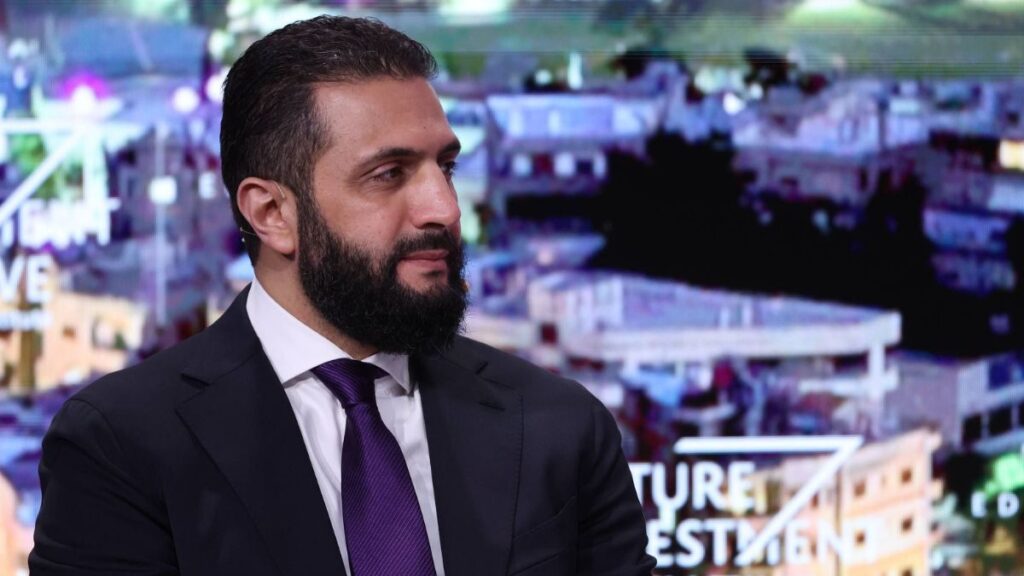

Syria’s transitional president, Ahmad al-Sharaa, said the UN Security Council’s decision to lift sanctions on him and Interior Minister Anas Khattab is a step in the right direction, noting that many countries helped Syria secure sanctions relief and reposition itself regionally and internationally.
During his visit to Brazil to attend the COP30 climate summit in the city of Belém, the Saudi outlet Asharq quoted the Syrian president on Friday, 7 November, commenting on his participation in the summit and the Security Council’s decision to lift sanctions.
Al-Sharaa’s remarks came after the Security Council on Thursday adopted a U.S.-sponsored resolution removing his name and the name of Interior Minister Anas Khattab from the sanctions list.
Al-Sharaa said, “This decision is moving in the right direction,” adding that many countries “helped Syria lift the sanctions and reposition itself regionally and internationally.”
He said Saudi Arabia was at the forefront of these countries, along with the United Arab Emirates, Qatar, Turkey, and Jordan, in addition to European states led by the United Kingdom.
He added that the United States also played an important role in helping to lift sanctions on Syria, alongside Russia and China, emphasizing, “Many countries took part in this effort.”
The birth of a new Syria
President Ahmad al-Sharaa affirmed that Syria has begun to regain its role on the international and regional stage, stressing that this return “requires everyone to have good relations with Syria, and for Syria to reciprocate at the same level.”
Al-Sharaa said Syria has started “to reclaim its regional and international role, and it is in the interest of many states to establish strategic relations with Syria.”
He added that “it is also in Syria’s interest to build strategic relations with others,” noting that this requires careful study and detailed discussion, “and perhaps we will have the opportunity to examine these issues in depth during the upcoming visit to the United States.”
From Brazil, al-Sharaa calls for investment in Syria instead of aid
The Syrian president said the past months have witnessed “the birth of a new trajectory for the region with the birth of a new Syria.”
According to al-Sharaa, Syria has begun taking “practical steps related to investing in regional security,” considering that countries in the region “affect one another, negatively and positively.”
He said, “What has taken place in Syria serves the interests of Saudi Arabia and the region as a whole.” On his participation in the climate summit, al-Sharaa noted that the environment is “an issue occupying the entire world and an opportunity for Syria to present itself anew.”
He considered that “participation in such events signals a new phase” in which Syria redefines itself, “enables wide sideline meetings with many countries, saves time, and lays the groundwork for a phase of multiple partnerships with states across the region.”
Syrians welcome lifting sanctions
In its meeting titled “Threats to international peace and security caused by terrorist acts,” the UN Security Council adopted Resolution 2799, which removes the names of Syria’s transitional president, Ahmad al-Sharaa, and Interior Minister, Anas Khattab, from the international sanctions list.
The decision, issued Thursday, 6 November, won the support of 14 out of 15 members without objections, with China abstaining, which allowed for its formal adoption.
Syria’s Permanent Representative to the United Nations, Ibrahim Olabi, said the resolution represents “a rare moment of unity in the Security Council to support Syria and stand by its people,” expressing thanks to the U.S. representative for efforts to pass the resolution. He said the decision reflects confidence in Syria and is the fruit of the international community’s positive engagement in recent months.
Syria’s Ministry of Foreign Affairs and Expatriates also welcomed the decision, describing it as “the Council’s first resolution after the fall of the former regime,” and saying it “reflects a unified international stance in support of Syria’s stability, territorial integrity, and sovereignty.”
The ministry considered the delisting “a legal and political confirmation of the state’s consistent approach to safeguarding Syrians’ rights, establishing security and peace, and combating the drug trade and terrorism,” noting that consensus in the Security Council after years of division “marks a victory for Syrian diplomacy, which has succeeded in restoring international recognition of Syria’s standing and pivotal role in the region.”