


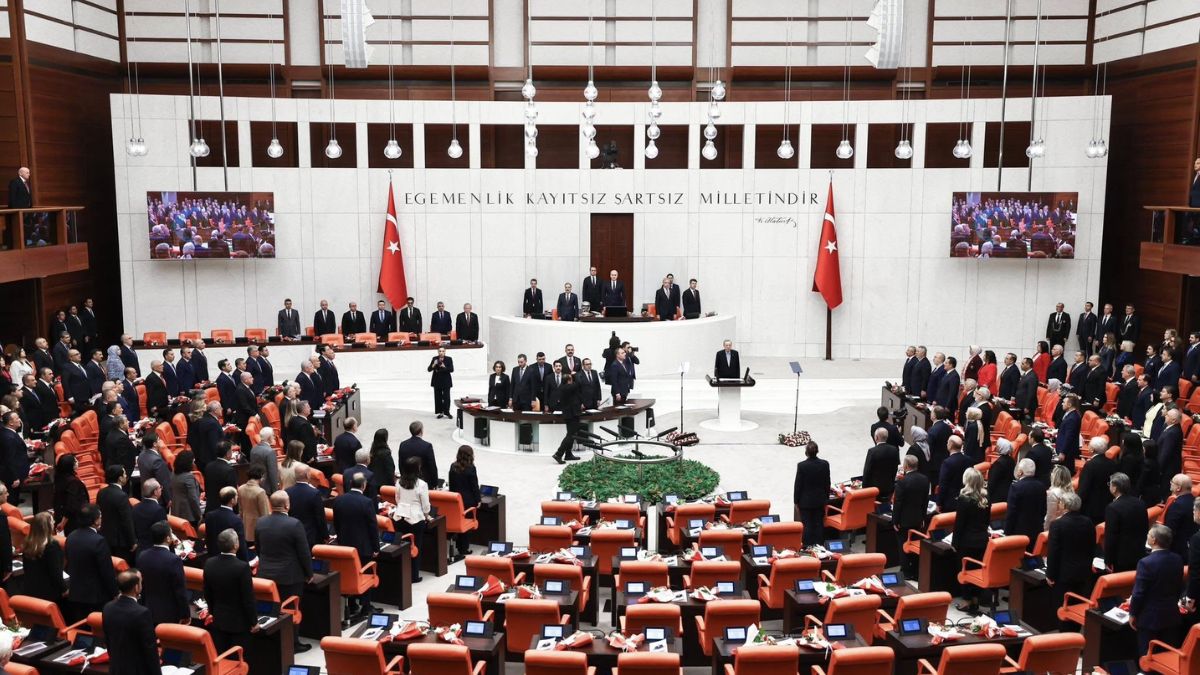
 Turkish President Recep Tayyip Erdoğan delivers a speech at the Grand National Assembly of Turkey on the occasion of its 28th term and fourth legislative year, October 1, 2025 (Turkish Parliament/Facebook).
Turkish President Recep Tayyip Erdoğan delivers a speech at the Grand National Assembly of Turkey on the occasion of its 28th term and fourth legislative year, October 1, 2025 (Turkish Parliament/Facebook).
Turkey’s Parliament approves three-year extension for military deployments in Syria and Iraq, two-year extension for UNIFIL role in Lebanon
Turkey’s Parliament on Tuesday, 21 October, approved President Recep Tayyip Erdoğan’s request to extend the mandate authorizing Turkish Armed Forces operations in Syria and Iraq for another three years. Turkish media, including TRT, reported that lawmakers also backed a separate presidential motion extending the Turkish contingent’s participation in the United Nations Interim Force in Lebanon (UNIFIL) for two years.
Erdoğan’s memorandum argued that what it called the persistent “terrorist” threat in areas adjacent to Turkey’s southern land border, and the lack of a durable stabilization process there, continue to pose risks to Turkey’s national security. The motion, as relayed by the semi-official Anadolu Agency, said the Kurdistan Workers’ Party (PKK), a reference used by Ankara to include the Syrian Democratic Forces (SDF), has refused steps toward integration into Syria’s central government due to a “separatist” agenda, and that it is hindering progress toward lasting stability.
The text added that Turkish deployments support both national and international efforts against “terrorism,” align with the expectations and needs of the current authorities in Syria, and relate to tasks such as mine clearance that affect daily life and the return of civilians, as well as the identification and destruction of chemical weapons in the country.
Ankara considers the SDF an extension of the PKK, which Turkey, the United States, and several European capitals list as a terrorist organization. Turkey has also fought the Islamic State group in Syria, especially along its southern border areas, acting alone, in coordination with the US-led international coalition, or alongside Syrian opposition factions prior to the fall of the former Syrian regime.
Turkey’s military presence in northern Syria began in 2017 with Operation Euphrates Shield, launched from Jarablus (northern Aleppo) toward the city of al-Bab (northeast of Aleppo) and surrounding towns, ending Islamic State control across eastern and northern rural Aleppo. At that stage, Turkey backed Syrian opposition factions from the rear, providing logistical and military support including artillery and air power.
In 2018, Operation Olive Branch directly targeted the SDF and allied groups in the Afrin area (northern Aleppo). In 2019, Turkey launched Operation Peace Spring in parts of northern al-Hasakah and Raqqa, seizing the border cities of Ras al-Ain (northern al-Hasakah) and Tell Abyad (northern Raqqa), with the participation of the “Syrian National Army” (now dissolved) that Ankara supported.
The “Syrian National Army” was a coalition of opposition factions organized into three corps. Following the January “Victory Conference,” the factions were dissolved and integrated into the Syrian Ministry of Defense of the current authorities.
Bloomberg: Turkey plans to supply Syria with weapons and military equipment
if you think the article contain wrong information or you have additional details Send Correction


 A
A
A
A
A
A


 More Politics